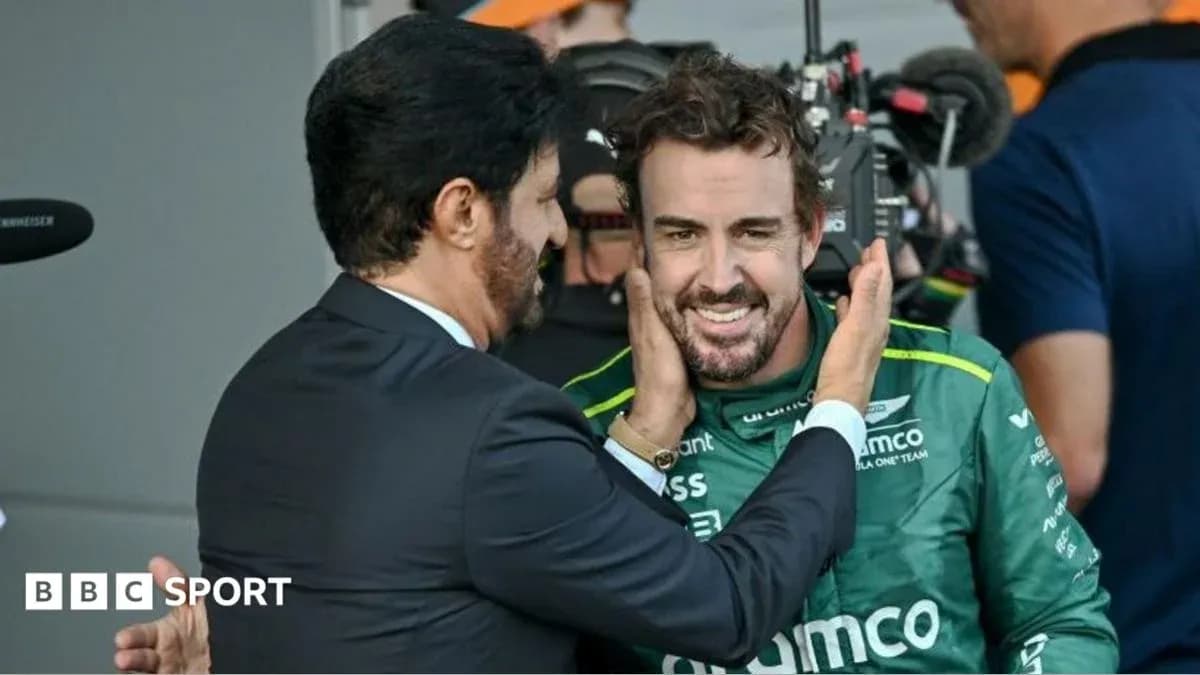
Mohammed Ben Sulayem has drawn a clear line in the sand: Formula 1, he believes, cannot afford to watch Fernando Alonso slip quietly out of the sport in an uncompetitive car.
The FIA president, speaking at an event in Madrid, was unusually blunt about the prospect of the 45-year-old walking away at the end of the season, with Aston Martin languishing at the back and Honda’s power unit widely regarded as the weakest on the grid.
“There is no way we can allow Fernando to leave – Alonso, a great champion – to leave just because of the circumstances,” Ben Sulayem said. “That's not the way to leave the stage. He has to be successful and then he leaves whenever he wants, not because he was forced to leave because of the performance.”
Alonso, a two-time world champion, is out of contract with Aston Martin at the end of the year. On Thursday he admitted his decision on whether to continue in F1 would come “not soon”, a telling phrase from a driver who has spent this season wrestling an uncompetitive car and a lacklustre engine.
Aston Martin sit 10th in the constructors’ standings. Their step backwards has been stark. The Honda unit, once a byword for power and progress, is now assessed as the least potent on the grid.
Ben Sulayem said he had already spoken with Alonso and had been struck by the Spaniard’s mood, particularly at his home race.
“I saw him very sad,” he explained. “I said, ‘Fernando, I understand, it's not acceptable that you are coming to your own country and now after two times a world champion…’”
The FIA president then revealed that steps had already been taken earlier in the year to give Honda and Aston Martin a route to improve.
“We did something earlier, in May, legally for the team towards the engine to go and improve,” he said. “And then I said to him: ‘I am not going to tell you what we are going to do. Please tell me what you want because you are the driver and come and tell me what do you want us to do to improve these results.’”
Those comments immediately raised eyebrows. A FIA president talking about “doing something” for a specific team and inviting a driver to ask for help edges close to the line of what many would consider appropriate for the head of an independent regulator.
The FIA moved quickly to clarify. A spokesperson stressed that Ben Sulayem was referring to the established Aduo system – F1’s additional development and upgrade opportunities mechanism – rather than any bespoke intervention.
Under Aduo, engine manufacturers whose power units are judged to be more than 2% down on the benchmark are granted extra chances to upgrade their designs. It is a formal, codified process, not a favour.
“It is a comment about the Aduo process and that he hopes FA stays in the sport,” the spokesperson said. “That is all.”
Pressed on whether Ben Sulayem’s remarks hinted at overreach from a president whose role is to administer the sport independently and objectively, the spokesperson pushed back, framing his words as the passion of a former driver rather than a policy statement.
“He is passionate about the drivers, having been one himself, and I really would not read too much into this,” they said.
The tension sits in plain sight. On one side, a governing body desperate to underline its neutrality. On the other, its president openly admitting he does not want to see one of F1’s great champions bow out at the wheel of a backmarker.
Alonso’s future remains his own call. Ben Sulayem may want him to stay, Honda may get a lifeline through Aduo, and Aston Martin may yet claw their way back into the fight. But if the results do not move, the question becomes unavoidable: how long will one of the sport’s fiercest competitors tolerate the view from the wrong end of the grid?