
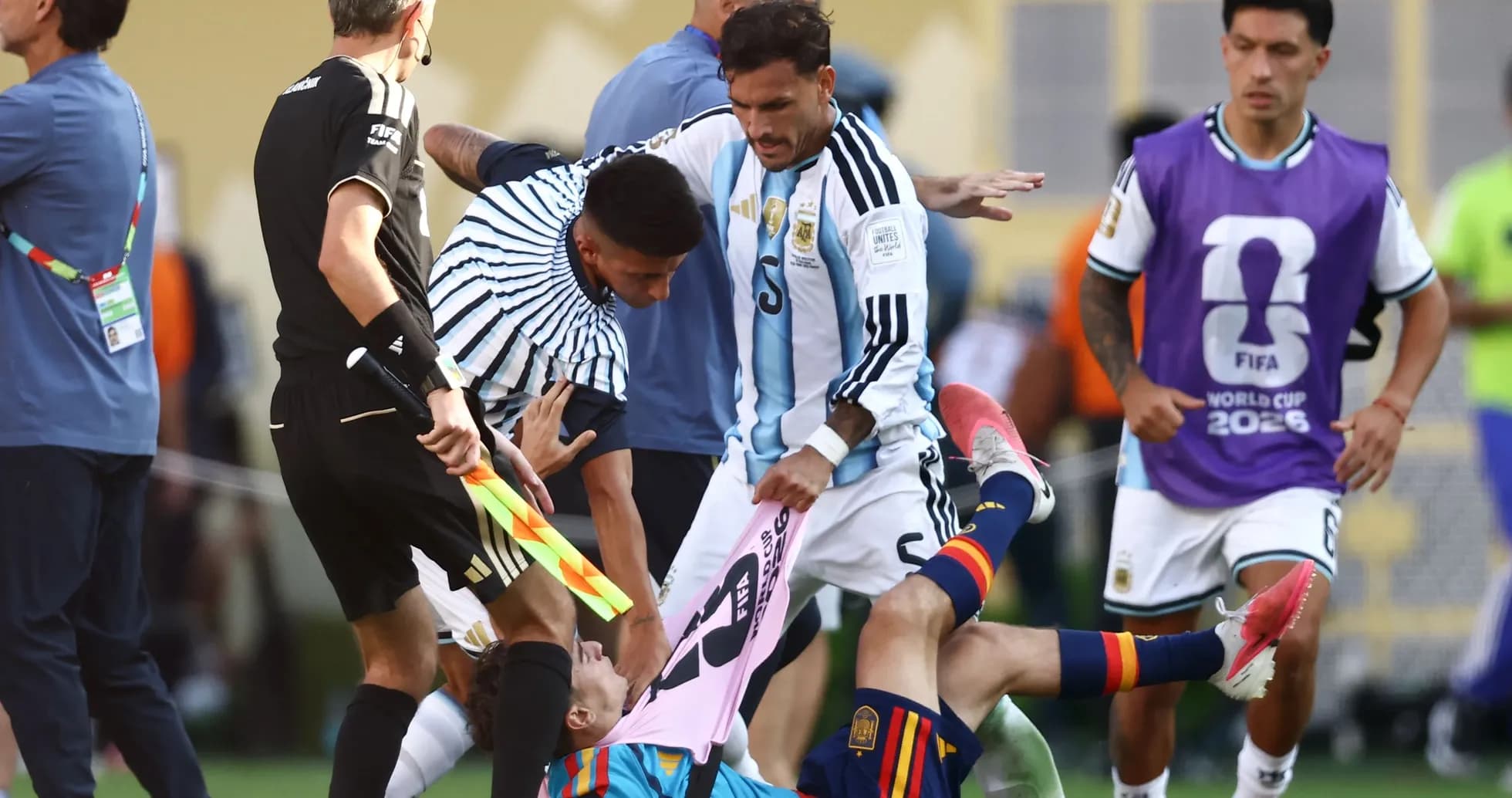
FIFA’s Appeal Committee has offered Argentina only a sliver of relief. Nahuel Molina walks away with a lighter punishment. Leandro Paredes does not.
According to Spanish outlet Marca, the governing body has cut Molina’s suspension from seven matches to four and trimmed his fine from 90,000 dollars to 60,000. The defender, formerly of Atlético Madrid, becomes the only major beneficiary of the appeal lodged by the Argentine Football Association after the stormy 2026 World Cup final defeat to Spain.
Paredes, by contrast, remains firmly in the dock. FIFA has confirmed the midfielder’s 10‑match suspension and a 90,000‑dollar fine, refusing to budge despite Argentina’s arguments.
The federation responded with a pointed official statement. It announced it will request the full written grounds for FIFA’s decisions and then take the fight to the Court of Arbitration for Sport (CAS). The AFA insists it has “sufficient arguments from both a factual and legal standpoint” to demand a review of the sanctions and is clearly preparing for a long legal battle.
The timing adds another layer of tension. CAS is already immersed in another high‑profile case, examining the chaotic 2025 Africa Cup of Nations final between Morocco and Senegal. A ruling in that matter is expected by the end of November, and Argentina’s appeal will now jostle for attention in a crowded disciplinary calendar.
Punishments rooted in discriminatory chants
At the heart of the case lie sanctions imposed by FIFA’s Disciplinary Committee over discriminatory chants heard during Argentina’s matches at the 2026 World Cup, including the final in which Spain edged a 1-0 win to lift the trophy.
FIFA not only targeted individuals. It also hit the Argentine Football Association with a 321,000‑dollar fine and imposed restrictions on crowd attendance at future national team games. Those measures draw on several articles of FIFA’s disciplinary code and relate to incidents across a string of fixtures: against Cape Verde, Egypt, Switzerland, England and, ultimately, Spain.
The fallout spread beyond Molina and Paredes. Thiago Almada received a one‑match ban under the original disciplinary decision, while long‑time national team figure Roberto Ayala, now on the coaching staff, was handed a three‑match suspension.
One small procedural victory had arrived back in August. FIFA agreed to Argentina’s request that player bans could be served in both friendlies and official matches under the CONMEBOL umbrella, “whichever comes first”. That ruling at least prevents suspensions from hanging over players indefinitely, but it does nothing to soften the length of Paredes’ absence.
For now, Argentina’s legal and sporting paths run in parallel: a national team reshaped by long bans, and a federation bracing for a decisive verdict in front of CAS that could redefine the boundaries of responsibility for what happens in the stands.





