The Week Football Lost Its Grip on Reality: Analyzing Champions League Narratives
Omar Marmoush has apparently suffered an “immediate Tottenham blow”. Carlos Baleba supposedly survived a similar catastrophe to join Manchester United.
None of it stands up to the slightest scrutiny. Yet here we are.
The Champions League: Everyone’s Living a “Nightmare”
You could be forgiven for thinking UEFA had unleashed some new circle of hell with this season’s Champions League draw.
“Arsenal’s Champions League draw in full as Gunners handed nightmare fixtures.” “Man City handed nightmare Champions League draw with Arsenal also given tricky fixtures as Man United face old foes on return to competition – and Jose’s back at the Bridge!” “Champions League group phase predicted by supercomputer with Man Utd having a nightmare after horror draw.”
Nightmare. Horror. Tricky. Repeat until the word loses all meaning.
The reality? The competition is stacked. The money has done its work. There are no soft touches left at the top level, no free passes into the knockouts. If you’re in the Champions League, you will face good teams. That’s not a horror show; that’s the point.
United’s “Horror Draw” That Ends in… Ninth
The Manchester United “nightmare after horror draw” is particularly melodramatic.
United, we’re told, have been “tipped to agonisingly miss out on the top eight” of the new league phase. The “boffins and brainiacs” at Football Ranked have run their model and dropped Michael Carrick’s side into ninth.
Ninth.
So the great calamity is… becoming the highest-ranked seeded team in the knockout play-offs, paired with the weakest unseeded opponent. A position most clubs would quietly take and move on.
If that’s a horror, the bar for trauma in European football has fallen through the floor.
Liverpool, United and the Myth of “Ruthless Stealth”
Jeremy Cross makes a fair overarching point in the Mirror: Liverpool once ran rings around Manchester United in the transfer market. That edge has dulled. Both now veer into the farcical often enough to be mentioned in the same breath.
But the romantic rewrite of Liverpool’s recent business jars.
“In that same period, Liverpool conducted their own business with ruthless stealth. Big targets were kept under the radar, until a deal was so close to being completed it would be made public. This happened with the likes of Virgil Van Dijk, Alexis Mac Allister, Alisson and Luis Diaz, to name but a few.”
It sounds impressive. It just isn’t true.
Liverpool’s pursuit of Virgil van Dijk was so “under the radar” that Southampton reported them to the Premier League for an illegal approach. Liverpool then issued a public apology and backed off before eventually getting their man. That’s not covert work in the shadows; that’s a very public mess followed by a very expensive fix.
Stealth has its limits when you’re tapping up the best centre-back in the league.
The Barcola “Desperation” That Never Was
Then comes the leap:
“Negotiations are taking place with PSG about a deal for Bradley Barcola, with a deal likely to come close to the fee paid to Newcastle for Isak. Under normal circumstances, such a move would leave supporters feeling overwhelmed excitement. The problem is, Liverpool have turned to Barcola in desperation less than a week before the transfer window closes, having pulled out of the bidding for Brighton’s Yankuba Minteh.”
Desperation? Late scramble? Last-ditch pivot?
Liverpool have been chasing Barcola all summer. This is not a panic rummage in the bargain bin with the shutters coming down. It’s a long, grinding negotiation over a £120m forward in a market where every elite club knows the going rate and PSG are in no rush to sell.
Cross, of all people, should understand how messy these sagas get. His own coverage of Elliot Anderson’s move tied itself into so many knots it could have done with a physio.
Shirt Numbers: “Bizarre”, “Dream” and Apparently Devastating
The circus doesn’t stop there.
“Bradley Barcola set to wear bizarre unused shirt number at Liverpool.” “Bradley Barcola can wear dream shirt number at Liverpool after PSG transfer agreement reached.”
Same player. Same shirt. Same number. One outlet calls it “bizarre”, another sells it as a “dream”. The only real constant is the need to dress up a squad number as something more than a merchandising detail.
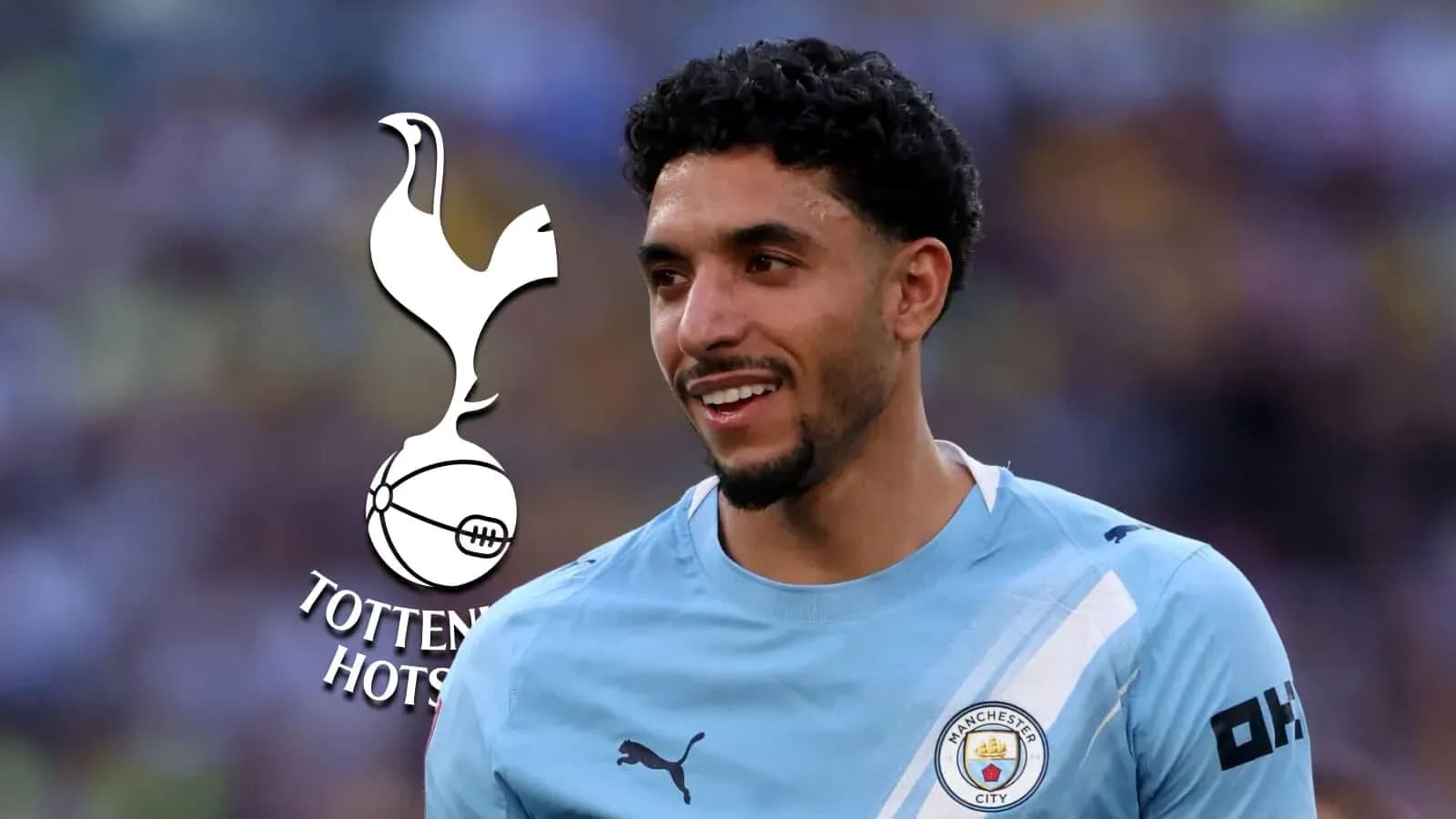
Then comes the supposed hammer blow for Omar Marmoush.
“Omar Marmoush to suffer immediate Tottenham blow after Man City £60m transfer breakthrough.”
Seasoned readers will recognise the tone. It’s the same template the Daily Express used for Carlos Baleba’s move to United. The “immediate blow” is not an injury, not a failed medical, not a collapsed deal.
It’s a shirt.
“Moving to Tottenham will give Marmoush the opportunity to play more regularly, having only made eight Premier League starts for City last season. However, he won’t have everything his own way when he arrives in the capital. That’s because he will need to pick a different shirt number, with his preferred No 7 already occupied by Xavi Simons.”
So the great Tottenham crisis is that a professional footballer might have to wear 11 instead of 7. Or 17. Or 77. Or anything else that doesn’t already belong to Xavi Simons.
If that’s an “immediate blow”, you start to wonder what language is left when a club actually loses a player to an ACL tear.
Ronaldo, United and a Market That Finally Said “No”
Samuel Luckhurst is right on one key issue: Manchester United’s inability to sell first‑team players remains a glaring weakness. In an era where elite clubs flip assets ruthlessly, United cling to theirs like a hoarder with a loft full of broken furniture.
But the attempt to use Cristiano Ronaldo as a benchmark doesn’t land.
“Even one of the greatest, Cristiano Ronaldo, was burnt by his association with United. When Ronaldo effectively filed for divorce with his November 2022 interview with the sycophantic Piers Morgan, Morgan said: ‘If it was just about money, you’d be in Saudi Arabia.’ Saudi was the only place to offer Ronaldo a home. Even he did not have shoppers flocking to United’s stall.”
Ronaldo didn’t fail to attract buyers because United’s market operation was uniquely dysfunctional. He failed because by that stage he had turned himself into a 37-year-old, wildly expensive problem.
He refused to accept a reduced role. He aired his grievances in a made‑for‑clips interview. He made it clear he wanted out on his terms, at his price, at his status. The modern elite game looked at the wages, the age, the baggage and shrugged.
Of course United couldn’t shift him. That has nothing to do with their struggle to move on a Joshua Zirkzee and everything to do with a sport that finally decided it could live without the drama.
When Hype Swallows the Game
Strip away the noise and a pattern appears.
- Champions League draws become “nightmares”.
- Long-term transfer targets are recast as last‑minute lunges.
- Squad numbers are framed as emotional trauma.
- A fading superstar’s self‑inflicted exile is pinned on a club’s sales department.
The football itself hasn’t changed that much. The stakes are still high, the margins still thin, the stories still compelling on their own. What has changed is the volume of the coverage and the inflation of every minor detail into a crisis.
Omar Marmoush will be fine without No 7. Bradley Barcola will be fine in whatever shirt Liverpool hand him. Manchester United will survive finishing ninth in a league‑phase table and playing an extra round in Europe.
The real question is whether the discourse around them can calm down long enough to notice what actually matters: who plays well, who wins, who cracks, who rises. Because if everything is a nightmare, nothing is.