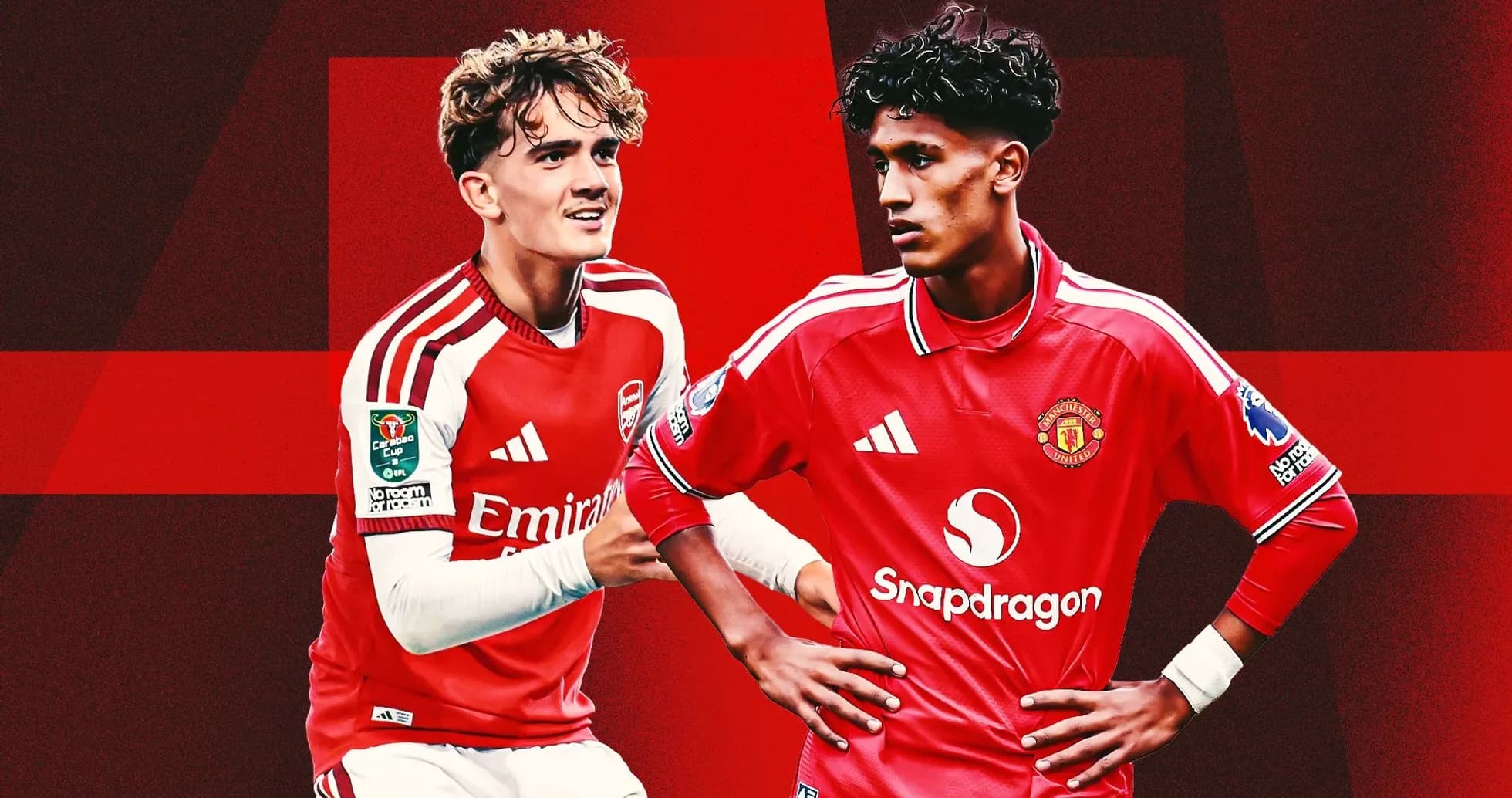
Manchester United are fighting to keep hold of a boy who has not yet turned 16, yet already has Europe’s elite circling. Real Madrid, Barcelona, Paris Saint-Germain and Bayern Munich all want Gabriel. United insist he is going nowhere.
Inside Old Trafford, senior figures are scrambling to make sure of it. They are not just protecting a prospect; they are protecting their own credibility.
Sir Jim Ratcliffe, the public face of United’s new football operation, has already felt the sting of supporter anger over unpopular calls. Letting a once-in-a-generation academy talent walk away for nothing would follow him for years. Gabriel is contracted until next summer, but he is not a full-time scholar, and that detail matters. When he turns 16 on October 16, he could leave for an EU club if he holds a European passport.
United are now deep into that question. Gabriel’s father, Joe O’Cearuill, played twice for Ireland. His mother is of Greek Cypriot heritage. Under post-Brexit rules, that combination could open a back door to Europe long before his 18th birthday.
Last year, United beat Manchester City to his signature. This time, the opposition is far stronger, and the signs are far more worrying. His head may already have turned.
Gabriel was due to train with the first team on Saturday. He did not show. He has not been seen at Carrington all week.
History on hold
Michael Carrick had pencilled Gabriel into his squad for Wednesday night’s Carabao Cup third-round tie against Brighton at Old Trafford. If the teenager had stepped onto the pitch, he would have become the youngest player ever to represent United’s senior side.
That plan has been shelved. The record will have to wait, if it comes at all.
For United’s academy, star power has been thin on the ground since Marcus Rashford burst through. Gabriel has been the great hope, the name whispered around the training ground since he joined at 11. A two-footed forward, slippery in tight spaces, decisive in front of goal – the kind of talent that makes coaches lean forward on their benches.
Comparisons to Lionel Messi are unfair and unhelpful, but there is something of Neymar in the way he glides past defenders and attacks space. He even laces up the same Nike model as the Brazilian, having signed a lucrative extension with the brand in March 2025. The hype is real, and so is the commercial pull.
The numbers back it up. At 14, he broke into United’s Under-18 side and shredded the league: 20 goals in 21 games. He swept up the inaugural Premier League U18s Player of the Year and United’s Jimmy Murphy Young Player of the Year, becoming the youngest winner of that historic award.
In August, he stepped up again, this time to the U21s. On his debut against Ipswich, he ran the show – two assists and a delicate chip in a 5-0 rout. A week later, he scored again as United hammered Leicester City 4-1.
This is not a normal 15-year-old. On the development curve, he is miles ahead.
The Dowman effect
United fans want to see him now. They see a first team short on ideas and goals. They see Max Dowman at Arsenal and wonder why their own prodigy is still in the shadows.
The Premier League has already been reshaped by teenage trailblazers. In 2022, Ethan Nwaneri became the youngest player in the competition’s history at 15 years and 181 days when he came on for Arsenal at Brentford. His path has not been smooth – loans to Marseille and Borussia Dortmund, mixed progress – but he now has more than 50 senior appearances and is still only 19.
Arsenal have doubled down on the “if you’re good enough, you’re old enough” mantra with Dowman. He became the league’s second-youngest player when Mikel Arteta threw him on against Leeds in August 2025. In March, Dowman produced a brilliant solo goal against Everton to break James Vaughan’s record as the youngest Premier League scorer at 16 years and 139 days.
By May, he was the youngest title-winner in league history. This week, he joined Wayne Rooney in a very exclusive club: the only 16-year-olds to score a brace for a Premier League side in a major competition, as Arsenal beat Ipswich 4-2 in the Carabao Cup.
Fourteen senior appearances already. Flair, strength, and a maturity that forces Arteta to keep finding minutes for him. The Arsenal manager has even mentioned Dowman in the same breath as Messi, but he has handled him with care, choosing his moments.
“We have to look after him. He’s 16 years old. You don’t see that in this league,” Arteta said after the Ipswich win. He stressed the demands of English football and the need to control the context around every appearance.
United’s dilemma: fragile body, fragile moment
Gabriel does not have Dowman’s frame. He is slight, often the smallest player on the pitch. His courage and tenacity make up some of the difference, but not all of it. Throwing him into the Premier League furnace too early could do damage that no highlight reel can fix.
Imagine he starts fast. A goal, an assist, a flash of brilliance. Instantly, the clamour becomes deafening. Play him every week. Build the attack around him. That is how overuse injuries happen, how confidence is drained when form inevitably dips.
Arteta can manage Dowman’s minutes because Arsenal are stacked. He can rotate, tweak, and still win. United do not have that luxury. Their performances swing wildly. Every game feels like a referendum on the manager.
If Carrick leaves Gabriel out after a strong cameo, he is accused of being timid. If Gabriel comes in and struggles, the narrative flips and the boy is branded overrated. Either way, the pressure lands on a teenager’s shoulders.
Former academy graduate Danny Simpson believes Carrick has judged it correctly so far. Speaking to GOAL via Free Bets, Simpson drew a sharp contrast between the United of his youth and the current side.
He recalled coming into a Ferguson team that was usually two or three goals up, surrounded by a “second XI” strong enough to win the league. That, he said, is Dowman’s world at Arsenal now – a confident, winning side, with high-quality back-ups making it easier to shine in short bursts.
United, he argued, are nowhere near that state. “I know we all want to see Gabriel play and it’s exciting, but it’s just a very different situation to Max Dowman at Arsenal,” he said. His message was simple: let Gabriel train with the group, learn, and wait. The chance will come.
Temptation in Spain
Waiting is harder when you look across Europe and see your peers already living the dream.
Even if Gabriel accepts that his situation is not identical to Dowman’s, he cannot ignore Lamine Yamal’s rise at Barcelona. Yamal made his senior debut at 15 years, nine months and 16 days. Like Gabriel, he was skinny, apparently vulnerable. On the pitch, he was anything but. His speed and intelligence allowed him to dodge the worst of the physical punishment.
La Liga’s rhythm helps. The league leans more on tactical structure and possession than the Premier League’s relentless transitions and collisions. It is a softer landing for pure technicians. In England, with less time on the ball and more contact, Yamal might have needed longer.
Gabriel may look at Barcelona or Real Madrid and see a fast lane to stardom. On the surface, it makes sense. Yamal broke through at a time when Barca were on their way to the title under Xavi but reeling from a Champions League group-stage exit. Raphinha, Ousmane Dembele and Ferran Torres were not yet at their current levels. There was space in the hierarchy.
That space has shrunk. Now Barcelona can call on Yamal, a peak Raphinha, Anthony Gordon, Karim Adeyemi and Gabriel Jesus in attack. Across the Clasico divide, Jose Mourinho has Kylian Mbappe, Vinicius Junior, Jude Bellingham and Yan Diomande in his Real Madrid dressing room.
At either club, Gabriel would be another name on a very long list. Minutes would be scarce. The path to the first team would be steeper than the one in front of him at United.
Entitlement, reality, and the badge
Whatever he chooses, Gabriel will have to wait his turn somewhere. The clearest route to regular football, right now, runs through Old Trafford, not the Bernabeu or Camp Nou. Insisting on everything, immediately, risks blowing up the best option he has.
United, for their part, cannot allow themselves to be backed into a corner by a player who is still 18 months away from sitting his GCSEs. Talent matters, but so does principle. Carrick and the academy staff have managed Gabriel carefully so far. If he re-engages, they will continue to do so. If he does not, they will not beg.
A drawn-out saga helps nobody. It drags attention away from a team trying to recover from a poor start to the season. It feeds a sense of entitlement that has already been called out from within the club.
Former manager Ruben Amorim, sacked in January after a short and turbulent spell, spoke bluntly about that culture before he left. “There is a feeling of entitlement we have in our club,” he said. Difficult moments, he argued, can be good for young players. Constant praise and instant rewards do not build resilience.
“Nowadays, they speak and go against the club because they feel entitled. Let’s stay. Let’s fight. Let’s overcome. That is the way we can solve things.”
Amorim failed in many areas, but on that point he struck a nerve. The greatest homegrown names in United’s history – George Best, Sir Bobby Charlton, Ryan Giggs, David Beckham, Paul Scholes, Gary Neville – earned everything. Nothing was handed to them. Standards were brutal, on and off the pitch.
Gabriel stands at that fork in the road. He can embrace the grind, accept that no one is bigger than the club, and try to write his story in the same colours as those legends. Or he can chase a faster route and a bigger brand elsewhere.
If he chooses the latter, United will move on. The badge has survived bigger departures than a 15-year-old forward. The real question is whether Gabriel understands that – and whether he is prepared to risk finding it out the hard way.