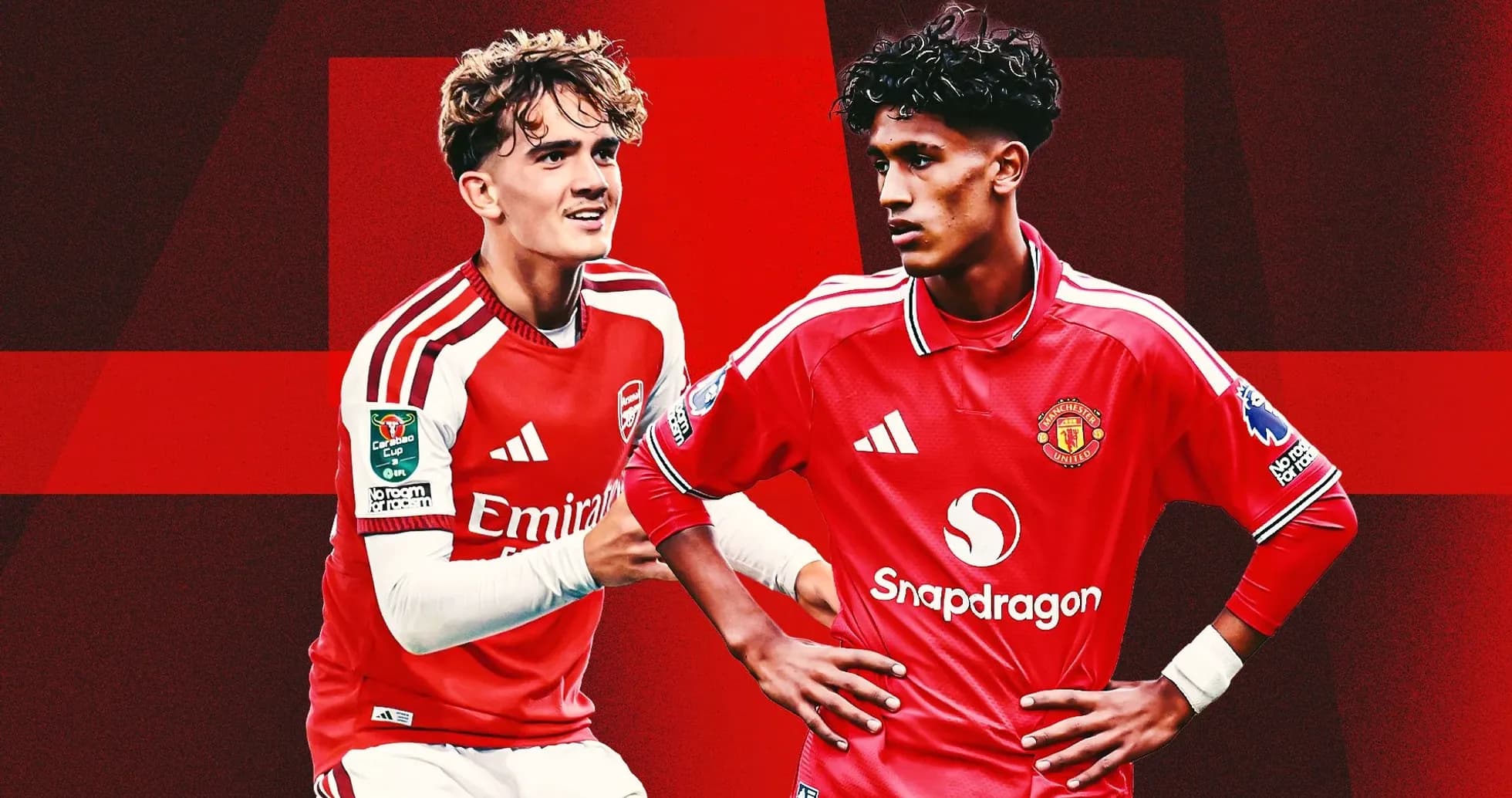
Manchester United are staring at a problem they thought they had already solved. Gabriel, the 15-year-old forward many inside Carrington see as a once-in-a-generation talent, is being courted by Real Madrid, Barcelona, Paris Saint-Germain and Bayern Munich. The biggest clubs in Europe smell opportunity. United, suddenly, smell danger.
Senior figures at Old Trafford have no intention of letting him go. Not now, not like this. Behind the scenes, they are scrambling to change his mind.
For Sir Jim Ratcliffe, the stakes are brutal. The INEOS chairman has already felt the heat of supporter unrest after a string of unpopular calls in his short reign as the public face of United’s football operation. Lose Gabriel on his watch, and the protests will only grow louder. Letting a prodigy slip away for nothing would be unforgivable in the eyes of many.
A contract that offers little protection
Gabriel is under contract until next summer, but the deal offers less security than it sounds. He is not a full-time scholar, nor part of the club’s standard academy model. When he turns 16 on October 16, he will technically be free to leave, provided he holds a European passport.
United are now deep in the weeds of that question. His father, Joe O’Cearuill, is a former professional who represented Ireland twice. His mother is of Greek Cypriot descent. Under post-Brexit regulations, that heritage could make Gabriel a dual national and open the door to a move to any EU club before he turns 18.
That loophole has Europe’s elite circling. United already fended off Manchester City last year to keep him. This time, the fight feels far more complicated.
It may already be too late.
Gabriel was due to take part in first-team training on Saturday. He did not show. He has not been seen at Carrington all week. For a boy who has been desperate to climb the ladder, the silence is deafening.
Michael Carrick had planned to include him in the squad for Wednesday’s Carabao Cup third-round tie against Brighton at Old Trafford. Had he stepped onto the pitch, Gabriel would have become the youngest player ever to represent United’s senior side. That historic cameo is now off the table.
The brightest light in a dim academy era
United’s academy has not produced a true global superstar since Marcus Rashford exploded onto the scene. Gabriel has been the great hope to end that drought ever since he arrived at 11.
He is a two-footed forward with outrageous agility, the kind of player who slaloms out of tight spaces that should swallow him whole. Give him a glimpse of goal and he finishes with a cold, clinical edge.
The Messi comparisons do him no favours, but there is a clear echo of Neymar in his game – the swagger, the improvisation, the way he tempts defenders into lunges they instantly regret. He even wears the same model of Nike boots as the Brazilian, having signed a lucrative extension with the sportswear giant in March 2025.
The numbers back up the hype. Last season, Gabriel broke into United’s Under-18s at just 14, another record, and promptly scored 20 goals in 21 league matches. He swept the board: the inaugural Premier League U18s Player of the Year award and United’s Jimmy Murphy Young Player of the Year, the youngest winner in the club’s history.
This August, he stepped up to the U21s and barely blinked. On debut against Ipswich he produced two assists and a deft chip in a 5-0 rout. A week later he scored again as United hammered Leicester City 4-1.
This is not a normal 15-year-old. This is a teenager operating several levels ahead of schedule. No wonder the fanbase is clamouring for Carrick to unleash him, especially with United short of inspiration in the final third and Max Dowman lighting up Arsenal.
The Dowman effect – and the dangerous comparison
The Premier League has seen this movie before. In September 2022, Ethan Nwaneri became the youngest player in the competition’s history at 15 years and 181 days, coming off the bench for Arsenal against Brentford. His path has not been seamless – loans to Marseille and Borussia Dortmund, form swings, the usual turbulence – but he now has over 50 senior appearances for the Gunners at just 19.
Arsenal have doubled down on that youth-first philosophy with Dowman. Thrown on by Mikel Arteta against Leeds in August 2025, he became the Premier League’s second-youngest player. In March, he broke James Vaughan’s record as the youngest scorer in the competition with a stunning solo goal against Everton at 16 years and 139 days.
By May, he was the youngest title-winner in Premier League history. This week, he joined Wayne Rooney in an exclusive club as only the second 16-year-old to score a brace for a Premier League side in a major competition, driving Arsenal to a 4-2 Carabao Cup win over Ipswich.
Fourteen senior appearances already, a blend of flair and physical power that demands selection. Arteta has even mentioned him in the same breath as Messi, while carefully drip-feeding his minutes.
“We have to look after him. He’s 16 years old. You don’t see that in this league,” Arteta warned after the Ipswich tie, stressing the intensity of English football and the need to choose the right moments to expose Dowman.
Gabriel is not built like Dowman. He is slight, often the smallest player on the pitch. His courage and determination help bridge that gap, but they do not erase the physical risks. Throwing him into the Premier League too early could backfire badly – especially if he starts brilliantly.
That is the paradox. If Gabriel makes an immediate impact, the pressure on Carrick to play him every week will be relentless. His body, still developing, would be pushed to its limits. Arteta can rotate Dowman because Arsenal’s squad is deep and balanced. He can win games with or without the teenager.
United do not have that luxury. Their performances swing wildly. If Carrick eased Gabriel out after a few games, he would be accused of being too cautious while the team struggles. If the youngster came in and failed to dominate, the backlash would be swift: overhyped, not ready, another false dawn.
Carrick’s caution – and the view from inside
So far, Carrick has resisted the temptation to bow to the noise. That restraint has impressed former United academy graduate Danny Simpson, who broke through under Sir Alex Ferguson.
Speaking to GOAL via Free Bets, Simpson drew a sharp contrast between his own pathway and the current reality.
He pointed to Dowman’s situation: a teenager stepping into a side “flying in confidence, full of top, top talent, winning games,” where even the second XI “could win the Premier League.” That was Simpson’s United too – a team so dominant that youngsters could be eased in for 10-minute cameos with the points already secure.
“It’s easy to come on and have an impact and play well,” he said. “I think maybe United at the minute is a bit different.”
Simpson understands the excitement around Gabriel, but he believes Carrick will judge the timing correctly. He referenced Shea Lacey as an example of a young talent being allowed to train with the first team and grow around the group without being rushed into the spotlight.
“Just let him train and be around the team and his time will come,” Simpson argued.
Temptation in Spain
That patience is harder to sell when a teenager can look across Europe and see his peers already shining on the biggest stages.
Even if Gabriel accepts that his circumstances differ from Dowman’s, it is impossible to ignore Lamine Yamal at Barcelona. The Spaniard made his senior debut at 15 years, nine months and 16 days, just as skinny, just as vulnerable to heavy challenges.
What protected Yamal was his explosive acceleration and sharp football brain. He out-thought and out-ran opponents in a league that prizes tactical control and possession over constant end-to-end chaos. La Liga’s rhythm, less physically punishing than the Premier League’s, offered space for a pure technician to flourish.
Drop Yamal into England at that age and his rise might not have been so rapid. Gabriel will know this. He may look at Barca or Real Madrid and see a shortcut to stardom.
On the surface, it is tempting. When Yamal broke through, Barcelona were en route to the La Liga title under Xavi but had crashed out of the Champions League in the group stage. Raphinha, Ousmane Dembele and Ferran Torres were not at their current level. There was room for disruption, space for a fearless teenager to elbow his way into the hierarchy.
That window has narrowed. Barcelona now boast Yamal, a peak Raphinha, Anthony Gordon, Karim Adeyemi and Gabriel Jesus in attack. At Real Madrid, Jose Mourinho can call on Kylian Mbappe, Vinicius Junior, Jude Bellingham and Yan Diomande. These are not squads crying out for an untested 16-year-old to carry the load.
Wherever Gabriel goes, he will have to wait. The difference is that at United, the path to a regular starting role is far clearer than at any of the clubs chasing him. Insisting on everything, immediately, could end up costing him the very career he craves.
A club line in the sand
United, though, cannot allow themselves to be dragged around by a teenager still 18 months away from his GCSEs. That is the harsh reality. However gifted Gabriel is, he cannot dictate the direction of a club of this size.
Carrick and the academy staff have managed his rise carefully so far. They will continue to do so if he stays and recalibrates. If he refuses, there is little sense in trying to chain him to Old Trafford against his will. A prolonged saga would only deepen the gloom around a team already trying to claw its way back from a poor start to the season.
Whether nudged by family, agents or his own ambition, Gabriel is behaving like a player convinced the world owes him his moment. That sense of entitlement clashes violently with the culture United still claim to uphold.
The homegrown giants of this club – George Best, Sir Bobby Charlton, Ryan Giggs, David Beckham, Paul Scholes, Gary Neville – earned everything. Nothing arrived on a silver platter. Standards, on and off the pitch, were non-negotiable.
Former manager Ruben Amorim, for all his failings during a short, ill-fated spell in charge, nailed one uncomfortable truth before his sacking in January. He warned of a growing entitlement inside the club, argued that difficult moments can be good for young players, and railed against a culture where “they speak and go against the club because they feel entitled.”
“Let’s stay. Let’s fight. Let’s overcome,” he said. “That is the way we can solve things.”
He got many things wrong. Not that.
Right now, with his current mindset, Gabriel does not look ready to carry the weight of the famous red shirt. The most important lesson for any youngster at United is simple: no one is bigger than the club.
If that message does not land, if the lure of Europe’s giants and instant gratification proves irresistible, United may be better off letting him chase his personal brand elsewhere – and finding the next boy willing to fight for the badge instead of the shortcut.