
Germany have broken hearts often enough over the past decade that hope has started to feel like a trap. Yet in Belgrade, under the sharp glare of an away Nations League tie that was supposed to be routine and forgettable, Jürgen Klopp’s team played like a group intent on dragging the national side into a new age.
A 3–1 win over Serbia sounds solid. The performance was something more: dominant, aggressive, and driven by players who not long ago were being spoken about in the past tense rather than the future.
Final Score: Germany 3 - 1 Serbia
Serbia Offer Little Resistance
On nights like this, the tradition is to find at least one opponent who deserves a nod. In Belgrade, that search turned up almost nothing.
Srđan Babić had moments, but his own goal told the real story of Serbia’s evening. Kosta Nedeljković could have made a case too, yet his reluctance to close down Florian Wirtz, time and again, summed up a back line that never truly engaged with Germany’s movement or tempo.
Serbia didn’t just lose. They barely contested the key battles. Germany dictated the game with 79% possession and rarely looked threatened.
Philipp Treu and the Right-Back Question
So the focus swings back to Germany’s own flaws, and one in particular: right-back.
Philipp Treu is the kind of player coaches love and analysts struggle with. The Freiburg defender covered the pitch with a ferocity that fit perfectly with Klopp’s demands. He chased everything. He pressed, recovered, and harried Serbia into mistakes.
Then came the problem: what happens next.
Treu wins the ball, steps forward, and suddenly the picture blurs. The final pass, the decision in the attacking third, the composure under pressure — they’re not there yet. He has the engine and the mentality of a modern attacking full-back, but not the end product to match.
This isn’t a call to discard him. It’s a harsher question for German football as a whole: how can a country that wants to play front-foot, expansive football still be so short of natural attacking full-backs that Treu, for all his limitations on the ball, remains the best option?
Klopp will need to work that one out on the training ground. The effort is there. The structure around him must now catch up.
Malick Thiaw: The Air Marshal Germany Have Waited For
At the back, though, one long-standing problem suddenly looked close to being solved.
Germany have searched for a dominant aerial defender for what feels like a generation. In Belgrade, Malick Thiaw played like a man ready to own that role.
Klopp anticipated Serbia’s plan: long balls, direct play, and physical duels. He responded by starting Thiaw ahead of Nico Schlotterbeck, and the Newcastle defender repaid that faith with a performance of calm authority.
He won his battles in the air, stepped in decisively on the ground, and carried the ball with a composure that evoked Joshua Kimmich. His passing was measured, deliberate, almost studious. Nothing rushed, nothing careless. The yellow card he collected was a footnote, not a flaw.
Thiaw even threatened at the other end, with two headed efforts — one from a set piece, one from open play — that underlined his presence in both boxes. Alongside Jonathan Tah, he anchored a back line that allowed Germany to squeeze Serbia high and never loosen the grip.
Benching Schlotterbeck might have raised eyebrows before kick-off. By full-time, it looked like simple logic.
Kimmich, the Quiet Conductor
Germany’s dominance with the ball had one obvious author.
Joshua Kimmich’s numbers will say he completed passes, covered ground, and kept possession ticking. They won’t come close to capturing how completely he bent the game to his will.
With Germany holding 79% of the ball, Kimmich dictated everything: tempo, direction, rhythm. He didn’t need Hollywood passes to stand out. He just needed to be relentlessly, brutally efficient.
Two details defined his night.
First, Brajan Gruda’s goal. The move began with Kimmich drifting to the right, pulling Serbia’s shape out of alignment and starting the passing sequence that freed Gruda to drive and finish. It looked simple. It was anything but. That’s Kimmich’s gift: he makes the complex look routine.
Second, the partnership with Aleksander Pavlović. It had echoes of their Bayern days — one player the metronome, the other the complementary presence who balances the midfield. They contrasted and completed each other in a way that felt natural, almost inevitable. If Germany are serious about building a stable core, this pairing should not be an experiment. It should be the template.
Florian Wirtz Finds Space, and Himself
For months, the talk around Florian Wirtz has circled around one word: confidence. The talent was never in doubt. The question was whether he still believed in it.
Serbia gave him the perfect stage to answer.
For reasons only they will understand, they repeatedly left Wirtz unmarked between the lines. He drifted into pockets, received line-breaking passes from midfield, and turned to face a defence that never seemed sure who should pick him up.
He is not a classic No. 10, chained to a zone. He roamed, switched roles, and constantly offered himself as the next link in the chain. Every time Kimmich or Pavlović split Serbia’s midfield, Wirtz was there, ready to carry the move forward, to shoot, to drag a defender out of shape.
Football is not a spreadsheet. Wirtz is proof. His value lies in the problems he creates for defenders who can’t pin him down. If he keeps playing with this freedom and conviction, the conversation will shift back from “what happened to the golden boy?” to “how far can he actually go?”
Brajan Gruda Announces Himself
Then came the moment that will live far longer than this Nations League night.
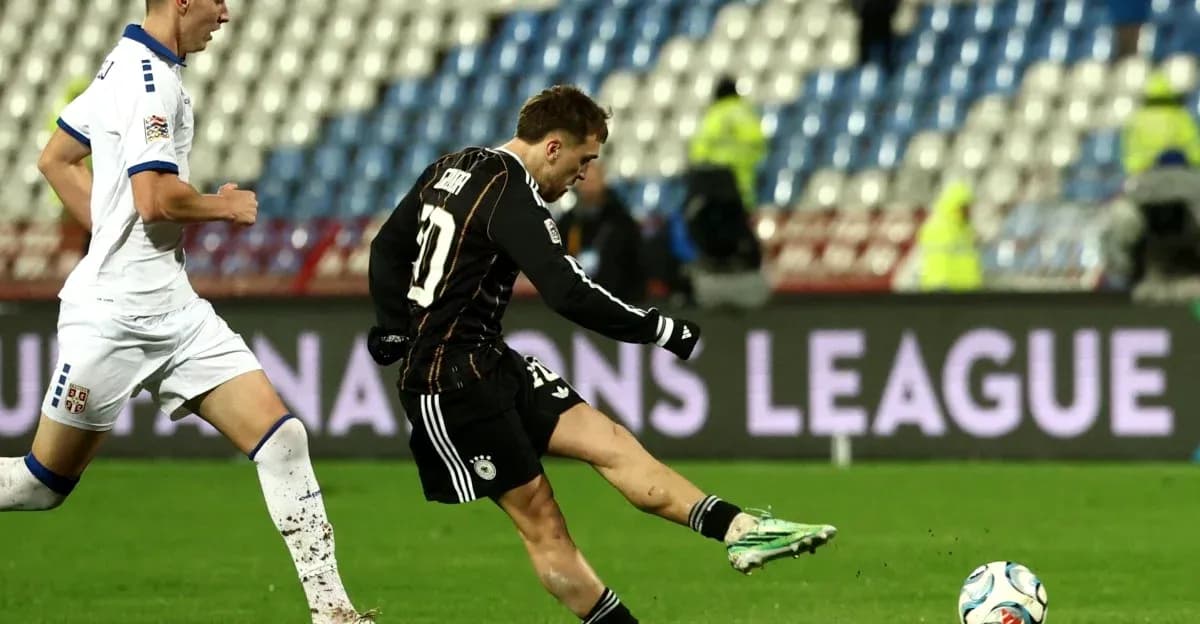
Brajan Gruda, making his senior debut, took the ball in his own half, turned, and decided that Serbia’s midfield and defence were simply obstacles to be removed.
He surged past the first line, glided beyond the second, and with defenders backpedalling, unleashed a sharp, precise strike from just outside the box. The ball flew in. The game, for all practical purposes, was done.
You didn’t need replays to understand what you’d seen. You just needed to feel the air leave the stadium.
Gruda had already built a reputation at RB Leipzig, where his performances — including a standout display against PSV Eindhoven — caught Klopp’s eye and earned him this call-up. In Belgrade, he showed why that faith was justified.
He ran at defenders with no hesitation. One-on-one, he backed himself every time. He fought in duels, sometimes to the point of over-aggression, but this Germany side has lacked that edge for too long to complain when someone brings it, as long as the cards stay the right colour.
With Kimmich ensuring the ball keeps coming back, a player like Gruda becomes priceless. Give him the ball, give him space, and he will attack the game as if it owes him something.
He was not just good for a debutant. He was the most dangerous attacker on the pitch.
Germany have known false dawns before. This might be another. Yet in Belgrade, under Klopp, with Kimmich conducting, Thiaw commanding, Wirtz drifting into old brilliance, and Gruda tearing through lines on his first night, it felt like more than a fleeting glow.
It felt like the start of a team that finally knows what it wants to be.





