Giannis and Klay Lead Miami to Dominant Win Over Detroit
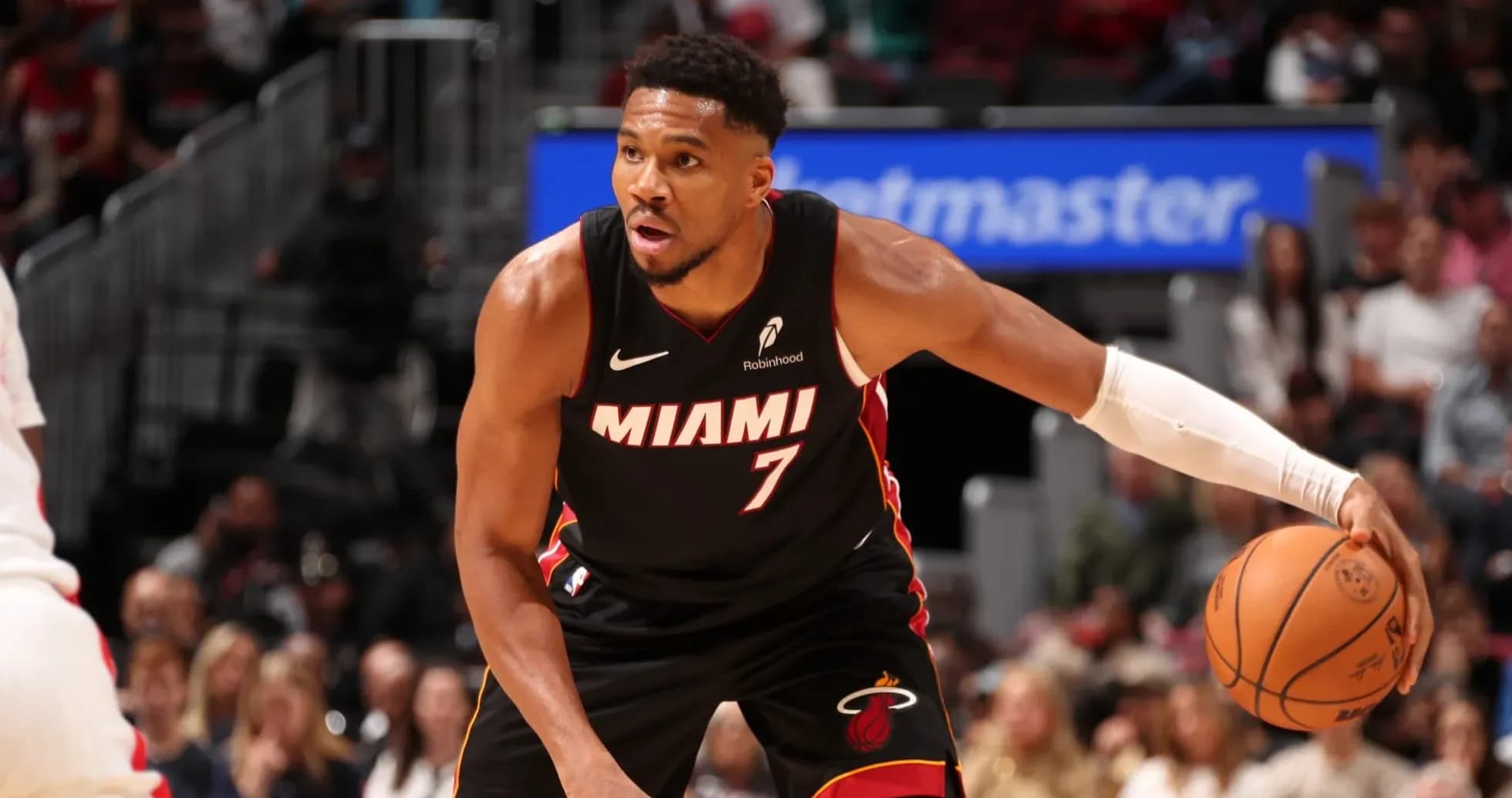
The line floated out from the Miami bench as Giannis Antetokounmpo threaded yet another no-look dart through traffic.
“He’s like Magic at times with his vision.”
On Saturday night, the Heat didn’t just beat Detroit. They toyed with them. They bent the game to Giannis’ rhythm, rode Klay Thompson’s shooting, and walked out with a 137-117 win that felt even more lopsided than the score.
This is what a contender starting to believe in itself looks like.
Giannis in Full Command, Klay in Full Flow
Detroit had Cade Cunningham at his shot-making best — 33 points, 5 rebounds, 8 assists — but Giannis simply overwhelmed the Pistons’ resistance.
Thirty-four points on 13-for-17 shooting. Fourteen rebounds. Eight assists. Three blocks. Barely a wasted possession.
He controlled every layer of the floor: rim runs, post touches, transition bursts, half-court reads. When Detroit loaded up, he saw over the top. When they retreated, he powered straight through them.
The performance carried a bit of history, too. Antetokounmpo logged his second game with at least 30 points, 10 rebounds, 5 assists and 2 blocks in a Heat jersey, tying LeBron James for the third-most such games in franchise history. Giannis has done it in just 13 games with Miami. The ink on this partnership is still wet, and he’s already treading on LeBron’s statistical footprints.
The pressure on Detroit’s defense never relented because Klay Thompson kept lighting fires along the arc. Twenty-six points. Six made threes. Another night where the ball barely seemed to touch his hands before it was gone, spinning toward the net.
He now has four games this season with at least six 3-pointers. For a player many wondered about physically and mentally after his injuries, this is a loud, emphatic answer. When Giannis bends the defense and Klay is stationed on the perimeter, Miami’s offense feels inevitable.
The win was Miami’s fourth straight, a surge that’s lifted the Heat to fourth in the Eastern Conference. A week or two ago, they were searching for rhythm. Now, they’re dictating it.
Nuggets Win the Old-Fashioned Way
In Denver, the defending champions leaned on something that looks almost out of place in today’s NBA: a big win with barely any 3-point shooting.
Nuggets 116, Pelicans 108. Only four made threes. That’s their fewest in a victory this season, and a number you’d usually associate with a bad offensive night.
It wasn’t.
Nikola Jokić orchestrated everything again — 26 points on 9-for-14 shooting, 8 rebounds, 10 assists — and Jamal Murray nearly matched him for control with 23 points, 7 rebounds, 9 assists. The two of them picked apart New Orleans with angles, timing and patience, punishing any defensive gamble.
Their connection crossed a notable threshold: Jokić and Murray have now recorded 1,000 assists to each other, the first duo to reach that mark in the play-by-play era (since 1997-98). It’s a number that underlines what the eye already knows: this is one of the great two-man games of the modern NBA.
Zion Williamson battled with 24 points, but Denver never really felt rattled. When they need to, the Nuggets can still grind you down with pure execution.
Cleveland’s Backups Steal the Night
If Denver’s win was about familiar stars, Cleveland’s was about unknowns stepping into the light.
Cavaliers 127, Mavericks 117 — with the regular starters out and the bench thrust into the spotlight. All five replacement starters scored at least 18 points, an improbable spread of production that buried Dallas under wave after wave of scoring.
At the heart of it: Tyrese Proctor.
Twenty-four points, 11 rebounds, 10 assists. His first career triple-double, and it came in a game where Cleveland needed every ounce of creation he could muster. He ran the show, attacked the glass, and found teammates in rhythm. It was the kind of night that can alter a young guard’s trajectory.
Across the court, Kyrie Irving returned to the city where he helped deliver a championship a decade ago and received the welcome he earned. He responded with 34 points, including a blistering 20 in the third quarter that kept Dallas within reach. The nostalgia in the building was real; so was the reminder that Kyrie can still seize a quarter and bend it to his will.
Another milestone slipped into the box score, too. Cooper Flagg moved past Kobe Bryant’s mark of 1,759 points to become the top-scoring teenager in league history, now trailing only LeBron James (2,362). The names he’s chasing tell you everything about the expectations orbiting his career.
Bulls Snap a Streak, Grizzlies Keep Rolling
In Minnesota, Chicago walked into a hostile building and snapped the Timberwolves’ five-game winning streak.
Bulls 117, Timberwolves 106.
Norman Powell set the tone with 24 points, attacking gaps and living at the rim. Tre Jones, back in his home state and on familiar hardwood, played one of his most efficient games of the season: 16 points on 7-for-9 shooting. The Apple Valley native looked completely at ease, as if the rims hadn’t changed since high school.
Memphis, meanwhile, is starting to look like a problem again.
Grizzlies 129, Nets 110, and it was Cedric Coward who led the way: 23 points, 12 rebounds, 4 assists, 2 steals, 2 blocks. A complete line from a player who thrives on activity. He was everywhere — on the glass, in the passing lanes, rotating to erase mistakes.
Memphis drilled 15 of 35 from deep (42.9%) and moved to 9-4. When the Grizzlies shoot like that and maintain their defensive edge, they smother teams.
New-Look Sixers: Results Now, Ceiling Later
Philadelphia wakes up at 10-3, second in the Eastern Conference, and yet you still get the sense this team hasn’t come close to its final form.
Tyrese Maxey has the keys to the offense and is driving with conviction. Jaylen Brown, Joel Embiid and LeBron James have settled into a shared hierarchy more smoothly than many expected, each taking turns without stalling the collective flow. Anfernee Simons comes off the bench and instantly injects points, the classic sparkplug who can flip a quarter in three possessions.
The numbers hint at a team still figuring out the finer details of its chemistry. The 76ers rank seventh in passes per game (299.1), but only 19th in assists (26.1). The ball is moving, but the reads aren’t always turning into clean, assisted looks yet.
Asked by The Athletic’s Tony Jones whether the team was still growing, Brown flipped the idea on its head. That’s the tension around this group: they’re already winning at a high clip, but they know there’s another gear waiting once their timing and trust fully catch up to their talent.
They’ll test that growth in a Sunday matinee against the Pacers (1 ET), another chance to see how quickly this experiment can harden into a contender.
West Heavyweights: Wemby’s Spurs or Luka’s Lakers?
Out West, two supernovas are dragging their franchises to the top of the standings — and forcing everyone to pick a side in an early-season debate.
Victor Wembanyama’s Spurs sit at 11-2 with him in the lineup after an 0-2 start without him. He’s averaging 28.8 points, 11.7 rebounds, 4.2 blocks. The numbers are absurd, but they still don’t quite capture the feeling of watching him throw lobs, erase shots and run the floor like a guard trapped in a center’s body.
Luka Dončić’s Lakers are 11-2 overall and 9-2 when he plays, riding his 38.6 points, 7.5 rebounds and 7.6 assists per game. His scoring is bordering on the surreal. He walks into games expecting 35-plus, and defenses know it yet still can’t do much about it.
NBA.com’s Brian Martin pointed to San Antonio’s three-guard lineup — De’Aaron Fox, Dylan Harper and Stephon Castle — as the engine behind the Spurs’ surge. In their first six games together, that trio logged 66 minutes and posted a plus-18.5 net rating. Over the last seven games, in 74 minutes, that number has rocketed to plus-36.5.
Then there’s Wembanyama himself, sitting fourth in scoring, fourth in rebounding and first in blocks while posting career-best numbers across the board. The stats make him look like a video-game creation. The tape backs it up.
On the other side, NBA.com’s Shaun Powell made the case for the Lakers. He acknowledged the warts — the point differential, the nights when the eye test wavered — but still called them the most impressive team given the context.
Luka holds the top spot on the Kia MVP Ladder. JJ Redick has quickly established himself as one of the league’s sharper coaches. Austin Reaves and Walker Kessler, both on hefty contracts, are delivering solid value, and the role players around them have been reliably productive.
Before Lakers-Suns (4 ET) and Spurs-Jazz (5 ET), the question lingers: who’s more convincing right now, the towering alien in San Antonio or the Slovenian maestro in Los Angeles?
Dybantsa Meets His Idol
In Washington, a different kind of matchup is brewing — one built on childhood posters and YouTube clips.
AJ Dybantsa, the No. 1 pick in the 2026 NBA Draft, grew up watching Kevin Durant, studying the angles and footwork of a 6-foot-9 do-it-all forward who broke the mold.
“My favorite player’s always been Kevin Durant, so sharing the court with him will probably be ridiculous,” Dybantsa said at his introductory press conference with the Wizards.
Tonight, it stops being hypothetical. Washington hosts Houston (7 ET), and Dybantsa finally shares the floor with the player who shaped his imagination.
Their games invite comparison. Both are long, rangy, explosive wings who make defenders twitchy. Give them a single step and they can create space for a midrange jumper. Put them in the middle of the floor, and they can draw attention, scan the defense and pick out the right pass.
Dybantsa’s vision is advanced for his age, if still inconsistent. Durant’s Oklahoma City-era tape — 2014, 2015 — shows the template: get to the center of the floor, force the help, punish the rotation. That’s the path the rookie is trying to walk.
“There’s only so much one-on-one I can do with him,” Dybantsa admitted in 2025, sitting across from Durant in an NBA x Nike Air Time interview.
He’ll find out tonight exactly how far that “so much” stretches.
The Glove on Fear, Feel and the Art of Defense
Gary Payton didn’t just defend people. He studied them, probed them, needled them until they cracked.
The nine-time All-Star and nine-time All-Defensive Team guard sat down with NBA.com to talk about that process — about feel, fear and the mental game that underpins great defense.
“You’ve got to have that feel for the game,” Payton said. “When you get into a basketball game, you feel it, and you feel that player out. What does he want to do a lot?”
When he checked in, he wasn’t just reading plays. He was reading personalities.
“When I came into a basketball game, I had to feel who could fear me. Who would fear me? If a young kid feared me, I knew I could take advantage of him. If a guy didn’t fear me, then what could I do to rattle him? What can I do to get him in a different mode, where he’s going to be thinking about me mostly, and not his teammates?”
That was the equation in his head:
“‘Do I have someone who’s going to fear me? Do I have someone who’s going to stick up to me?’
“When I adjusted to that, I altered my game that way.”
It’s a window into a mindset that still echoes in today’s league, especially for anyone daring to guard the reigning Kia MVP, Shai Gilgeous-Alexander.
On a night when stars shined, kids chased idols, and contenders flexed, Payton’s words cut to the core of it all: in this league, talent starts the conversation. Feel — and fear — decide how it ends.