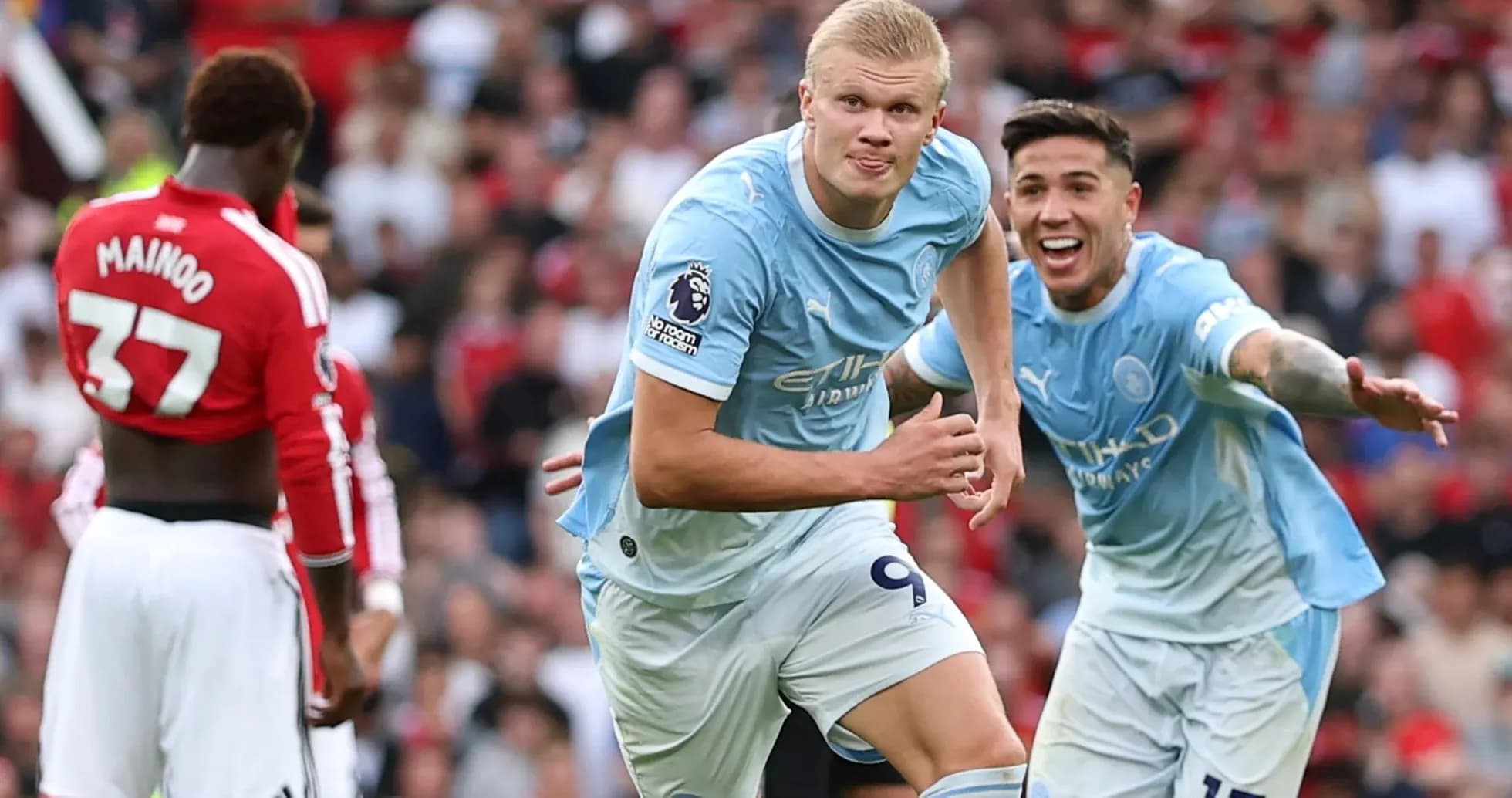
Erling Haaland’s winner at the heart of the latest VAR storm did not creep into the net quietly. It exploded there.
On the hour, with the derby balanced on a knife edge, Manchester City’s No.9 spun into a pocket of space at the back post and lashed the ball into the roof of the net from a brutal, tight angle. The flag went up. Celebrations died in an instant. Everyone inside the stadium knew the drill: freeze, wait, stare at a big screen and hope.
This time, the wait ended in fury.
A boot, a line, and a ghosting striker
Patrick Dorgu’s outstretched boot kept Haaland onside. The United full-back, scrambling to cut out a low cross from the left, inadvertently turned himself into City’s saviour, playing the Norwegian on by inches as the ball fizzed across the face of goal. Haaland, ruthless as ever, did the rest.
That part was clear enough once the lines went down. Haaland was on. The assistant’s flag was wrong.
The real row lived a few yards further infield.
Enzo Fernandez had never got back onside. He stood as City’s furthest man, planted between the posts, then hurled himself at the cross as it flashed across him. He didn’t touch it, but he absolutely went for it – a full-blooded diving header attempt right in front of goal.
Lisandro Martinez reacted to that movement, stepping towards his fellow Argentine as the danger unfolded. Behind him, Haaland drifted into the blind spot, unmarked, unchallenged, waiting to punish the hesitation.
The officials, after a long check in the VAR hub, let the goal stand. No on-field review. No second look for the referee. Just a green light for City and a red mist for United.
“It absolutely beggars belief”
Michael Owen has sat in that VAR bunker. He has listened to the conversations, watched the angles, felt the pressure. He knows it is not the simple, slow-motion luxury many imagine.
Even so, he could not fathom this one.
“I've sat in the VAR hub and gone through lots of decisions and it isn't easy. I mean it's 10 times harder than people think,” he told GOAL, ahead of returning to hosting duties on ‘Match Officials Mic’d Up’ alongside referees chief Howard Webb.
“However, this was as straightforward as it gets really. I simply don't know how they can come to this decision.”
Owen revealed a crucial detail: the assistant’s original flag had been for Haaland.
“What I do know is that the linesman gave offside for Haaland. So he gave offside for Haaland, I know that for a fact. So that can only have distorted their view in terms of they think, ‘right well we've got to check for Haaland, let's draw the lines, oh my word he's onside’.”
That is where, in his view, the process broke.
“But how they can't check, or if they do check, how they can't pull it up for an offside from Fernandez - he clearly makes a movement towards the ball. What movement is more obvious than a diving header! It's not a case of has he tried to touch that or not? He's flung himself for a diving header. It absolutely beggars belief. It doesn't get any more straightforward in my eyes.”
For Owen, this was not a grey area. It was a glaring error in broad daylight.
Carrick’s anger and a system under scrutiny
Michael Carrick did not hide behind diplomacy either. His United side had played more than 65 minutes against 10 men after Phil Foden’s early dismissal for kicking out at Bruno Fernandes. They still left with nothing.
“I can't understand how we are trying to help referees - putting so many layers behind them, so many people, so many bodies, so many screens and so many offices, to try to come up with the right decisions,” Carrick said after the 1-0 defeat.
“And if that's how the rule is interpreted, that you're not interfering with play because you have thrown yourself at the ball six yards from goal and pretty much nearly touched it, it's worrying if that's how the game is seen by those who are officiating it.”
His point cut to the core of the debate: what does “interfering with play” actually mean if not that?
United’s sense of injustice only deepened when, as Gary Neville had predicted on co-commentary for Sky Sports, an apology arrived.
Pro Ref admit “error of judgement”
Pro Ref issued a statement that did little to cool the temperature.
“It was established that Enzo Fernandez did not play the ball and therefore that makes any offside offence subjective, however, on this occasion, the VAR did not recognise the likely impact of his position and should have recommended an on-field review.
“Contact has been made with Manchester United this evening to acknowledge what we deem is an error of judgement. A review of the incident will take place.”
For United, those words land after the damage is done. The points are gone. The table does not carry an asterisk for “VAR error admitted.”
The broader picture is just as uncomfortable for the officials. The season is only weeks old, yet VAR has already muscled its way to centre stage, dominating post-match conversations and overshadowing the football itself.
Owen is far from alone in demanding clarity and consistency. The technology is here to stay. The question is whether the people using it can restore trust before the next title race, relegation scrap or derby is bent by another decision that “absolutely beggars belief.”