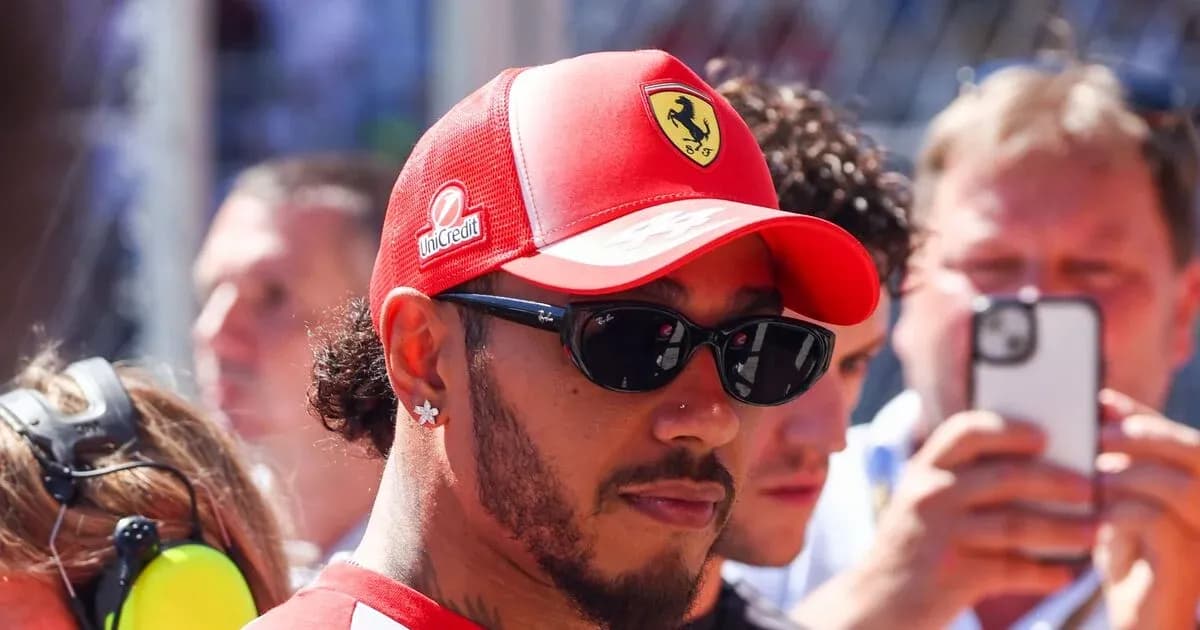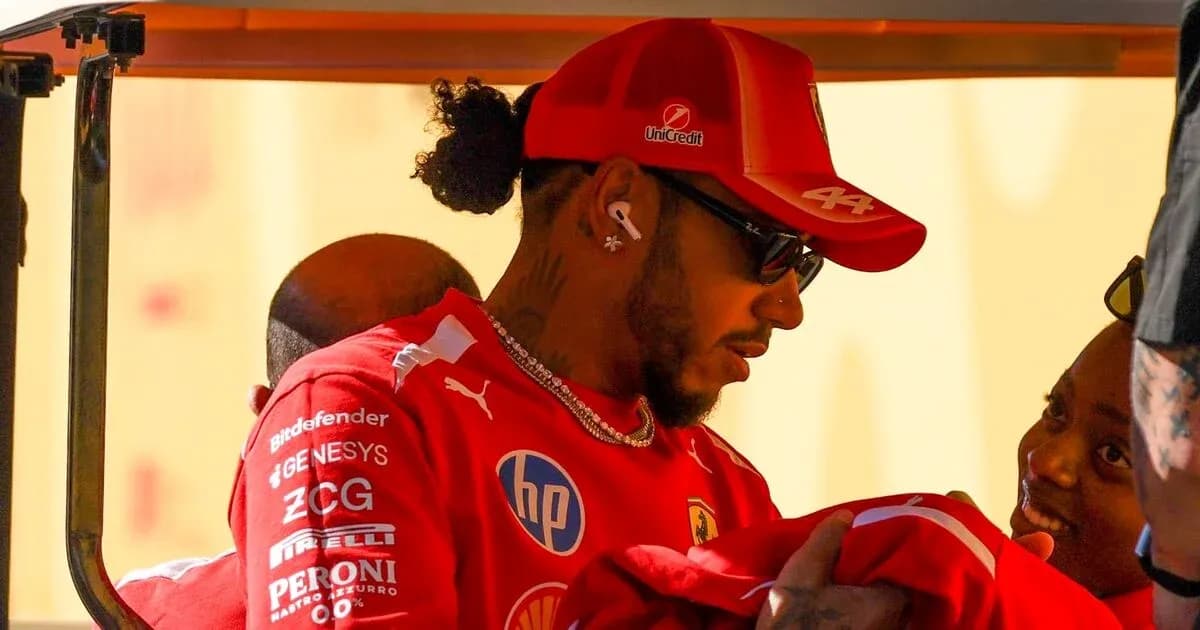
Lewis Hamilton found himself at the centre of a storm at the Spanish Grand Prix – and it had nothing to do with the crash that put his Ferrari in the barrier.
The incident came in final practice at the Madring, with Hamilton on a flying lap when the rear stepped out at the final corner. The seven-time world champion slid straight on and buried the nose of his Ferrari into the barrier, triggering an immediate red flag.
So far, so routine. Drivers crash, sessions stop, cars get recovered.
Sparks, smoke and a stubborn call
Hamilton managed to select reverse, wriggle the Ferrari out of the barrier and get going again. Because of the circuit layout, he had no choice but to complete a full lap to reach the pit entry.
But the car was clearly wounded.
The front wing, smashed in the impact, had folded under the nose and was now wedged beneath the chassis. As Hamilton crawled around, sparks sprayed from the front of the Ferrari. The broken wing scraped along the tarmac, while the front-right tyre began to smoke heavily as it rubbed against the carbon debris.
The damage escalated quickly. The tyre finally gave way, deflating completely after suffering a puncture.
From the pit wall, Ferrari’s messages grew more urgent.
“Stop in the safest place, in the safety place possible,” came the call from his race engineer over team radio.
Hamilton pushed back: “If I can make it back, I will. If not, I will do it safely.”
The team came again, more direct this time: “We have a puncture on the front right. Stop the car.”
“I can see that,” Hamilton replied – yet he still kept rolling, trying to coax the crippled Ferrari further around the lap before eventually pulling over at the side of the circuit and climbing out.
‘You don’t drive the car in an unsafe condition’
From the commentary box, patience snapped.
Sky Sports F1 lead commentator David Croft did not mince his words as the replays rolled and the radio messages were played out.
“I know he’s done 393 Grands Prix, but the rules are, you don’t drive the car in an unsafe condition,” Croft said. “The team is telling him to stop and the driver has twice now gone against that on the radio. And he finally does stop the car. I get the feeling race control are going to take a very serious view of that, because the team told him to stop.”
At the time of writing, race control had not announced any investigation, but the tone from the commentary box reflected the seriousness with which such incidents are usually treated.
Anthony Davidson, alongside Croft, turned his attention to Ferrari’s side of the exchange. For him, the instructions needed more edge, more clarity.
“The team need to give him more information,” Davidson argued. “They need to say, ‘The front wing is under your car and the race director is going to give us a penalty over this’.”
A warning for the next generation
Davidson then widened the lens. For him, this was about more than one veteran champion trying to nurse a damaged car back to the pits.
“Any young driver that is watching this right now, you don’t do that. You just don’t do that,” he said. “That’s what you could have tried to do [get back to the pits] but that rule is there for a reason. If it went under the car completely and jacked your front wheels up and there were marshals on the track, you’ve got to think of all these scenarios.”
The safety argument is clear: a car dragging broken bodywork, with a punctured tyre and limited control, risks shedding debris, losing steering or becoming unpredictable in zones where marshals may be working under red-flag conditions.
Under the FIA’s penalty guidelines, the stewards have a range of options if they decide Hamilton’s actions breached the regulations. A reprimand would be the lightest outcome. A grid penalty would be a far more severe response, especially at a circuit where track position can dictate a driver’s entire Sunday.
For now, the crash is already in the past. The lap he tried to complete with a wrecked front wing may prove harder to leave there.