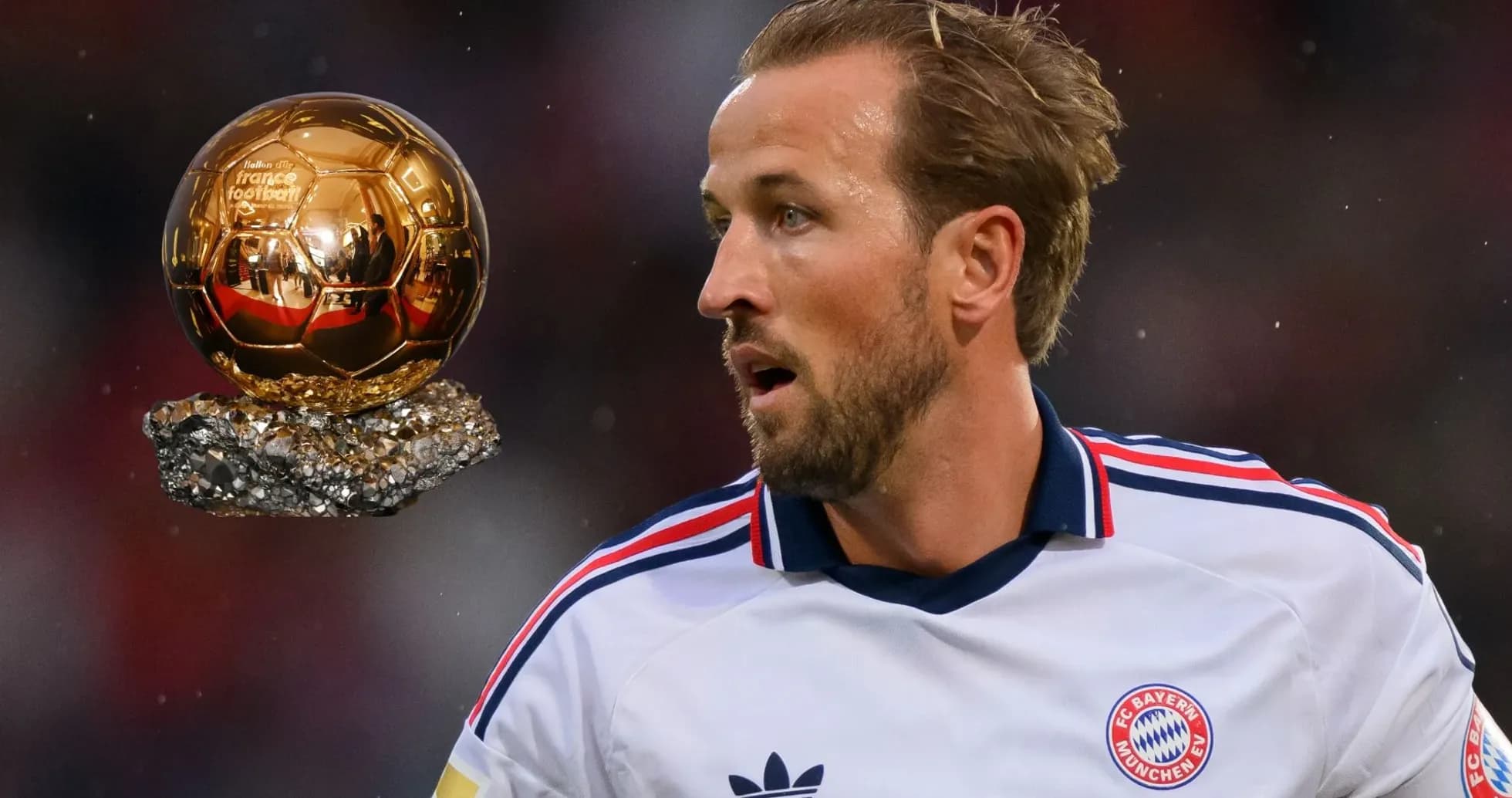
For a quarter of a century, English football has stared at the Ballon d’Or stage from the wings, watching others collect the most coveted individual prize in the game. The wait might be about to end.
Harry Kane, the boyhood fan who once dreamed of simply becoming a professional, now stands on the brink of being named the best player on the planet. Not by sentiment, not by reputation, but by numbers so outrageous that even he calls them “silly”.
A lonely English club
England’s relationship with the Ballon d’Or has always been sparse, almost austere. Only four winners in the award’s long history: Stanley Matthews, the very first recipient back in 1956; Bobby Charlton, the World Cup icon; Kevin Keegan, who went back-to-back in 1978 and 1979; and Michael Owen, the last Englishman to scale that peak in 2001.
Since then, a parade of nearly-men.
- Billy Wright
- Duncan Edwards
- Johnny Haynes
- Jimmy Greaves
- Bobby Moore
- Gary Lineker
- Alan Shearer
- David Beckham
- Frank Lampard
- Steven Gerrard
- Jude Bellingham
– all good enough to reach the podium, none quite able to touch the crown.
The modern era has not helped. Lionel Messi and Cristiano Ronaldo turned the Ballon d’Or into a private duel, hoarding 13 trophies between them over 15 years. Eight for Messi, five for Ronaldo, and a generation of stars left to fight over the scraps.
That stranglehold has finally loosened. The door is open again.
A new landscape, a familiar name
The last two Ballon d’Or ceremonies have hinted at a shift. Rodri and Ousmane Dembele have muscled their way into the conversation, collecting major honours and symbolising a changing of the guard. Both are in the running again after lifting World Cup and Champions League trophies in 2026.
They are not alone. Kylian Mbappe, Lamine Yamal, Michael Olise, Khvicha Kvaratskhelia – this is a field rich with talent and narrative.
Yet the bookmakers, and many observers, keep circling back to one name: Kane.
The numbers explain why. Sixty-one goals for Bayern Munich last season. Twelve more for England. Seventy-three in total for club and country. A second Bundesliga title secured. A body of work that belongs in the same statistical postcode as the two GOATs who defined an era.
Ronaldo never hit 73 in a single campaign; his personal best stands at 69. Only Messi, with an absurd 82, has ever gone higher.
This is the company Kane now keeps.
Owen’s verdict
Owen, the last Englishman to hold the Golden Ball and now an ambassador for Casino.org, has lived this journey. He understands how rare it is.
“There’s only four of us that have won it in its history,” he told GOAL. “What is the history? 75 years or something? So, we’re talking every 20 years, just under 20 years is the average anyway. So, we’re pushing that average at the moment, because it’s 25 years since I won it.”
He doesn’t expect the drought to drag on much longer.
“Obviously, Harry’s got a good shot at it. I do think it’s quite an open year, but I do think Harry Kane’s got a great chance of winning it. It’d be a fabulous achievement if he did.”
Open year or not, Kane’s case is built on hard evidence: goals, titles, influence. The argument almost writes itself.
Kane’s strange limbo
Kane, for his part, sounds like a man caught between reflection and relentlessness.
“Not that long ago, I was that fan wanting to become a professional footballer, and I am here now and winning awards and the Ballon d'Or is the same,” he told TNT Sports. The boy in the stands has become the man under the spotlight.
Yet he insists the decision is now beyond him.
“Of course, now it is out of my hands, it is down to the voters and the people who decide it. The season I had was my best season by far, and we’ll have to wait and see.”
That wait is complicated by his own mindset. While the football world debates his credentials, Kane is already chasing the next peak.
“It is a weird one because I am already focused on this season now, and the next season. Can I be better? Can I improve? But I also want to appreciate what I did.”
This is the tension at the heart of every great goalscorer: the need to savour, and the instinct to move on.
The beauty of the argument
Kane understands the nature of the debate he’s stepped into. The Ballon d’Or has always been a lightning rod for opinion.
“The thing with football opinions – there are so many opinions, so many arguments for different players, and people love this player because ‘he’s fast’ and ‘he’s got great IQ’ and ‘his finishing is great’,” he said. “So I think that is what makes football special, all those debates, and the Ballon d'Or is definitely one of them. I’m happy that I am in contention, so we will have to wait and see.”
He is right. The award has never been purely about numbers, never purely about trophies. It lives in the grey area where influence, style, narrative and success collide.
Kane’s story has all of that: the long pursuit of major silverware, the move abroad, the avalanche of goals, the leadership of England, the sense of a career hitting its absolute peak.
A stage set in London
On October 26, at the London Palladium Theatre, the verdict will arrive.
An English captain, with a season that even the game’s greatest would envy, waits to discover if he will join Matthews, Charlton, Keegan and Owen on that small, gilded list.
After 25 years of watching others lift the Golden Ball, English football stands on the edge of another defining moment.
The numbers say Kane has done enough. The history books are open. Now it is up to the voters to decide whether this is the year an Englishman finally reclaims the crown.