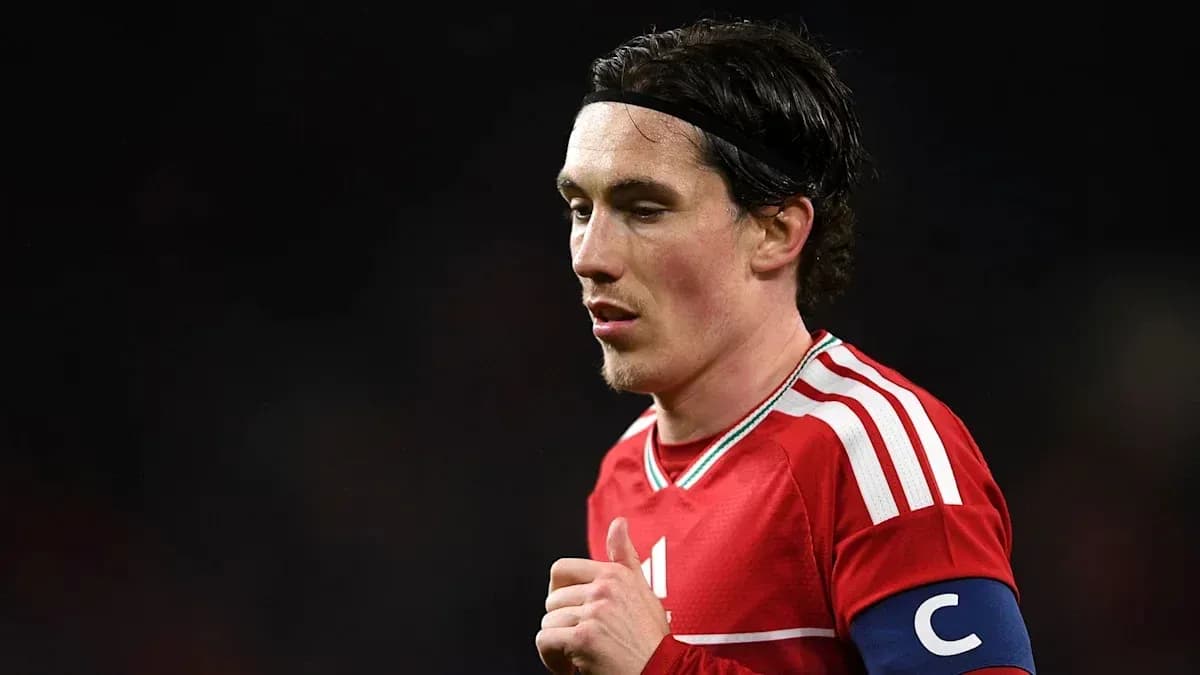
Harry Wilson’s quad has tightened, and with it, so has Wales’ margin for error.
The Leeds United forward is now a major doubt for the start of Wales’ Nations League campaign, just as Craig Bellamy prepares to lead his country back into League A against heavyweight opposition.
Named in Bellamy’s squad for a demanding run of fixtures against Portugal, Denmark and Norway in September and October, Wilson was expected to be one of the pillars of a side already short on experience in key areas. Instead, his club manager Daniel Farke has delivered the update Wales feared.
“Harry Wilson is out of this game, a quad injury, he reported some problems after the last game and also during this training week,” Farke said on Friday, ruling the 29-year-old out of Leeds’ Premier League meeting with Crystal Palace on Sunday.
“He will also probably miss the Welsh games, so definitely not good news for him and also not for the Welsh team.”
For Bellamy, it is a gut punch. Wilson’s international form over the last 12 months has been outstanding, his 17 goals in 69 caps underlining his status as one of Wales’ most reliable attacking threats. When the pressure has cranked up, he has often been the player to find a moment of quality, a set-piece, a run between the lines.
Now, on the eve of a brutal schedule, that threat may be stripped away.
Wales’ injury list grows
Wilson is far from the only concern. Bellamy’s first Nations League campaign is beginning to look like a test of depth as much as talent.
Joe Rodon, Wilson’s team-mate at Elland Road and a cornerstone of the Welsh defence, is already out. Cardiff City’s young defensive pair Dylan Lawlor and Ronan Kpakio are also unavailable. Higher up the pitch, Cardiff forwards Isaak Davies and Rubin Colwill are missing, as is Wrexham attacker Nathan Broadhead.
That is a sizeable chunk of energy, mobility and versatility removed from a squad that has slipped to 38th in the world rankings, their lowest position since August 2014. For a side trying to punch back up towards the elite, the timing is cruel.
Wales will, of course, want to run their own checks on Wilson. National teams often cling to the hope that a club prognosis might soften under a different medical eye or a different risk calculation. But Farke’s tone suggested this is not a marginal call. A quad injury for a player who relies on sharp changes of pace and clean ball striking is not something to roll the dice on lightly.
A brutal return to League A
The schedule offers no sympathy.
Wales open away to Portugal on 24 September, a trip that would be daunting even with a full-strength squad. The Portuguese, stacked with talent and newly re-energised under a fresh managerial cycle, will see this as a fixture they must dominate at home.
Then comes Denmark. Twice.
The Danes, ranked 21st in the world, are a hardened tournament side, tactically drilled and physically relentless. Wales will host them in Cardiff and then travel to Copenhagen, where the atmosphere and intensity rarely dip below fever pitch.
In between those two meetings, Norway arrive in Cardiff on 1 October. World Cup quarter-finalists, they bring power, pace and a clear sense of identity. There are no soft landings in this extended international window, no obvious fixture to ease new ideas into place.
Bellamy’s challenge
For Bellamy, the task is clear and unforgiving: rebuild on the fly, in the top tier of the Nations League, without several of his most trusted pieces.
Wilson’s absence, if confirmed, forces a rethink of the attacking blueprint. He offers more than goals – he links midfield to attack, drifts into clever pockets, and delivers from dead balls. Remove that, and others must step up not only in output, but in personality.
This is the reality of life in League A. Injuries strip away comfort. Opponents expose any hesitation. There is no room to ease into a new era.
By the time Denmark walk out at Cardiff City Stadium on 4 October for the final game of this block, we will know far more about Bellamy’s Wales: their depth, their resilience, and whether they can absorb the loss of a player as influential as Harry Wilson and still look like a team on the rise rather than one clinging on.