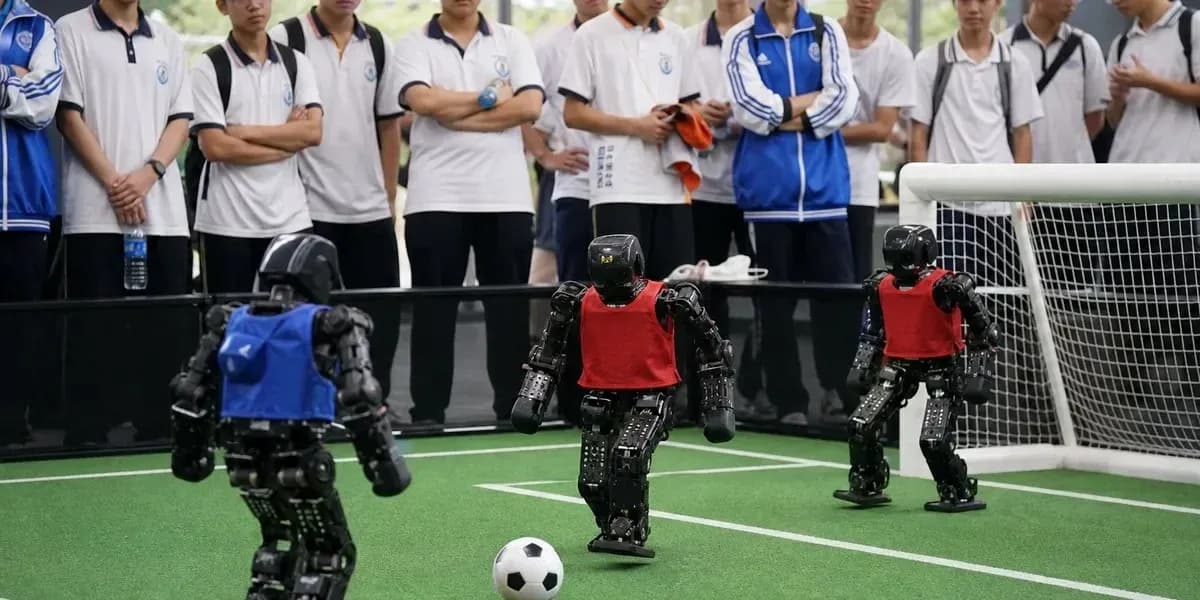
The whistle blew in Nanning on Thursday, but it wasn’t teenagers sprinting off the line. It was their creations.
China’s first humanoid robot football carnival for secondary school students kicked off in the capital of the Guangxi Zhuang Autonomous Region, turning a corner of the city into a laboratory for the sport’s next frontier. More than 40 students from 10 schools have stepped out of the classroom and into the technical area, coaching machines instead of teammates.
On the pitch, it’s three-on-three. No remote controls. No joystick corrections. Once the game starts, the robots are on their own, running fully autonomously on artificial intelligence. Every side works with the same model – the Booster K1 humanoid robot – so the difference comes from code, not hardware. Tactics are written in lines of programming, not drawn on a whiteboard.
For Guangxi, this is a landmark. Organizers describe it as the largest and highest-level humanoid robot football event ever staged in the region for secondary school students, a statement of intent from a part of southern China eager to plant its flag in AI education and tech-driven sport.
Football, but Make It AI
The matches look like a stripped‑down version of the game: three robots a side, small teams, big decisions. Each machine has to read the field, track the ball, react to opponents, and adjust in real time. Every movement is a test of perception, balance, and decision-making.
For the students, it’s football as a live exam. Did the algorithm handle pressure? Did the robot track back quickly enough? Did it recognize space, or freeze when the ball ricocheted at an odd angle? Every goal – and every stumble – feeds back into the next line of code.
The carnival sits alongside the 23rd China-ASEAN Expo, running in Nanning from September 17 to 21, and it fits neatly into the city’s message this week: technology isn’t just for labs and factories; it’s for play, competition, and family life too.
A Showcase Beyond the Pitch
The robot games are only one part of a wider program. Around the mini-pitches, the schedule stretches out into scientific events, interactive demonstrations, and organized China-ASEAN exchanges. Parents and children move between displays, watching robots chase footballs one moment and exploring AI applications the next.
This year, one of the expo’s three exhibition zones is dedicated entirely to artificial intelligence and cooperation in that field. The theme, “CAFTA 3.0 Opportunities, Better Life,” underlines what’s at stake: AI as a driver of everyday improvement, not just a buzzword.
In that context, the sight of humanoid robots playing three-a-side football feels less like a novelty act and more like a signpost. Today, secondary school students are teaching machines how to press, pass, and shoot. Tomorrow, how far will their ambitions – and their robots – be allowed to run?