
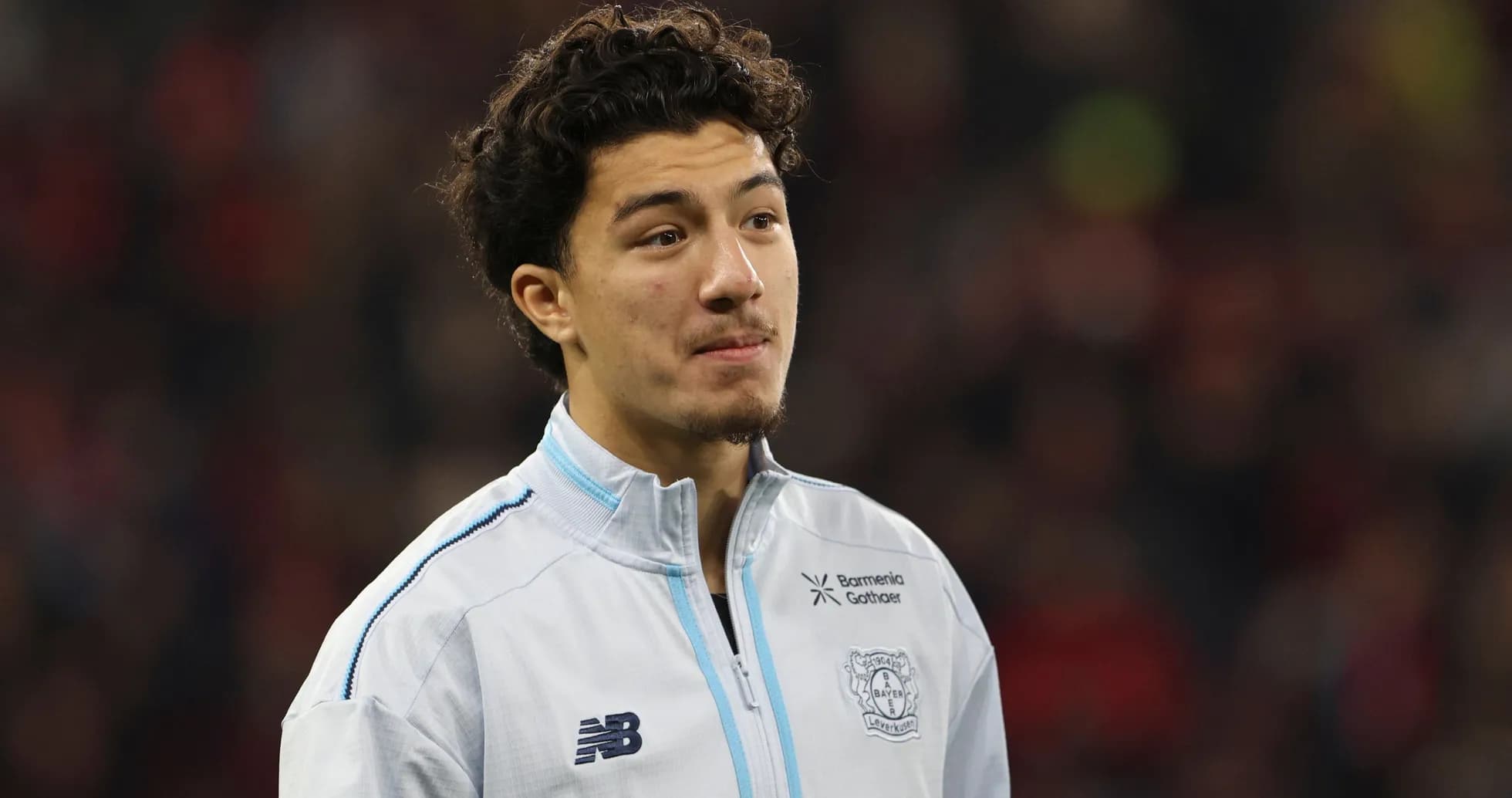
Ibrahim Maza plays football as if the ball really is his closest friend.
“I feel good with the ball; we're good friends,” he told RTL not long ago. “I try to be at one with the ball.” On nights like Halloween against VfB Stuttgart, those words don’t sound like a slogan. They sound like a warning.
That evening, in Bayer Leverkusen’s 4-2 defeat, the 20-year-old playmaker twisted and teased his way through red shirts in spaces that barely existed. DAZN commentator Jan Platte reached for the only comparison he felt big enough: “If Ronaldinho had been in the stadium, he would have come down and given him his crown. That was unbelievable.”
From Berlin’s cages to the Champions League spotlight, that same street-bred flair has survived intact. It’s only half the story, though. The other half is harder, less glamorous, and explains why Paris Saint-Germain are reportedly prepared to push to the limit to get him.
The artist who hates laziness
Maza calls himself a worker before he calls himself a star.
“An artist who doesn't work isn't worth that much on the pitch,” he says. It sounds like a slogan until you hear where it comes from.
At Hertha BSC’s academy, where he arrived at ten, he was not the golden boy. Not the poster child. Not even a guaranteed starter. Pal Dardai, then working in the youth setup and later to become a club icon on the touchline, delivered the kind of message that either breaks a teenager or builds him.
“You have a gift from God, don't squander it,” was the polite version. The real one, as Dardai later told it, was more brutal: “If you carry on being this lazy, you won't achieve anything at all.”
At under-17 level, Maza did not walk into the team as the headline prospect. Oliver Reiß, now in charge of Manchester City’s under-21s and his coach in that second U17 year, remembers it clearly.
“He didn't come into the under-17s as the sought-after top talent,” Reiß recalled on the Denkfabrik Nachwuchsfußball podcast. Early in that season, Maza sat more often than he started. Bence Dardai, now at VfL Wolfsburg, and Noel Aseko, now at Eintracht Frankfurt, drew the scouts’ eyes.
Then something shifted.
Reiß and assistant Oliver Schröder began to notice the little differences. “We noticed that he somehow did different things with the ball,” Reiß said. Maza was not yet one of the untouchables for the biggest games, “but it was clear relatively early on that he had something special.”
The key, in his mentor’s eyes, wasn’t just the tricks.
“What we really liked about him was that he managed to combine being a good footballer with having that resilience,” Reiß explained. He had seen dozens of gifted kids who sparkled when the game flowed their way and vanished when it didn’t. Maza was different. “Even against the greatest adversity,” Reiß said, he was “a long way from letting the game happen to him.”
When setbacks hit, he bit back. That mix of technique and stubbornness became his signature.
From bench player to Berlin’s great hope
The first half of that U17 year told one story: a talented kid on the fringes. The second half told another. Maza forced his way into the team. He stayed there.
Reiß moved up with him to the under-19s, and Maza didn’t just follow. He took over. He became a regular immediately, and the internal noise around him in Berlin grew louder. Hertha, almost by accident, had found their much-hyped academy jewel after all.
Maza himself has never forgotten who helped light the fuse. “I made my biggest step forward under him,” he said of Reiß in a 2024 interview on Hertha’s website.
The rise accelerated. In April 2023, at just 17, he made his Bundesliga debut in a 0-2 defeat against Bayern Munich. It came only a year and a half after he had struggled to secure a place in the U17 side.
Hertha’s relegation soon after could have been his launchpad, a full season of second-division football to grow into the senior game. Instead, a meniscus injury halted everything. Months of recovery, then the grind back into the first-team picture.
He did it. By the time Leverkusen called in 2025, Maza had spent a year and a half as an established member of Hertha’s senior squad. Bayer paid €12 million for a teenager and handed him one of the Bundesliga’s heaviest shirts: help replace Florian Wirtz, who had left for Liverpool FC.
Plenty of players would have shrunk under that shadow. Maza didn’t.
“I try never to let outside pressure get to me,” he told RTL. “Whether people say I have to do this now or should have done this or that. I'm very aware myself of what I have to do on the pitch, and I already put a certain amount of pressure on myself, but it's still within healthy limits.”
Settling in Leverkusen, catching Messi’s eye
Leverkusen quickly discovered they had not just signed a dribbler but a decision-maker. After a short adjustment period, Maza grew into one of Xabi Alonso’s key figures, at home in both the Bundesliga and the Champions League.
By the end of the 2025/26 season, his name sat among the elite of his age group. The Kopa Trophy, awarded annually to the world’s best under-21 player as part of the Ballon d’Or ceremony, put him on its shortlist. The detail that really travelled, though, was who voted for him.
Lionel Messi, with a ballot in his hands, placed Maza in his top three alongside Barcelona prodigies Lamine Yamal and Pau Cubarsi.
“To be chosen by Lionel Messi is, of course, a great honour,” Maza said. “It gives you an extra dose of motivation when someone like Messi says you've got something.” When asked about the Ballon d’Or itself, he didn’t dodge. “That has always been a dream of mine.”
Dreams need numbers. In his second season at Leverkusen, he is delivering them. Eight goal contributions in 14 appearances so far — four goals, four assists — only tell part of the story. He has become the reference point in Bayer’s midfield, the player team-mates look for when the game tightens and the crowd grows restless.
Yet the better he plays, the louder the rumours grow.
His contract runs until 2030, but stories of a blockbuster move are multiplying. For weeks, reports have circled around PSG. The French champions, Champions League winners and serial collectors of attacking talent, are said to rate him as highly as Messi does. They are not alone.
Deniz Undav, who spent that Halloween evening chasing Maza’s shadow for Stuttgart, didn’t hide his feelings. “Go to Paris, mate, I don't want to play against you any more!” he reportedly shouted to him after the game, according to Bild. Later, on Sky, he added: “In Maza, Leverkusen have an outstanding player. He opens up space and wins duels.”
For a striker, there is a subtext there: give me that man in my team, not against me.
Three cultures, one decision
If Undav dreams of linking up with Maza, it won’t be for Germany. That door has closed.
Maza wore the DFB badge from under-18 to under-20 level, but just over two years ago he chose Algeria. Born in Berlin to an Algerian father and a Vietnamese mother, he could have picked any of the three nations.
“I love all three countries and, in the end, made my decision for various reasons, those are private,” he said at the start of the year. The heart likely tugged him towards Algeria — summer holidays, family visits, the pull of roots. The head had its say as well.
Germany’s competition in his position is savage. Florian Wirtz and Jamal Musiala, only two years older, already occupy the spotlight. Algeria offered something else: a fast track to senior football and responsibility.
“I wanted to be able to play for a senior national team as early as possible and make as many appearances as possible for the national side as a professional,” he told Bild.
The plan worked perfectly. In October 2024, a month and a half before his 19th birthday, he made his Algeria debut. Since then, he has collected 24 caps, not as a passenger but as a central piece in a side with continental ambitions.
His breakout on the international stage came at the Africa Cup of Nations in Morocco around the turn of 2025 to 2026. He ranked among Algeria’s best players, prompting one Algerian outlet to christen him “Mazadona” — a nod to Diego Maradona that might weigh heavy on some shoulders, but fits the way he glides past opponents.
Last summer, he went to the World Cup as a starter. Algeria reached the round of 32 before Switzerland ended their run with a 2-0 win. In the group stage, Maza crossed paths with Messi again, this time on the pitch. Argentina won 3-0, Messi scored a hat-trick, and yet the veteran still saw enough in the young midfielder to later include him in his Kopa Trophy trio.
The message was clear: the kid belongs on this stage.
How long can Leverkusen hold him?
Back in the Bundesliga, Maza continues to blur the line between street footballer and modern playmaker. He carries Berlin’s asphalt in his first touch and Leverkusen’s tactical schooling in his movement. He works. He tackles. He tracks back. He still plays as if the ball is his friend, but now he protects it like a professional.
Bayer have him under contract until 2030, a powerful position in theory. Reality feels different. Every slaloming run, every disguised pass, every Champions League night that ends with his name on the lips of commentators pushes him closer to the game’s financial giants.
PSG are circling. Others will follow. Algeria already have him. Germany do not. Leverkusen, for now, do.
The question is no longer whether Ibrahim Maza will reach the very top. It’s which crest he’ll be wearing when he finally walks onto that Ballon d’Or stage he has already dared to imagine.





