
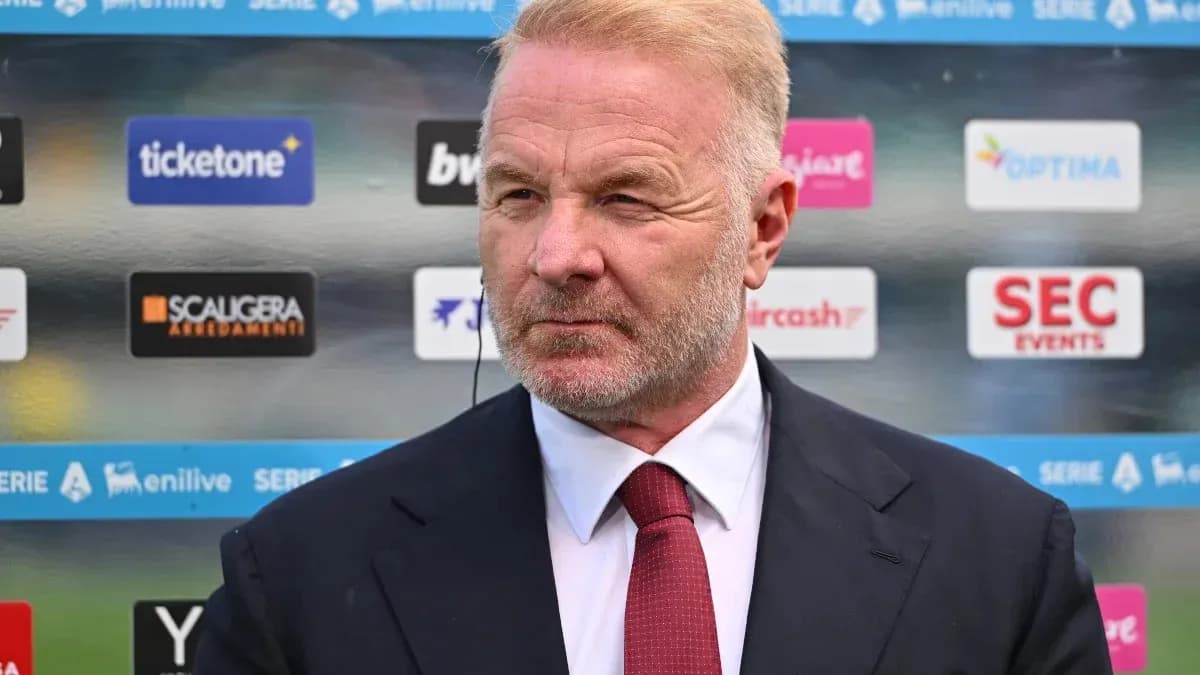
Igli Tare has offered a stark insight into Rafael Leao’s final months at Milan, admitting the Portuguese forward no longer had football at the centre of his life before his move to Galatasaray – and revealing how Liverpool walked away from a near-complete deal for Joe Gomez.
The former Milan director, sacked in May along with Max Allegri, CEO Giorgio Furlani and Geoffrey Moncada after the club failed to secure Champions League qualification, spoke candidly on Sky Sport Italia’s Calcio Unplugged podcast about a turbulent spell at San Siro.
‘Football was no longer a priority’ for Leao
Tare arrived at Milan with a clear external impression of Leao. Meeting him in person changed that.
“I had only known of Leao from the outside, but when I got the opportunity to get to know him in person, I thought he was an extraordinary guy,” Tare said. “I really cared for him very much as a person.”
The admiration, though, came with frustration. Milan expected more. So did Tare.
“He was the player we all expected more from. I think football was no longer a priority for him. That's how to read the situation.”
Leao’s world had expanded beyond the pitch. He released a rap album last year, developed a growing profile in music and fashion, and increasingly juggled those pursuits with a playing career that never quite hit the heights Milan believed he could reach on a consistent basis.
“I think he was focused more on his life outside of football, so music, fashion, things like that,” Tare continued. “I never doubted his love for Milan, you could tell he suffered at not performing consistently, he had a lot of fitness problems, so always had the handbrake on.”
The image is of a player torn. A star who wanted to dominate but rarely felt at full throttle.
“I tried to have more individual meetings with him than any other Milan player, and every time I got the sense he wanted to do more. But wanting to is sometimes not enough.”
By then, the writing was already on the wall. Leao’s contract ran to June 2028, yet Milan were unwilling to match his wage demands for a renewal. Both sides knew a parting of ways was coming; the problem was finding someone ready to pay for a player whose form and fitness never truly aligned.
The market was colder than many expected.
No concrete offers ever arrived for him,” Tare revealed.
In the end, the solution came late. Very late. Galatasaray stepped in deep into the transfer window, finally providing Milan with an exit route for a player whose talent had stopped matching his impact.
Inside a chaotic summer and the Gomez near-miss
Leao’s situation unfolded against a backdrop of upheaval. The summer of 2025 was already tense; the pressure of missing out on the Champions League sharpened every decision. Then, with the clock ticking on the transfer window, Allegri changed the plan.
“It was difficult for us because we decided to change system five days before the end of the transfer window,” Tare explained. Milan abandoned the 4-3-3 and pivoted to a three-man defence.
That single decision rewrote their recruitment strategy almost overnight. A squad built for one shape suddenly needed different profiles at the back. Top-level centre-backs, at short notice, with limited leverage and no Champions League football to offer.
“Going from a 4-3-3 to a three-man defence made it hard for us to find someone of that level in five days.”
The first blow landed quickly. Manuel Akanji chose Inter. Milan’s absence from the Champions League proved decisive, stripping them of both prestige and revenue at the worst possible time.
“We were a bit unlucky, first because Manuel Akanji went to Inter as we weren't in the Champions League,” Tare said.
So the search moved on. The next target was Joe Gomez.
Here, Milan thought they had their man.
“We had an agreement with Liverpool for Joe Gomez,” Tare revealed.
The deal, though, was built on a domino. Liverpool’s move for Marc Guehi from Crystal Palace had to go through first. It didn’t.
“When Marc Guehi's move from Crystal Palace to Liverpool collapsed at the last minute, Liverpool pulled out.”
Milan were left stranded. The paperwork for Gomez was ready. They were, as Tare put it, “waiting only for that move” to sign.
It never came.
With the window closing and a new system demanding numbers in defence, Milan had to act simply to avoid a crisis at centre-back.
“In order to avoid being without centre-backs, we signed Odogu at the last minute as a signing for the future.”
A future signing forced into the present by a late tactical switch, a failed chain transfer, and the absence of Champions League football. A snapshot of a club trying to rebuild on shifting ground, while one of its brightest stars drifted away from the game that made him.





