
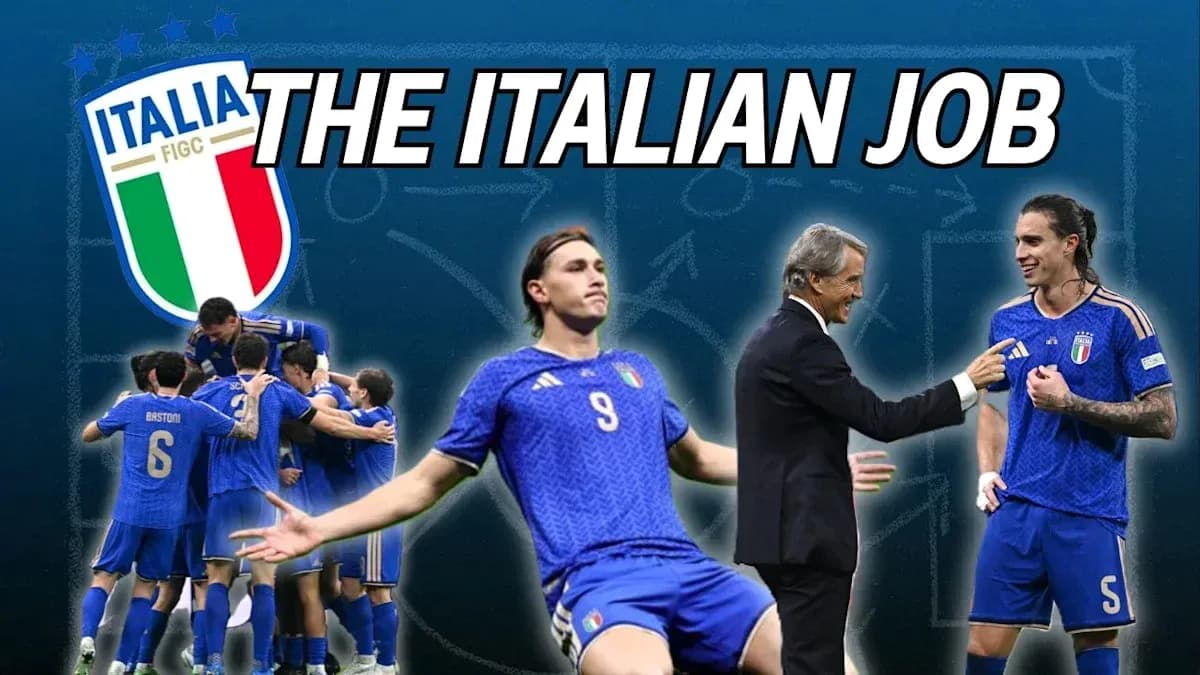
Italy’s 3-1 win over France didn’t just light up San Siro. It shook the country awake.
On a cold November night in Milan, Roberto Mancini’s side tore into one of world football’s heavyweight nations and, by the following morning, the newspapers had their verdict: this was a statement. Not a friendly, not an experiment, but a Nations League performance that carried the weight of a team rediscovering its edge.
Azzurri seize the stage
From the press box at San Siro, the story wrote itself. Italy went toe-to-toe with France and refused to blink. A 3-1 scoreline over such opposition is rare enough; the manner of it is what had the Italian media reaching for superlatives.
The front pages focused on the intensity, the organisation, the courage to play. Mancini’s blueprint – aggressive pressing, quick combinations, constant movement between the lines – finally met a stage big enough to test it. Against one of the strongest squads in the world, the Azzurri didn’t just survive. They dictated.
Certain names inevitably dominated the columns. The biggest winners were those who married talent with personality, players who treated France not as a threat but as a challenge. The morning papers highlighted their authority on the ball, their willingness to demand possession in tight spaces, their refusal to retreat even when France tried to raise the tempo.
Then came the image that framed the night.
Pio Esposito’s moment
The photograph ran everywhere: Pio Esposito, arms wide, a roar frozen on his face, teammates rushing towards him under the San Siro lights. Italy’s third goal, the one that broke French resistance and sent the stadium into full celebration, became the symbol of the evening.
It wasn’t just another goal. It was the strike that turned a strong performance into an emphatic result. The media latched onto that, pointing to Esposito’s composure and timing, the way he attacked the moment as if he’d been doing it at this level for years.
For a country obsessed with the emergence of new forwards, that image carried a charge. Here was a young Italian attacker delivering in a high-stakes Nations League clash against elite opposition. The message between the lines of the match reports was clear: this is the kind of personality Italy have been waiting for.
The penalty that didn’t change the story
Sebastiano Esposito’s penalty miss in the second half could have turned into a subplot of doubt. It didn’t. It became something else entirely.
The cameras caught the shot, the frustration, the brief glance to the sky. What they didn’t fully show – and what Lorenzo Bettoni set out to uncover from Milan – were the seconds wrapped around that moment. Who spoke to him before he placed the ball? Who tried to calm him after he missed? How did the bench react as the ball flew wide?
Those details filtered into the coverage. The papers noted the reaction of his teammates, the way they pulled him close, refused to let his error define the night. Italy were already in control, and the miss didn’t derail the performance. If anything, it highlighted the team’s mental strength. Heads didn’t drop. The structure held. The initiative stayed with the Azzurri.
That resilience featured heavily in the analysis. Against a side as ruthless as France, a missed penalty can flip a game on its head. This time, it barely dented Italy’s authority.
Behind the cameras, behind the headlines
What gripped Italian readers the next day wasn’t just the goals or the scoreline, but the hidden layers around them.
From the stands and the mixed zone, Bettoni pieced together the moments the television coverage skimmed past. The glances between defenders as they organised the line. The small nods of approval from Mancini after a risky press paid off. The quiet conversations in the seconds before that penalty, when tension and trust shared the same patch of grass.
Newspapers homed in on those scenes to explain why this night felt different. This wasn’t a smash-and-grab or a backs-to-the-wall epic. It was a controlled, confident display, full of personality and underpinned by a squad that looked united in both the big moments and the tiny, almost invisible ones.
Italy’s 3-1 victory over France will live in the record books as a result. Inside the country, it is already being treated as something more: a performance that hints at a team ready to stand among the game’s powerhouses again – and to prove that this was not just a one-off, but the start of something that has to be sustained.





