
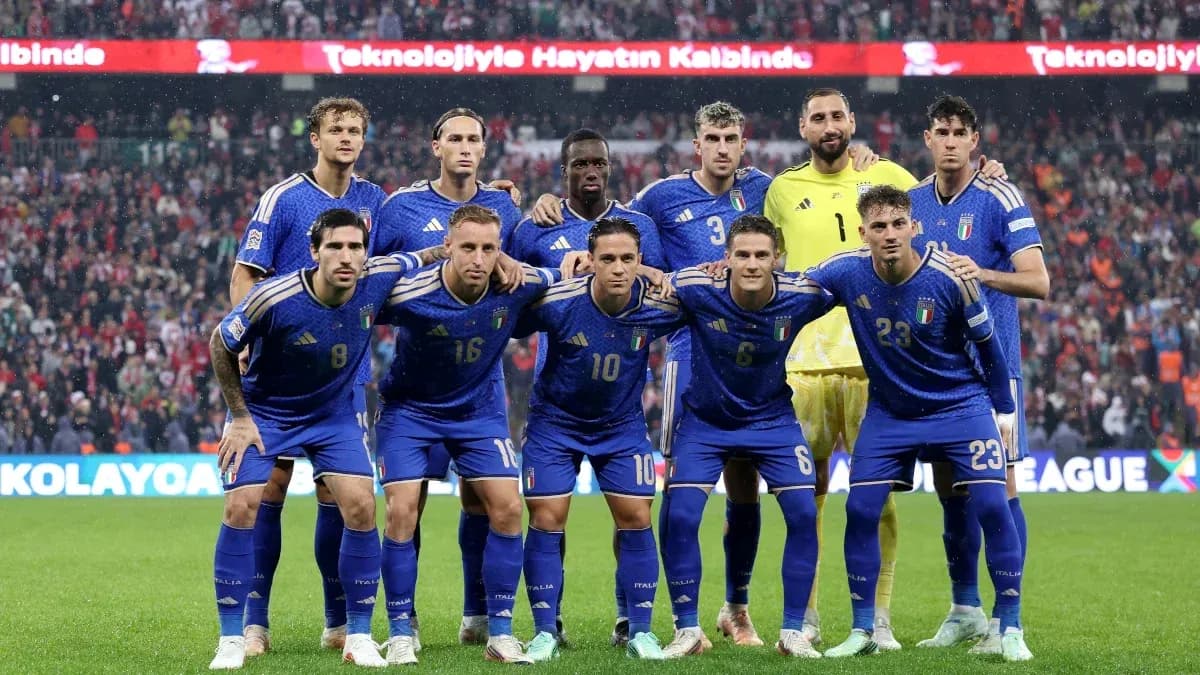
Roberto Mancini has ripped up another page of Italian football tradition. This November, he will lead out the youngest Italy squad the country has ever named – and that’s before you even count the two teenagers who are only there to taste the air of the senior camp.
For the Nations League clashes with France on Thursday and Belgium on Sunday, Mancini has called up 31 players. The headline is not a recall, not a big-name omission, but a number: an average age of just 24 years and 171 days for the core group.
And that average actually gets younger if you include the two prodigies who will not even feature.
Teenagers at the door
Riccardo Cassano is 17. Simone Lontani is 18. Between them, they have zero competitive minutes in senior club football. Yet they have been summoned to Coverciano, handed the training kit of the national team and told to mix with the elite.
Their role is clear. They will train with the senior squad for a few days, absorb the rhythm, the standards, the pressure, then step back down to the U18s and U19s, where they are expected to see real action during this international window. It is a controlled taste of the future.
Strip those two out of the calculation, and the numbers still tell a story. Even without Cassano and Lontani, this is officially the youngest Italy squad ever assembled.
Mancini is not just flirting with youth. He is building around it.
A new generation takes centre stage
Teenagers are no longer the exception. They are a theme.
Honest Ahanor (18), Matteo Palma (18) and Mattia Liberali (19) all make the cut. Just above them, Alphadjo Cisse (20), Pio Esposito (21) and Marco Palestra (21) form the next wave, players already trusted at major clubs and now pushed onto the international stage.
Cisse, in particular, has been playing with the swagger of someone who knows his time has come. His goal for AC Milan against Bologna at San Siro in late October underlined why he is here: sharp movement, clean finish, no fear. That kind of conviction travels well into national team football.
Across the back line, names like Ahanor, Palestra and Palma sit alongside Alessandro Bastoni, Riccardo Calafiori, Michael Kayode and Giorgio Scalvini. It looks less like a conservative defensive unit and more like the blueprint of Italy’s back four for the next decade.
In midfield, the blend is just as stark. Nicolò Barella remains a pillar. Around him, Mancini has stacked the options with youth and energy: Nicolò Fagioli, Davide Frattesi, Niccolò Pisilli, Samuele Ricci, Alessandro Romano, Sandro Tonali. Cassano and Lontani are listed here too, symbolic markers of how early the coach wants to integrate technical talent.
Old heads in a young dressing room
The most striking detail? The “veteran” of this squad is only 30.
Guglielmo Vicario, now at Juventus, is the oldest player in the group at that age. Barella, at 29, is the second-most senior figure. Federico Gatti and Federico Dimarco, both 28, follow. That is the leadership core. No 34-year-old warhorses, no ceremonial call-ups.
This is not a dressing room built around nostalgia. It is one where players barely into their thirties are suddenly the reference points, the ones expected to guide teenagers who grew up watching them on television.
Mancini’s choice is bold. It is also coherent. The Nations League may not carry the weight of a World Cup or a European Championship, but matches against France and Belgium are no place to hide. If young players can survive there, they can survive anywhere.
The squad in full
- Goalkeepers: Marco Carnesecchi (Atalanta), Gianluigi Donnarumma (Manchester City), Guglielmo Vicario (Juventus)
- Defenders: Honest Ahanor (Crystal Palace), Alessandro Bastoni (Inter), Riccardo Calafiori (Arsenal), Federico Dimarco (Inter), Federico Gatti (Juventus), Daniele Ghilardi (Roma), Michael Kayode (Brentford), Marco Palestra (Chelsea), Matteo Palma (Udinese), Giorgio Scalvini (Atalanta)
- Midfielders: Nicolò Barella (Inter), Riccardo Cassano (Como), Issa Doumbia (Sporting CP), Nicolò Fagioli (Fiorentina), Davide Frattesi (Lazio), Simone Lontani (Parma), Niccolò Pisilli (Roma), Samuele Ricci (Como), Alessandro Romano (Cagliari), Sandro Tonali (Tottenham)
From the anthem in Bologna to the tests ahead against France and Belgium, this is what Italy now looks like: raw, talented, unafraid of birth certificates. The question is no longer whether Mancini trusts youth. It is how far this generation can push Italy once the Nations League pressure really bites.





