
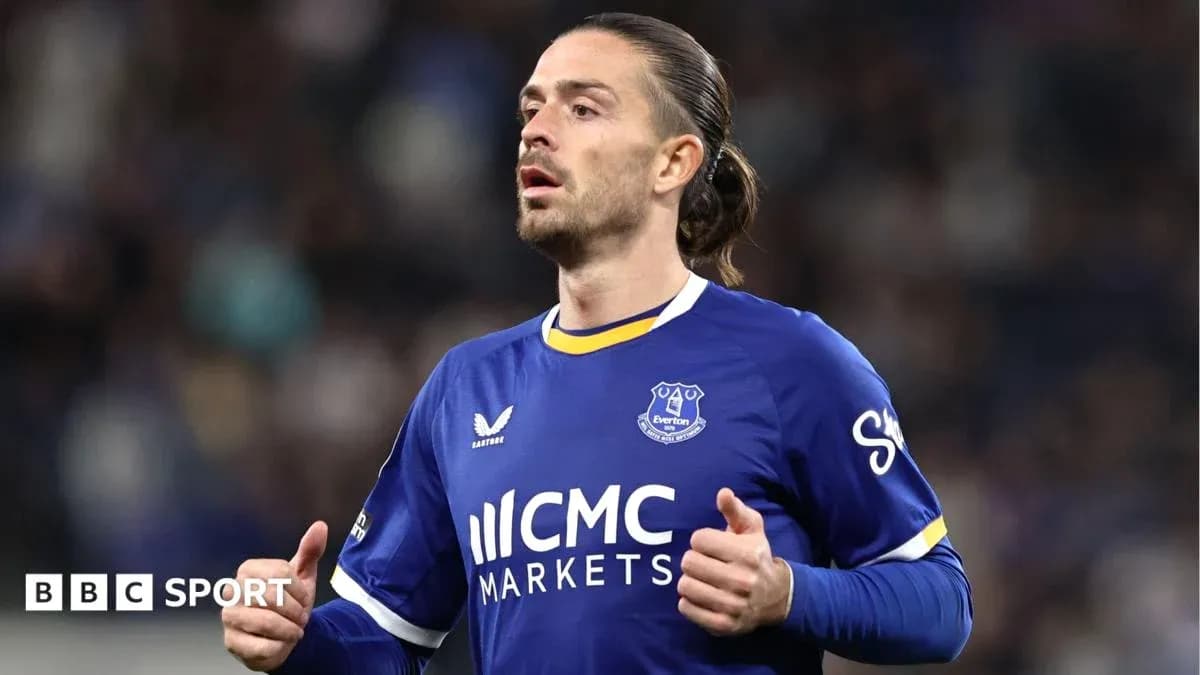
Jack Grealish swept back into Everton on deadline day in a white Lamborghini and, for a few hours, it felt like the club had its summer back.
Supporters ringed Finch Farm, phones in the air, waiting for the player whose first loan spell had been cut short by a broken foot but not before he had left a mark. Grealish, 31 now, still carried that same easy charm, that same sense of mischief and possibility. He stayed into the early hours, signing everything, posing with everyone. When he finally drove away, the feeling was clear: one of theirs had come home.
It was a move loaded with risk. David Moyes had been left with a threadbare squad after a chaotic window, only 18 senior players to take into a Premier League season. Grealish, frozen out at Manchester City at the start of the final year of his contract, needed somewhere to matter again. Everton needed a spark, a gamble worth taking.
Weeks later, that gamble has reached a brutal checkpoint.
A public line in the sand
Everton did not hide behind vague explanations when Grealish vanished from the squad for the Carabao Cup tie against Newcastle United. The club called it what it was: “a breach of club discipline”. The detail was stark. He had not turned up for training on Monday.
For Britain’s first £100m footballer, a player who once helped power City to a Treble, it was another jolt in a career that keeps veering off course. This was not a quiet internal matter. By going public before kick-off, Everton underlined the seriousness of the offence and the standards Moyes intends to enforce.
Inside the club, this is not being framed as a final warning or some melodramatic “Last Chance Saloon”. Moyes cannot afford to banish one of the few genuine game-changers in such a thin squad. But the pressure has changed shape. The room for error has shrunk.
This is now a “now or never” stretch for Grealish at the sharp end of the Premier League. Fail at Everton, and the drop from the elite starts to look less like a threat and more like an inevitability.
Moyes’ anger, Everton’s response
Moyes, a disciplinarian by instinct and history, has backed the club’s decision. The punishment was agreed at a high level, with his input and full support. Grealish has already held talks with senior figures at Everton. The message, by all accounts, was not subtle: there can be no repeat.
BBC Sport understands there have been minor time-keeping issues with Grealish before, but never on this scale. Inside Finch Farm, he is generally regarded as a hard trainer, someone who looks after himself and buys into the work. That only deepens the frustration.
If Moyes needed a reminder that Everton can function without him, it arrived within 90 minutes. With Grealish absent, Everton produced arguably their best performance of the season, beating Newcastle 3-1 to reach a Carabao Cup quarter-final away to League Two side Fleetwood Town, the team that knocked out champions Arsenal in the previous round.
The irony was unavoidable. On the left flank, where Grealish might have operated, 20-year-old Tyrique George brought pace, energy and directness, the sort of dynamism Moyes craves. The team played with a tempo that has sometimes stalled when Grealish drifts inside, draws fouls and slows the game.
Moyes would not be drawn into a public dissection.
“You probably know I'm not going to give any details. It's a club decision and I support it. It's something I don't want to speak too much about,” he said, choosing instead to praise the group that had delivered.
“The one thing about Everton is that they have got real good values. All the players stand behind it and accept the values, on the pitch and off the pitch, and I think the players did a good job.
“It is a small squad, but we are doing our best to keep challenging. We are not accepting any excuses for anything and I think the players are doing a great job. There was a humility about us.”
He never mentioned Grealish by name in that context. He did not need to. The subtext was obvious: standards, unity, no excuses.
A bond under strain
The disappointment will cut deep because this was not a marriage of convenience. When Grealish first arrived on loan in August 2025, he spoke of an instant connection with Moyes.
“As soon as I spoke to the manager, I knew there was only one place that I wanted to go and that was Everton,” he said then. The feeling was mutual. Moyes, battling limited resources as owners The Friedkin Group eased away from major investment and prepared to sell, saw in Grealish a risk worth taking.
For a time, it worked. Grealish, fresh from being part of City’s 2023 Treble, brought personality and craft until a foot fracture at Aston Villa in January ended his season. His decision to stay at Finch Farm to complete his rehabilitation rather than return to the Etihad underlined how happy he was on Merseyside.
Everton did not rush into the second loan. They weighed the injury, the finances, and, yes, the character. Moyes still pushed for it. Grealish insisted he wanted Everton and only Everton.
The return, though, has not caught fire. Across eight appearances this season – six for Everton, two for City – he has neither scored nor assisted. His tendency to dwell on the ball jars with the quicker, more vertical style Moyes wants. When he missed the league defeat at Arsenal with what the club called “illness”, it already felt like a stop-start campaign.
For a manager relying on every fit senior body, this week’s absence through indiscipline will have stung even more.
The man behind the headlines
Inside Everton’s dressing room, Grealish is not seen as a disruptive presence. Quite the opposite. He is widely liked by team-mates and staff, described by those around the club as “a lad with a heart of gold, kind and charming, who actually loves being here”.
The evidence of that softer side is not hard to find.
Recently, Grealish donated £10,000 to a GoFundMe page for Everton supporter Leon Skapars, a 36-year-old father of three diagnosed with cancer. The family are raising money to explore treatment options. Skapars’ wife, Crystal, spoke of what that gesture meant.
“In that moment, Jack gave our whole family something we desperately needed, hope. What he has done for our family is something we will never forget. It makes us feel incredibly emotional.”
Grealish has been a regular presence at community events. He helped present awards at the Daily Mirror’s ‘Pride Of Britain’ ceremony, telling the audience: “Footballers are classed as heroes – but these are the real heroes.”
In April, he extended his role as principal ambassador to Special Olympics Great Britain for three more years, having first taken on the position in 2022. To mark it, he invited five of the 10 Special Olympics GB athletes who completed the London Marathon to Everton’s Hill Dickinson Stadium, giving them a VIP day, a tour and time with him pitchside.
At Finch Farm, he is often among the first to volunteer for Everton’s community projects, including sessions with the Everton in the Community Down Syndrome team. He regularly talks about the inspiration he draws from his sister Hollie, who has cerebral palsy.
This is the version of Grealish that those close to him champion: generous, engaged, emotionally open.
Yet his story has always run on two tracks.
A familiar pattern, a shrinking runway
Grealish’s career has been punctuated by moments that invite scrutiny. In April this year, he was photographed asleep at a Manchester rooftop bar, drinks scattered around him. It was not illegal, but for an injured player in rehabilitation, under constant camera surveillance, it was clumsy at best.
In March 2020, while at Aston Villa, he was fined by the club and issued a public apology after breaking lockdown rules during the pandemic to visit a friend. Later that year, in November, he admitted two counts of careless driving after incidents in which a Citroen van and a Mercedes were damaged.
Each time, he has apologised, reset, and those who know him best have rushed to defend his character. Within football, and particularly at Everton, the personal references remain glowing.
That is what makes this latest breach so painful for his many admirers. It does not fit the image of the player who spends hours with fans, who puts his name and money to good causes, who talks so often about responsibility.
It does, though, fit a pattern of lapses that threaten to drag his footballing career away from the level his talent once promised.
Everton will try to bring him back into the fold. Moyes needs his quality, his ability to change games, his personality in a dressing room that has been through years of turbulence. The manager will also demand a response: better fitness, sharper performances, absolute professionalism.
The club’s values have been nailed to the mast. The supporters, who welcomed him back like a returning hero in that white Lamborghini, will watch closely.
For Jack Grealish, this is no longer about price tags, social media clips or old Treble medals. It is about whether he can still be trusted to carry the weight of a club’s belief.
Because after this week, the chances to prove it are running out.





