Jamal Murray's Role in Denver Nuggets' Title Quest
The Denver Nuggets know exactly where they stand.
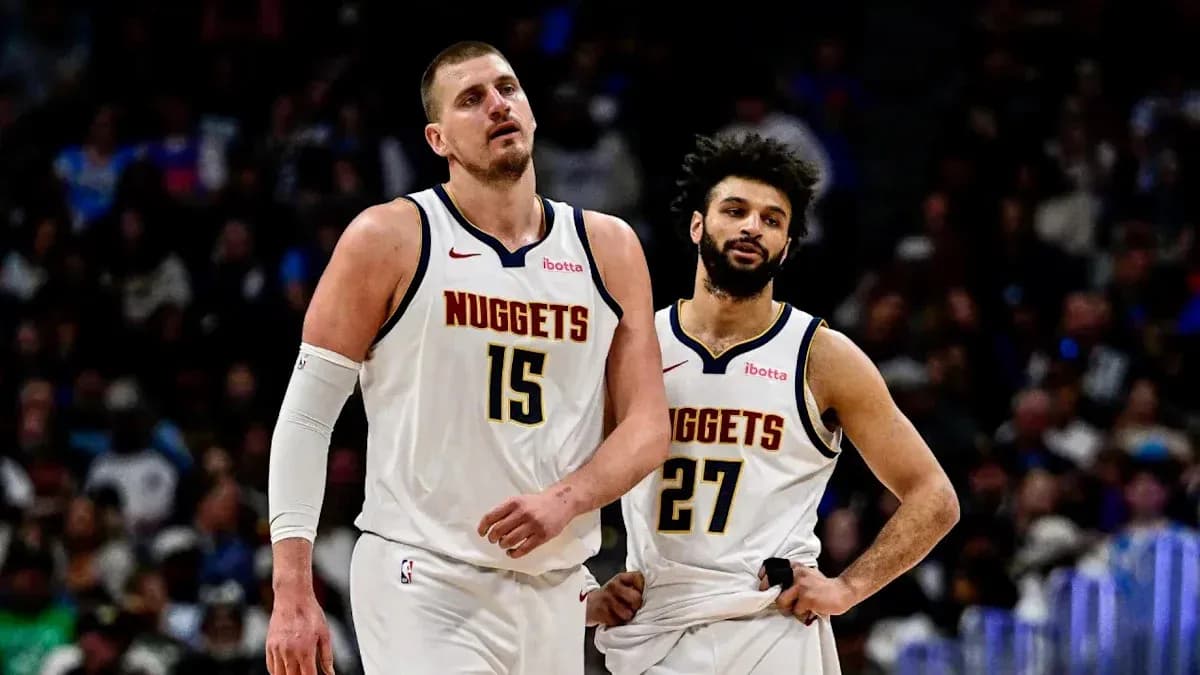
Their title window is still open, but the breeze is changing. Nikola Jokic is edging toward the back half of his prime, and Denver can’t afford to waste any more of these seasons. That reality throws a sharp spotlight on Jamal Murray, the guard who so often tilts their fate one way or the other.
The projections for 2026-27 suggest a big Murray year. There’s real optimism. There’s also a catch.
Murray’s role in fixing Denver’s shot diet
Denver’s biggest problem last season wasn’t accuracy. It was volume.
The Nuggets attempted just 87.8 field goals per game in 2025-26, 26th in the league. They were ruthlessly efficient when they did shoot — 49.6 percent from the field (second in the NBA) and 39.6 percent from three (best in the league). That combination screams for more aggression, more attempts, more pressure on the rim and perimeter.
This is where Murray’s next step matters.
His Basketball Reference per-36 projections for 2026-27 translate into a slightly reshaped scoring profile once converted to per-game numbers. With a similar workload to last season — roughly 35.4 minutes per night — the models point to a guard who scores a touch less, but does more of everything else.
The reason is simple: DeMar DeRozan.
With DeRozan arriving as a proven 21.1-point-per-game scorer from the Kings, Murray’s pure scoring load is expected to dip. From a career-high 25.4 points per game on 18.1 field-goal attempts last season, he’s projected to slide to 23.7 points on 17.5 shots.
That’s not a collapse. It’s a recalibration.
Denver is effectively trading a small slice of Murray’s volume for the presence of another “bucket-getter.” Given how efficient Murray remains, that’s a sacrifice the numbers say he can absorb without losing his star impact.
Defensive edges and elite efficiency
The projections don’t just like Murray’s offense. They quietly back his all-around game taking a step.
On the glass, he’s expected to average 4.3 rebounds, which would be the second-best mark of his career. His rim protection — modest but meaningful for a guard — ticks up to 0.5 blocks per game, again flirting with his top seasons.
The steals matter even more. Murray’s projected to climb back to 1.1 steals per game, reflecting his ability to jump passing lanes and disrupt at the point of attack. On a team that leans heavily on Jokic’s positional defense, those extra deflections and strips at the perimeter can swing possessions.
All of that sits on top of elite projected efficiency.
Murray is slated to hit 42.1 percent from three, which would be the third-best mark of his career, and 47.9 percent from the field overall, also the third-highest figure he’s ever posted. For a high-usage guard sharing the floor with Jokic, that’s All-NBA-level efficiency.
Denver already led the league in three-point percentage. With Murray shooting at that clip again, they’ll have every chance to stay there.
From scorer to organizer
The most intriguing part of Murray’s 2026-27 outlook isn’t the scoring or the shooting. It’s the playmaking.
Denver’s offense has long leaned on Jokic as the de facto point guard. That makes them brilliant, but also predictable. When one man creates almost everything, playoff defenses eventually start to scheme for that singular source.
Murray’s projected 6.7 assists per game cuts into that predictability.
If that number holds, it would be the second-highest assist average of his career, just behind the 7.1 he posted in 2025-26. With DeRozan, Jokic, Aaron Gordon, Cam Johnson, and Christian Braun all capable finishers, there’s a clear path for Murray to match or even beat that career high if they convert at expected levels.
That passing growth isn’t a luxury for Denver. It’s a necessity.
Tyus Jones arrives as the nominal secondary point guard, but he’s coming off a season in which he averaged only 2.4 assists. He has shown he can orchestrate at a high level — his 7.3-assist campaign with the 2023-24 Wizards proved that — yet he still has to acclimate to the Nuggets’ system and Jokic-centric offense.
Until that happens, Murray has to be the one who bridges the gap between scorer and floor general. The projections suggest he’s ready for it.
The turnover problem that won’t go away
There is, however, a stubborn blemish on Murray’s statistical profile.
Turnovers.
For nine years, he hasn’t fully shaken the issue that haunts most high-usage guards. As his role has grown and his status has climbed — capped by an All-NBA Third Team nod in 2025-26 — the giveaways have followed him.
The models see more of the same.
Murray is projected to average 2.3 turnovers per game, which would be a career high and well above the point guard league average of 1.7. If that holds, it would mark the third time in nine seasons that he’s set a new personal high in turnovers.
Context matters. When Jokic sits, Murray often becomes the sole offensive engine, forced to create off the dribble, initiate sets, and score in heavy traffic. Mistakes come with that territory.
But for a team chasing another title, those giveaways are the one number on his sheet that can’t keep climbing.
Denver is banking on Jones easing that burden. If the backup guard settles in and takes on more of the creation load with the second unit, it could soften Murray’s usage spikes and drag that turnover rate back toward the league norm.
That’s the hope. The projections, for now, remain skeptical.
Can this version of Murray be All-NBA again?
Strip it all down, and the question hanging over Denver is clear: can Jamal Murray play at an All-NBA level again in 2026-27?
The numbers say he has the tools. Slightly lower scoring, better distribution, strong efficiency, improved defensive activity — that’s the profile of a guard who can anchor a contender next to a generational center.
But the margins decide awards and championships.
If Murray tightens his handle, protects the ball, and still drives an offense that features Jokic, DeRozan, and a deep supporting cast, his case writes itself. If he doesn’t, those extra empty possessions could be the difference between another deep run and a painful reminder that title windows don’t stay open forever.
Denver’s season, and perhaps the last great stretch of Jokic’s prime, may hinge on which version of Murray shows up when the ball goes up in October.