
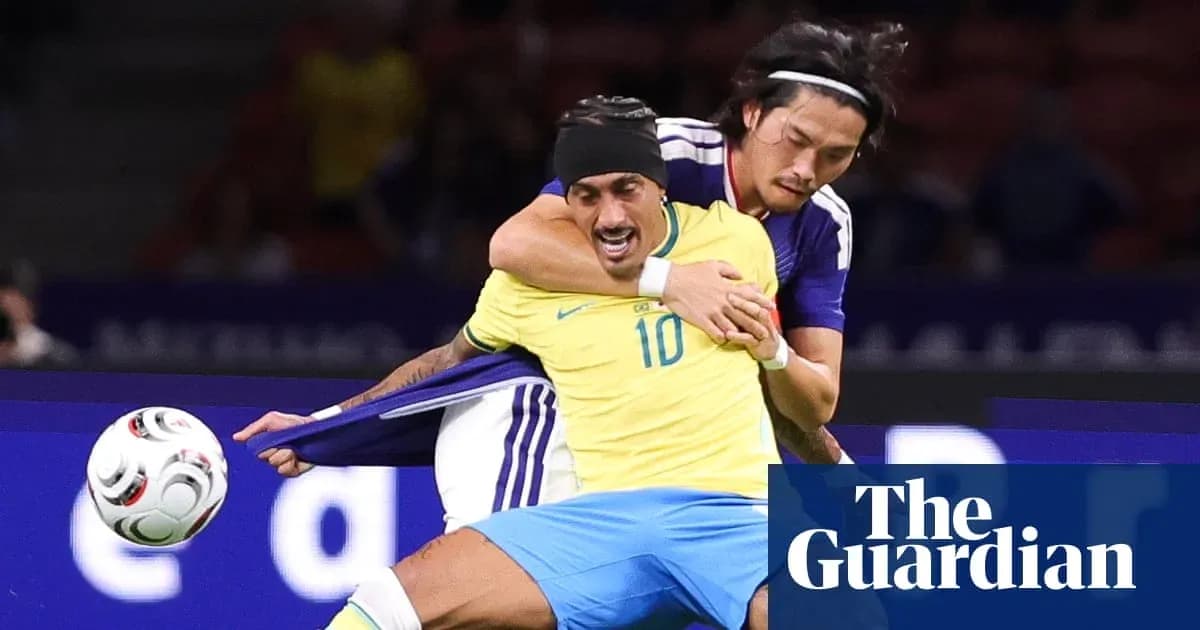
Brazil’s night in Singapore ended in chaos, controversy and a 3-2 defeat that will sting far beyond the label of “just a friendly”.
Raphinha, already substituted, was sent off from the touchline. Carlo Ancelotti followed him down the tunnel moments later. Japan walked away with a statement win and a reminder that they are no longer content to play the undercard in global football.
The game had already taken a wild turn by the time Tatsuhiro Sakamoto struck the stoppage-time winner that lit the fuse. His late goal, hotly disputed by the Brazilian bench, sparked furious protests. Raphinha, withdrawn after 71 minutes, let his anger spill over on the sideline and saw red. Ancelotti’s complaints earned him the same fate in a fractious finale that laid bare Brazil’s nerves.
The drama at the end only made sense in the context of what came before.
Japan tore into Brazil from the first whistle. Inside 20 minutes, they were 2-0 up and full value for it. Takefusa Kubo, sharp and fearless, opened the scoring, punishing a disjointed Brazilian back line. Keito Nakamura then doubled the lead, and suddenly the five-time world champions looked rattled, second to loose balls and unable to stem Japan’s tempo.
Vinícius Júnior dragged Brazil back into it almost by force of will. In the 33rd minute he reduced the deficit, a reminder that even on a turbulent night Brazil still carry individual brilliance capable of changing a game in a heartbeat.
Japan refused to fold. They kept their shape, picked their moments and forced Brazil into a scrap. When Vinícius struck again in the 75th minute to level the match, it felt like the inevitable swing of heavyweight quality. Brazil finally had a foothold, their rhythm returning, their stars on the ball in dangerous areas.
Then came the twist.
With the clock deep into stoppage time and Brazil pushing for a winner of their own, Sakamoto struck what would become the flashpoint of the evening. His late goal, celebrated wildly by the Japanese players, sent shockwaves through the Brazilian bench. The protests that followed turned a compelling friendly into a stormy spectacle, with Raphinha and Ancelotti both dismissed as tempers boiled over.
Japan left with a 3-2 win and another landmark result. Brazil left with questions, bruised pride and two red cards hanging over a night that was supposed to be routine preparation.
In Singapore, the scoreboard told one story. The touchline told another.
Messi’s Shadow Looms as Uruguay Spoil Argentina’s New Era
In Buenos Aires, the air felt different. No Lionel Messi, no No 10 on the team sheet, and for the first time in years Argentina stepped out at home knowing their greatest player would not be there to save them.
Uruguay did not come to pay tribute to a bygone era. They came to spoil the party and start one of their own.
Under new coach Diego Forlán, Uruguay claimed a 2-1 win in the clásico rioplatense, handing Argentina a jarring defeat in their first match since Messi’s international retirement in early October. For a fan base still processing the end of a golden chapter, it was a cold, sharp reminder of what life without him can look like.
The night began with symbolism. La Bombonera, usually a cauldron that sells out on reputation alone, was short of a full house. Most who did come wore the familiar albiceleste with Messi’s No 10 on their backs. On the pitch, though, that number stayed vacant.
Lionel Scaloni, fresh from extending his contract through 2030, made a deliberate choice. He left the No 10 unassigned, explaining he has yet to choose a successor and, with no obligation to use it, prefers to leave it empty for now. The absence of the shirt mirrored the absence of the player: obvious, heavy, impossible to ignore.
On the field, the void was even clearer.
Argentina lacked the explosive, decisive spark that Messi so often supplied in the final third. Nicolás Paz and Thiago Almada tried to shoulder responsibility, drifting between the lines, looking for the killer pass or the sudden burst of genius. It never quite came.
Uruguay, disciplined and direct, waited for their moment. It arrived shortly after the break, and it came in the ugliest possible fashion for the hosts. In the 48th minute, Leonardo Balerdi turned the ball into his own net, handing Uruguay the lead and silencing the stadium.
Five minutes later, Argentina’s problems deepened. Maximiliano Araújo struck in the 53rd minute, doubling Uruguay’s advantage and putting Scaloni’s side on the ropes. The visitors, buoyed by their new direction under Forlán, smelled vulnerability and played with a conviction that belied the “friendly” tag.
Argentina needed a response and finally found one through Julián Álvarez. In the 73rd minute, the forward pulled a goal back, offering a lifeline and a flicker of the old belief. The crowd rose, sensing a late surge, a familiar script where Argentina claw their way out of trouble.
This time, the equaliser never came.
Without Messi to bend the game to his will, Argentina pushed but did not pierce. Uruguay held firm, saw out the final minutes and walked away from Buenos Aires with a notable win and a promising first step under Forlán.
For Scaloni, the long road to 2030 has already started to show its demands. For Argentina, the question lingers: who, if anyone, will dare to pull on that vacant No 10 and carry the weight of a nation?





