Jaylen Brown's Heartfelt Goodbye to Boston
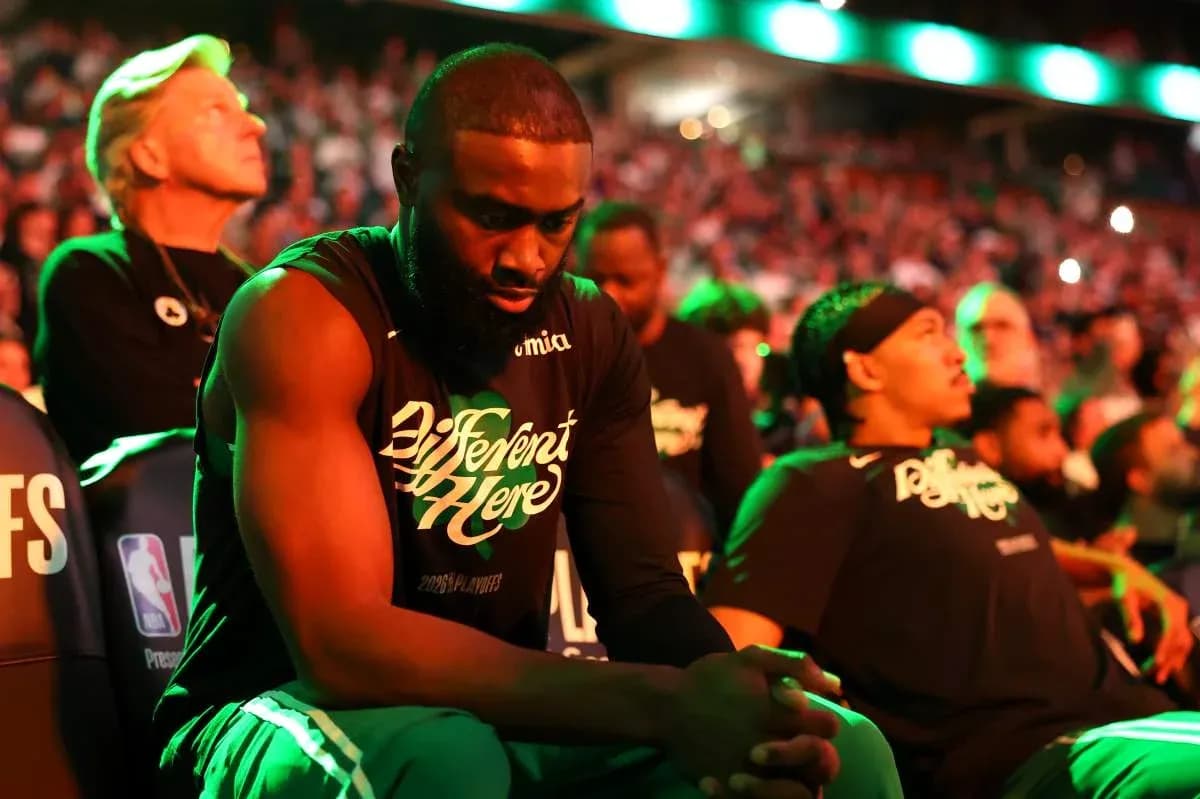
Jaylen Brown came back to Boston on Sunday without the green, but not without the weight of what he meant to the city.
No parquet, no banners overhead, no roaring TD Garden. Just an open park, a summer sky over Boston Common, and a crowd that turned a block party into something closer to a goodbye ceremony.
A Trophy in the Crowd, a Lump in the Throat
This was Brown’s idea: “741 Frequency Fest: A Love Letter to Boston Block Party,” a free, all-ages event tucked near the Charles Street entrance. On paper, it was part festival, part brand activation—music, carnival games, giveaways, back-to-school drives, merchandise from his 741 line.
In reality, it became a final huddle between a star and a city that grew up together.
At one point, fans hoisted a replica of the Larry O’Brien Trophy above the crowd, a golden reminder of the title Brown helped deliver in 2024. The symbol cut through the noise. This wasn’t just nostalgia. It was acknowledgment.
When Brown finally took the microphone, the five-time All-Star—usually so composed in front of cameras and crowds—paused, searching for words.
“Listen, I’m at a loss for words,” he told them. “When I got to the city, I said I’m going to go to war for this city.”
The voice cracked a little. The message didn’t.
He thanked the people who had backed his community work, who had pushed him, who had stayed with him through the slumps, the criticism, the near-misses. Then he aimed his final words squarely at the place he had called home for a decade.
“I just want to say thank you to Boston,” Brown said. “Thank you to the city.”
A Goodbye on His Terms
The festival ran for five hours, but the moment that defined it lasted only a few. Brown looked out over the crowd and saw faces that had been with him since he was a 19-year-old draft pick with questions about his jumper and his handle.
“I’m seeing all these people out here, and honestly, I love each and every one of y’all,” he said. “I appreciate y’all for coming.”
That gratitude landed differently because of how his Celtics story ended.
In July, Boston traded him to the Philadelphia 76ers in a blockbuster deal for Paul George, two first-round picks and two second-rounders. The move split up Brown and Jayson Tatum after nine seasons together and sent a Finals MVP to one of the franchise’s oldest rivals.
The trade blindsided him. At his introductory press conference in Philadelphia, Brown admitted he threw his phone across the room when he got the news. He made it clear: leaving Boston was not his choice. He had spent roughly a third of his life in the city and would have preferred to stay a Celtic.
Sunday gave him a chance to separate the organization’s decision from his bond with the people who filled those stands and those streets.
The Celtics front office ended his tenure with a transaction. Brown responded with a block party.
From Question Mark to Champion
The journey that led to this farewell started in 2016, when the Celtics used the No. 3 pick in the draft on a teenager out of California and Berkeley who many wondered could shoot well enough, dribble well enough, think the game fast enough to anchor a contender.
Ten seasons later, he walked away as an NBA champion, a Finals MVP and a five-time All-Star.
During Brown’s decade in Boston, no franchise in the league won more combined regular-season and playoff games. He helped drive seven trips to the Eastern Conference Finals and two appearances in the NBA Finals.
The peak came in 2024. Brown dominated the Eastern Conference Finals, claimed that series’ MVP, then did it again on the biggest stage, earning NBA Finals MVP as Boston captured its record 18th championship. That run didn’t just validate his talent. It cemented his place in the franchise’s modern history.
Yet his imprint on the city stretched well beyond the 94 feet inside TD Garden.
A Different Kind of Legacy
Brown poured time, money and energy into Boston’s underserved neighborhoods. He launched initiatives aimed at education and economic inequality, and he used his platform to push the city to confront its racial history rather than hide from it.
His Bridge Program connected Black and Latino students with opportunities in science, technology and entrepreneurship—an attempt to widen pipelines that had long been narrow or closed.
That work is why Sunday felt less like a star athlete waving goodbye and more like a community closing a chapter it had written with him. The fans weren’t just celebrating a player who had delivered a title. They were saluting someone who had invested in their kids, their schools, their streets.
No one needed a scoreboard to understand what he meant.
Rival Colors, Same City
Soon enough, Brown will walk back into TD Garden wearing a 76ers uniform. Philadelphia has armed him with LeBron James, Joel Embiid, Tyrese Maxey and VJ Edgecombe—a lineup built to challenge Boston in the East and to test the very team that decided it could move on from its Finals MVP.
That first game back will be thick with tension. Every touch will draw a reaction. Every shot will feel like a referendum on the trade.
Sunday wasn’t about any of that.
There was no hint of bitterness in Brown’s voice, no public second-guessing of how the Celtics handled his exit. Standing in front of the people who had watched him arrive as a teenager and leave as a champion, he chose a different tone.
He chose gratitude. He chose love.
The franchise turned the page with a deal. Brown closed his Boston story by saying goodbye the way he played his best basketball here—on his front foot, unafraid, and very much on his own terms.