
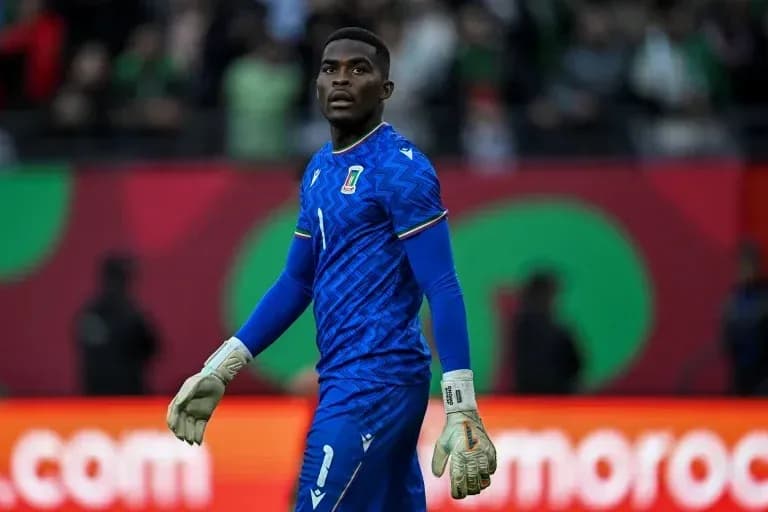
FC Andorra goalkeeper Jesus Owono has been handed a 12‑match suspension by the Spanish football federation’s disciplinary committee after the challenge that led to the death of Tenerife striker Jesus de Miguel.
The ruling, delivered on Friday, follows one of the darkest incidents Spanish football has faced in recent years.
A routine match that turned into tragedy
The incident came on November 2 in a second division game that, until that moment, carried only the usual tension of a league fixture. Midway through play, Owono sprinted out of his area and into midfield to attack an aerial ball. As he launched himself to clear it, he collided violently with De Miguel.
The referee showed a red card. The stadium fell silent.
De Miguel, 30, was rushed to hospital and placed in intensive care. The following day, November 3, the Spanish forward died from his injuries. News of his death rippled through the league and beyond, turning what had been a disciplinary matter into a national shock.
Committee imposes maximum ban
In its written decision, the federation’s committee anchored its judgment in the referee’s report, which described the dismissal in stark terms: Owono was sent off for “violently striking an opponent in the chest with his leg, using excessive force, while the ball was in play”.
From there, the committee drew a straight line to the heaviest sanction available.
“The tragic outcome of the incident, resulting in the death of Jesus de Miguel Alameda, is public knowledge,” the statement read. “In view of the nature of the conduct described and the accompanying circumstances… the maximum sanction, 12 matches of suspension, is justified.”
The punishment underlines how seriously the authorities have treated the challenge, even as they stop short of judging intent. On the legal front, Spanish police sources confirmed last week that an investigation has been opened under judicial supervision to determine precisely what happened and whether any criminal responsibility exists.
“The hardest days of my life”
While the disciplinary and legal machinery moves, the human cost sits heavily on everyone involved, none more so than Owono himself.
The Equatorial Guinea international, who joined Andorra to build a career in European football, has been left devastated. In a statement released by FC Andorra last week, he tried to put his emotions into words and barely could.
“These are the hardest days of my life. I struggle to find the words and it is very difficult for me to process anything that has happened,” he said.
“I feel immense pain over the loss of Jesus. I think of him, of his family, and of all the people who loved him.
“I know there will be many issues to address, and I will face whatever comes with the utmost respect. But right now, honestly, I cannot think about anything other than Jesus and the pain we are going through. Rest in peace, Jesus.”
His coach, Carles Manso, made clear on Thursday that no one at the club will push the goalkeeper back onto the pitch. The decision, Manso stressed, will belong entirely to Owono: if and when he feels able to play again, it will be on his terms.
A club and a game in mourning
On Saturday, Tenerife’s stadium became a place of collective grief rather than competition. Fans and players gathered to say goodbye to De Miguel, turning the arena into a sea of silence and remembrance.
The farewell followed his funeral on Thursday, where around 400 mourners came together. Among them were Spain coach Luis de la Fuente and Real Madrid president Florentino Perez, a measure of the respect De Miguel commanded across the Spanish game.
Their presence did not change the facts, but it underlined them: this was not just a lower‑division tragedy tucked away on a quiet weekend. It was a loss felt at every level of Spanish football.
The 12‑match ban will eventually expire. The legal investigation will eventually close. Careers will resume, seasons will roll on. But for Tenerife, for De Miguel’s family, and for a goalkeeper living through “the hardest days” of his life, the question now is not how football responds in the next fixture, but how it learns to live with a moment that can never be taken back.





