
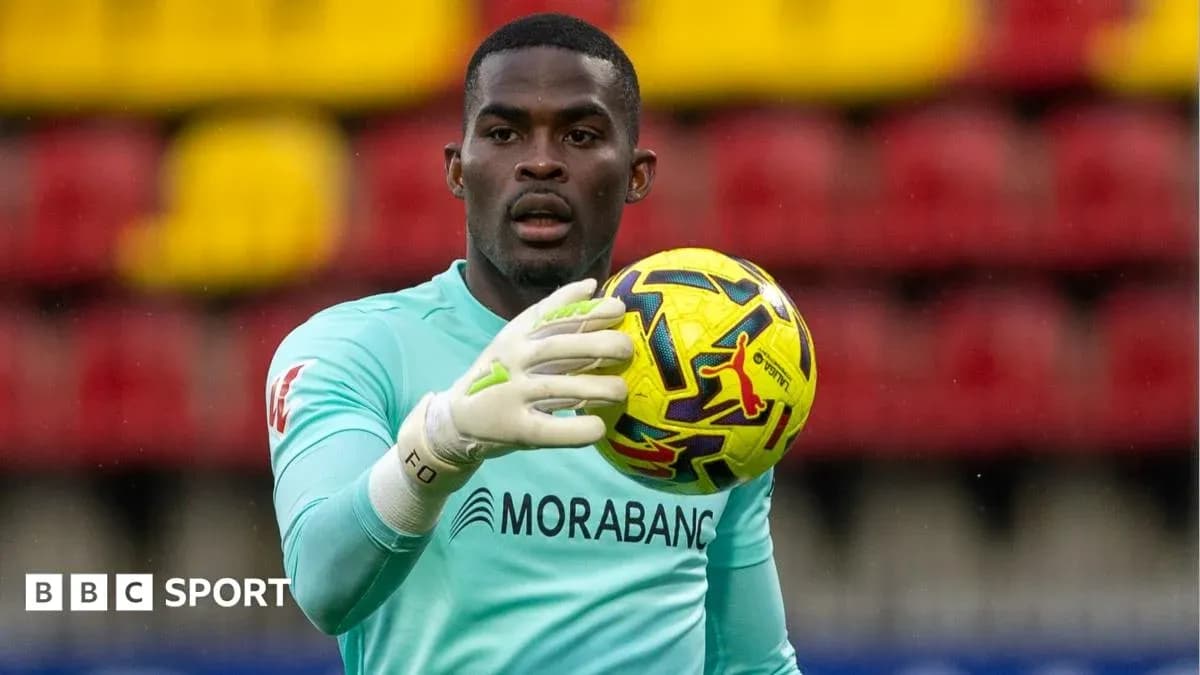
FC Andorra goalkeeper Jesus Owono has been handed a 12‑match suspension by the Spanish football federation’s disciplinary committee after the challenge that led to the death of Tenerife forward Jesus de Miguel.
The incident, which shook Spanish football, came in stoppage time of the Segunda División meeting between the two clubs on 2 November. Owono, 25, was shown a red card after a collision with De Miguel. The Tenerife striker died in hospital the following day, aged 30.
Maximum ban after referee’s report
In its written decision, the disciplinary committee stressed that it was bound by the referee’s account of the incident. The report stated that Owono “was sent off for violently striking an opponent in the chest with his leg, using excessive force, while the ball was in play”.
With that as its framework, the committee applied the harshest punishment available.
“The tragic outcome of the incident, resulting in the death of Jesus de Miguel Alameda, is public knowledge,” the ruling noted. It went on to say that “the nature of the conduct described and the accompanying circumstances” meant “the maximum sanction, a 12‑match suspension, is justified”.
There was no attempt to reinterpret the events beyond the wording of the match official. The federation instead anchored its decision in the letter of the report and the gravity of what followed.
Match will not be replayed
The federation also moved to close the competitive chapter of a game that no one involved is likely to forget.
The match in Andorra had been abandoned seven minutes into stoppage time, immediately after the collision. The score was 2-2. Rather than order the remaining minutes to be played at a later date, a separate federation committee ruled that the game will not be resumed and that the 2-2 result will stand.
“This avoids having to resume play from the precise moment at which the tragic incident occurred,” the federation said, underlining that the decision was taken as “the most respectful course of action, given the extraordinary and tragic circumstances of this case”.
In sporting terms, it is an unusual move. In human terms, it draws a line under a fixture that turned into a trauma.
Owono faces an uncertain future
While the committees have spoken, the human fallout is still unfolding.
On 4 November, FC Andorra released a statement on Owono’s behalf. In it, the Equatorial Guinea international described living through “the most difficult days” of his life and spoke of the “enormous pain” he feels over De Miguel’s death.
Since then, the goalkeeper has stepped away from the game. On Thursday, FC Andorra manager Carles Manso confirmed that Owono has not yet decided whether he will return to professional football at all.
Manso explained that the 25‑year‑old is currently with his family and under no pressure from the club.
He is, the coach said, “completely free to make any decision” about his future. “What we have to do is support him in every way and be close to him. We will give him space so that he feels completely free to make any decision, whether he wants to return, when, or if he does not want to return. When he feels it is appropriate and when he feels genuinely ready to take a decision like that [he will do so].”
A 12‑match ban is a clear, quantifiable sanction. The real measure of this tragedy, for both families and for everyone who stepped onto the pitch that night, will be felt in decisions and emotions that cannot be timed, appealed, or neatly recorded in any report.





