
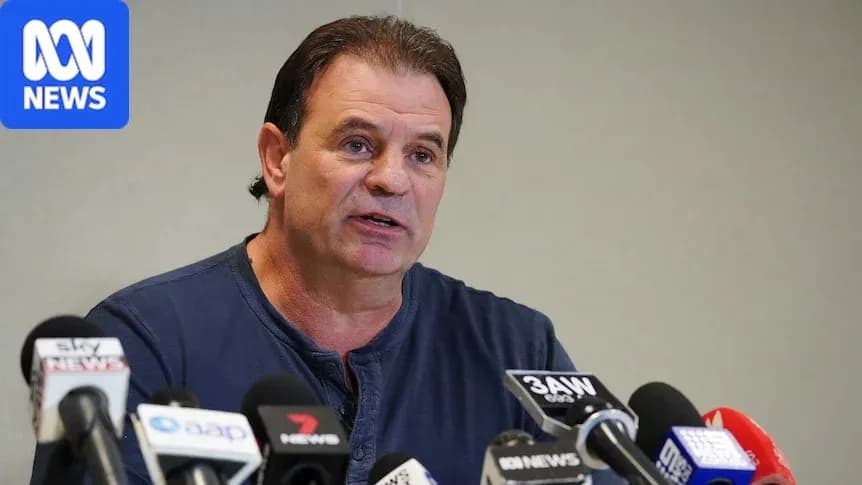
John Setka has never been one to back away from a fight. He’s not backing away now.
The former Victorian secretary of the CFMEU has admitted breaking workplace laws in a bitter, personal push to have AFL umpiring boss Stephen McBurney sacked — but he remains unapologetic, even as the Federal Court weighs a hefty penalty and an even bigger legal bill.
A union strongman in the dock
In a Federal Court hearing on Friday, barristers for both Setka and the CFMEU formally admitted breaches of the Fair Work Act. At the heart of the case: a two-week burst of public threats in mid-2024, when Setka warned the AFL it would pay dearly if it kept McBurney in charge of umpiring.
“This is going to cost the AFL a lot of f**king money. I hope it's worth it,” Setka said at the time.
“Projects without our full co-operation are going to be a f**king misery for them. They will regret the day they ever employed him.”
The Fair Work Ombudsman alleges those demands were unlawful because they targeted McBurney over his previous, lawful work as Australian Building and Construction Commissioner, a role in which he took part in more than 50 court cases against the CFMEU between 2018 and 2023.
The AFL stood by McBurney, a four-time grand final umpire who remains the league’s head of officiating.
Now, the court will decide what that defiance costs.
Setka faces a maximum fine of $18,730. The CFMEU, now under administration and desperate to present itself as a reformed outfit, could be hit with penalties of up to $93,900.
The financial sting for Setka could run much deeper. The union has refused to indemnify his legal costs, leaving the once-dominant powerbroker to fight on his own dime.
He did not appear in court on Friday.
‘Not a severe penalty’
Setka’s barrister, Margo Harris, urged Justice John Snaden not to impose a heavy sanction, painting a picture of a man whose days of wielding industrial power are over.
She told the court Setka is retired, going through a divorce, and spending most of his time caring for his elderly mother.
Harris pushed back at the idea of a calculated, orchestrated vendetta, even as the court heard he gave multiple interviews and posted on social media.
She argued there was no evidence he “actively sought” media attention, despite his comments appearing across newspapers, radio and television.
She also insisted he did not “deliberately” wage a media campaign against McBurney, prompting a pointed exchange with the judge.
“When I say deliberate, there's a range of deliberateness. It's not a question of being pregnant or not pregnant,” she said.
“It comes in the stream of the interview. There's a question asked of him, he answers it.”
The implication was clear: this was Setka being Setka — blunt, combative, reactive — rather than a man carefully choreographing a public crusade.
‘There can be no question’
The Fair Work Ombudsman wasn’t buying that.
FWO barrister Marc Felman told the court the conduct was “very, very serious” and squarely aimed at punishing McBurney for doing his previous job as the nation’s construction watchdog.
“There can be no question that this is a media campaign,” Felman said.
Setka’s comments went well beyond industrial rhetoric. At one press conference, he labelled McBurney “a zealot” who “hates unions” and “hates workers in general.”
On social media, he posted a mock “(Not) Wanted Dead or Alive” poster featuring McBurney’s image — a pointed, personal attack on a figure who had spent years hauling the union into court.
Calling for an AFL official to be sacked is not, in itself, illegal. The line was crossed, Felman argued, because the demand was tied directly to McBurney’s lawful conduct as ABCC commissioner.
That connection turns a public spray into a breach of the Fair Work Act.
A union trying to shed its skin
While Setka stands alone on costs, his old union is fighting for something different: a clean break from the culture that defined his era.
The CFMEU has been taken over by administrators, with hundreds of officials from Setka’s time either removed or having walked away. The new leadership is desperate to convince the court — and the public — that the days of treating fines as a routine expense are over.
Barrister Andrew White, representing the CFMEU, pressed that point hard.
He urged Justice Snaden to moderate any penalty on the union, arguing that “a new culture of lawful but robust unionism is taking hold” and that law-breaking is no longer seen as “the cost of doing business.”
The timing adds another layer of tension. The case lands just three days before Victoria’s Royal Commission into the state government’s “Big Build” projects begins public hearings, a process already shadowed by allegations of corruption and criminal infiltration in the construction sector.
Setka, who left the CFMEU weeks after his verbal assault on McBurney, is also facing separate criminal charges over alleged harassment of the union’s administrators. Those proceedings sit in the background, adding to the sense of a movement trying to tear itself away from its most controversial figure.
Waiting for judgment
For now, there is no final number, no final line under the saga.
Justice Snaden will set penalties for both Setka and the CFMEU at a later date, a decision that will signal how harshly the courts intend to treat personal, public campaigns against regulators who move into other roles.
Setka has built a career on confrontation, on pushing the limits of the law and, at times, stepping over them. The question now is not whether he crossed the line — he has admitted as much — but how high the price will be for a man who once treated fines as collateral damage and for a union that insists it no longer can.





