
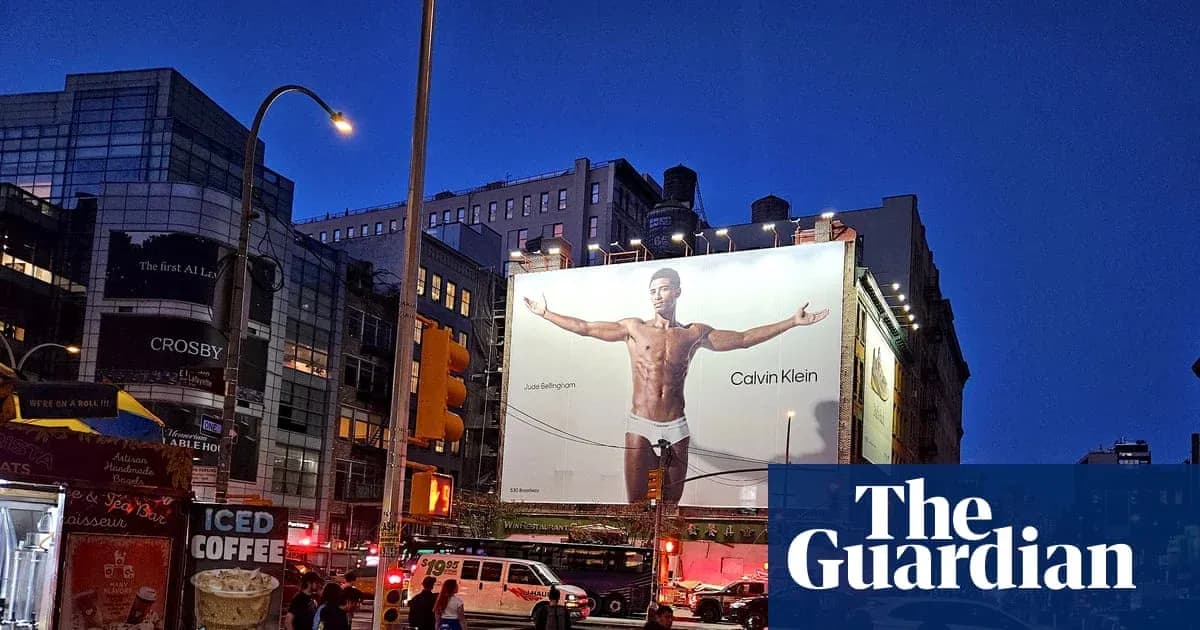
On Sunday, Jude Bellingham will walk out in England white to face Spain. Yet his week has been defined as much by billboards and glossy covers as by tactics and team sheets.
The 23-year-old is now the face – and torso – of Calvin Klein’s latest underwear campaign and the first footballer to appear solo on the cover of British Vogue. For a player already carrying a nation’s hopes, it is a striking expansion of his reach. This is not just a midfielder in form. This is a modern football corporation being built in real time.
From pitch to billboard
The Calvin Klein images have been impossible to ignore. Bellingham, stripped to his underwear, sometimes holding that familiar Christ the Redeemer pose, looms over London streets and New York corners. In Soho, people stop, stare, and pose for selfies beneath him. A World Cup summer turned him into a global football star; a Manhattan billboard confirms he is now a recognisable celebrity in the United States, too.
The numbers back it up. Fashion data firm Launchmetrics reported that within 48 hours the Calvin Klein campaign generated $35.8m (£27m) in media impact value – a calculation of what all that social-media noise is worth in hard cash. Lyst, the fashion platform, says searches for Calvin Klein underwear have jumped 25% since the images dropped. The shots did their job.
Yet the foundation of this frenzy still lies 90 minutes at a time on grass. Public relations consultant Mark Borkowski is clear about the hierarchy. “Bellingham is an exceptional sporting talent, and his brand value is understandably enormous,” he says. “But fashion doesn’t create that value, football does. Fashion merely provides another means of exploiting it.”
The point is sharp. The myth starts in midfield.
The Beckham blueprint – with a twist
The roadmap is familiar. David Beckham drew it two decades ago and has been living off its dividends ever since. Since retiring in 2013, Beckham has evolved into a brand and personality that dwarfs his playing days, part of a power couple with Victoria that reached billionaire status this year.
Bellingham’s trajectory feels like a new chapter of that playbook. His partnerships are already stacked at the top end of the market: Adidas, Skims – Kim Kardashian’s underwear brand – Louis Vuitton, and now Calvin Klein. Each move is deliberate, each logo carefully chosen.
Daniel-Yaw Miller, writing in his SportsVerse newsletter, has already made the comparison. “It’s very intentional,” he says. “What [Bellingham is] doing is aimed at the higher tier of the market but at the same time, a big part of his personality is very relatable.” That balance – luxury brand ambassador with a down-to-earth public persona – is what every modern superstar chases. Bellingham seems to have found it early.
Behind him is a tight inner circle. His mother, Denise, a former HR executive, serves as his personal manager. The family is not just protecting his interests; it is actively shaping the Bellingham brand. With his 21-year-old brother, Jobe, earning a first England call-up this month, the question is already being asked: is this about to become a family empire? A second Bellingham fronting campaigns would only deepen the commercial footprint.
Heart-throb in high definition
There is another layer to his marketability: he is a heart-throb, too. The kind of looks that, in another life, might have landed him in a boyband rather than a Champions League midfield. Vogue leant into that, issuing a pull-out poster with his cover. Miller is blunt: “It helps that he’s incredibly good-looking.”
He is not alone in this space. A new generation of male footballers is embracing fashion as part of their professional identity. Bukayo Saka and Son Heung-min fronted Burberry’s autumn campaign. Kylian Mbappé has worked with Christian Dior. Declan Rice appears on the cover of GQ this month. The old divide between footballer and fashion model has dissolved; the modern elite expects to be both.
Miller frames it as long-term planning. “The earnings that they can get during their football career are obviously huge,” he says. “But what sets them up for life beyond that is being brands and businesses in their own right. It’s not only just a money thing. It’s about cementing a legacy and securing their profile in the game long term, commercially and culturally.” Careers end. Relevance, if managed correctly, does not have to.
Style, substance – and the limits of the model
Not everyone is dazzled by the Bellingham billboard era. Felicia Pennant, editor of football-and-fashion magazine Season, sees a clear difference between his path and Beckham’s early experiments.
Beckham, she argues, pushed harder. He appeared in boundary-pushing shoots for The Face in 2001, covered in fake blood, and in art pieces by Sam Taylor-Johnson. “Beckham was the subject of art and he was the art rather than selling the art,” she says. In contrast, Pennant views Bellingham’s work as safer. “I think what Jude’s doing feels quite transactional … there’s nothing that directional about anything he’s done so far.”
It is a pointed critique. Beckham’s image-making flirted with provocation and subculture; Bellingham’s so far sits squarely in premium mainstream. High-end, high-visibility, but not necessarily high-risk.
Borkowski, too, sounds a warning note. Fame, he says, can quickly become a trap. “Fame surrounds exceptional young athletes with people whose livelihoods depend on telling them how wonderful they are. That can become a very dangerous echo chamber,” he says. “The football makes the myth. The business can preserve it. But hubris can destroy both.”
That is the tightrope in front of Bellingham now. On Sunday, he will be judged, as ever, on his touch, his timing, his decisions under pressure against Spain. Off the pitch, the images, the campaigns and the covers will keep coming. The question is whether he can keep the core of it – the football – sharp enough to justify the rest, and avoid becoming just another billboard that burned too bright, too soon.





