
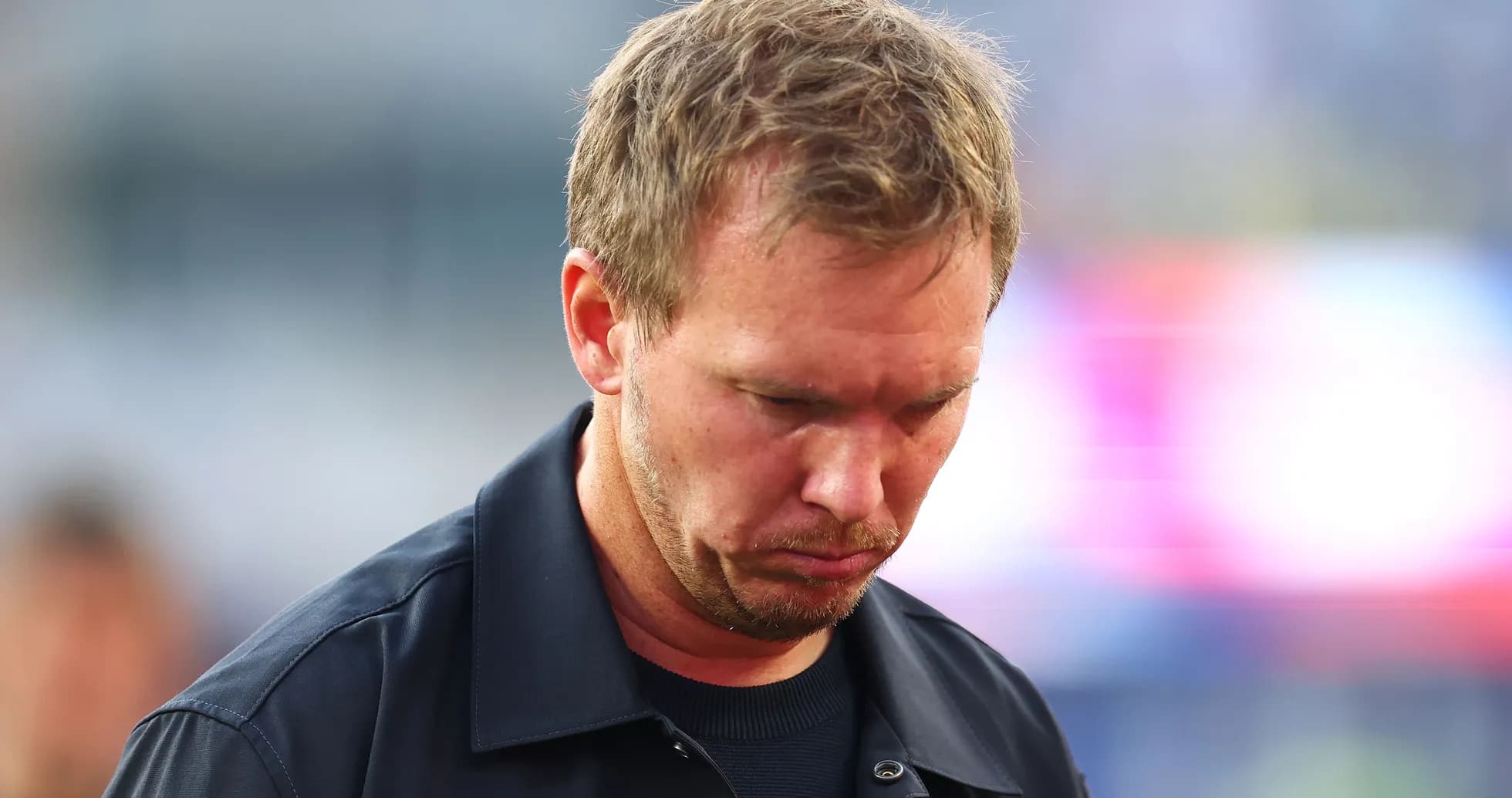
Julian Nagelsmann’s Bayern exit still rankles in Munich, and not just with the man himself.
More than a year on from that abrupt spring dismissal in 2023, one of the people who worked closest to him at Säbener Straße has broken ranks. Dr Maximilian Pelka, Bayern’s team psychologist between 2021 and 2023, has condemned the way the club hierarchy handled the departure of the then-35-year-old coach.
A sacking on the slopes
Nagelsmann’s end at Bayern has been told often enough: a 2-1 Bundesliga defeat to Bayer 04 Leverkusen, a title race slipping behind Borussia Dortmund, and then the shock announcement while the coach was on a short skiing holiday during the international break.
The detail that still stings those around him is how that holiday was framed.
Bayern had approved the trip. Nagelsmann, after reporting to his office on Säbener Straße as usual on the Monday after the Leverkusen loss and continuing his work, took a few days off once most of his squad had departed for national team duty. Then the axe fell.
Club patriarch Uli Hoeneß later pointed to that spontaneous break as one of the decisive factors in the decision to remove him. The implication: in a crisis, the coach had chosen the slopes over the training ground.
Pelka rejects that narrative outright.
“Exactly the right thing to do”
Speaking to kicker, the psychologist painted a very different picture of the context in which Bayern pulled the trigger.
“Perhaps we need to explain again what situation the club was in at the time,” he said. “The team were in the quarter-finals of the DFB Cup and had just knocked PSG, with Messi, Neymar and Mbappe, out of the Champions League. But Bayern were second behind Dortmund in the league. That brings us to the pressure of expectations. Everyone always wants more, more, more.”
For Pelka, the idea that a brief pause amounted to negligence simply does not hold up.
“He is an adult. I don't need to recommend anything to him. But these international breaks give coaches a chance to step off the treadmill for a while. So it was not right to suggest that he had failed to deal with the crisis properly,” he argued.
Pelka accepted that the sporting situation was tense. Bayern were not cruising to the title, and the margin for error at the German record champions is famously thin. Yet he insists Nagelsmann’s decision to get away for a few days was not a dereliction of duty, but a rational response to the relentless pressure.
“Taking three or four days away from the madness to clear his head. With all the national team players away anyway, that was exactly the right thing to do,” Pelka said.
Recharge or grind yourself down?
Inside elite clubs, optics often beat logic. Fans and bosses want to see the coach at the training ground, in meetings, on the phone, always working. The image of a coach on holiday in the middle of a wobble is an easy target.
Pelka challenged that reflex.
“In my view, the Bayern coach had wanted to prepare for the weeks ahead,” he explained. “Of course everyone wants to see you keep working during a difficult period. But does that make sense in the end? Or does it make more sense to recharge so you can be fully there again over the following weeks and months? As far as I know, the trip had also been agreed.”
The subtext is hard to miss: Bayern, in his eyes, not only changed coach in a moment of sporting stress, they also helped create a narrative that Nagelsmann had somehow misread the gravity of the situation.
For a psychologist who lived inside that dressing room, that cuts deep. The dismissal was one thing. The story built around it was another.
From Bayern bench to Germany – and another hard stop
Nagelsmann did not stay unemployed for long. In September 2023, the DFB turned to him as Germany coach, handing him the task of restoring a national team that had lost its edge and its aura.
He remained in the job for almost three years. The project ended abruptly after a disappointing 2026 World Cup campaign, another high-profile tenure cut short. Jürgen Klopp stepped in to replace him, a seismic appointment that immediately shifted the spotlight.
Nagelsmann, once Bayern’s great long-term bet and then Germany’s next big hope, now finds himself without a club.
The questions Pelka raises linger in the background. In a game that demands “more, more, more,” how long can any coach last if even a sanctioned three-day escape in an international break is held against him?





