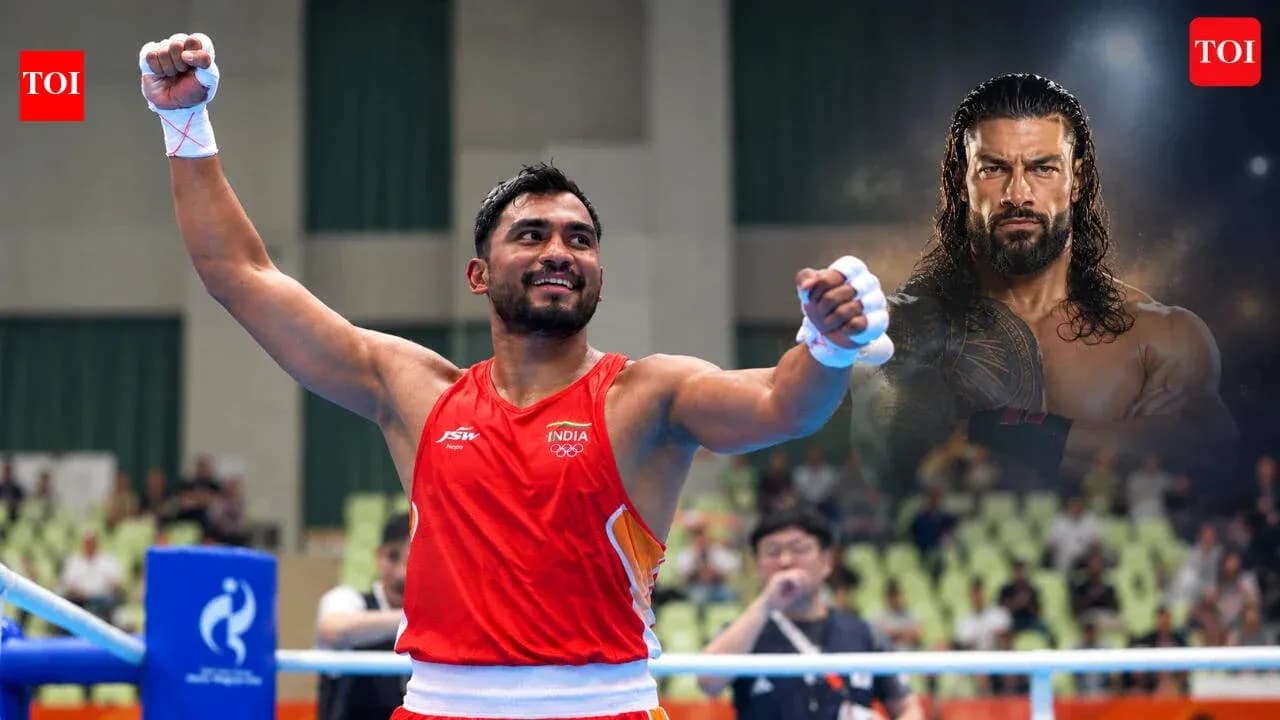
The cotton mattresses never stood a chance. Nor did the pillows, the walls, or the homemade punching bag stuffed with mountain soil.
In Chakarpur village, Khatima, long before he wore Indian Army fatigues or climbed an Asian Games podium, Kapil Pokhariya was just the boy who tried to turn his house into a WWE ring. Roman Reigns ruled his television screen and, soon enough, his life.
He would skip meals, ignore playtime, ditch outings. If WWE was on, Kapil was in front of the TV. When the show ended, the real spectacle began. He’d rewind the recordings, study the moves, then launch himself into his own version of WrestleMania in the living room.
“I never knew that copying Roman Reigns and practising those punches would bring me this far,” Kapil told TimesofIndia.com. He still has those recordings saved. “Honestly, I started learning how to throw punches by copying Roman Reigns,” he said, laughing. WrestleMania and Money in the Bank were his favourites.
The boy imitating a pro-wrestler is now a man with a bronze medal from the men’s 90kg boxing event at the 2026 Asian Games in Aichi-Nagoya, Japan. An Indian Army havaldar. A continental medallist. And suddenly, that childhood obsession looks less like mischief and more like destiny.
From Chakarpur to the Ring
Boxing was never in the family blueprint.
Kapil’s father, Narendra Singh Pokhariya, served in the Indian Army. He wanted his son to study hard, clear the exams, and join the forces as a commissioned officer. A respectable path, a clear ladder. Gloves and gumshields did not feature in that dream.
What did feature, almost daily, was his son flying off furniture, smashing into cushions and mimicking WWE stars. At first, Narendra reacted like most fathers would. He scolded him. He even beat him at times for breaking things around the house. The wrestling craze felt like a nuisance.
Then came the sack of sand.
One day, after school, Kapil dragged a thick sack home and quietly filled it with sand. He hung it up and began punching it with everything he had. No cameras. No crowd. Just a boy and a bag.
“A teacher used to teach boxing at a nearby school. I saw the students punching a bag and decided to make one myself,” Kapil recalled. “My father scolded me in the beginning, but later he took me to a training centre and got me admitted there. That is how I got into boxing.”
That decision changed everything.
A Small Ground, a Big Lesson
There was no fancy academy waiting for him. No sprawling complex with a line of national champions.
Kapil started out on a small training ground, sharing space with boys his age and others older, all trying to learn the basics. After a few months, he came under the guidance of coach Pooran Bohra.
“I come from a small village where boxing was never a popular sport,” Kapil said. “Pooran Bohra sir was there. He trained a small group of boys for just a few hours on selected days of the week. But I was interested in learning. I listened to him carefully and repeated everything he taught me when I returned home.”
The hunger was there. The technique slowly followed.
By 2015, Kapil was ready for his first state-level competition. New gloves, new arena, new nerves. The crowd felt huge. The occasion, even bigger. And it swallowed him.
He lost in the first round of his first-ever bout.
“I was really disappointed,” he admitted. “It was the first bout of my life, and I was seeing such a large crowd for the first time. I lost in the first round. But that competition and the defeat taught me a lot. My interest in boxing grew even stronger after that.”
Most careers stall at that point. His didn’t. The loss sharpened him.
Gold, a Job, and a Father’s Hug
The next time he stepped onto a big stage, it was at a national-level competition. The nerves were still there, but the boy from Chakarpur had changed. This time, he didn’t just win a bout. He won the gold medal.
The medal brought prize money. The prize money brought attention. The performance brought a job.
In April 2017, Kapil joined the Indian Army and was appointed as a havaldar. For his boxing career, it was a leap.
The Army gave him structure, facilities, and a clear pathway to compete at a higher level. Services competitions, regular training, better sparring — all of it combined to turn raw power into polished craft. The medals kept coming.
At home, his father watched the transformation with quiet pride.
“My father wanted me to study and join the Army as a commissioned officer. He joined as a sepoy and retired as a havaldar. But he wanted me to reach a higher rank if I joined the Indian Army,” Kapil said.
The turning point wasn’t an international medal. It was a national one.
“The day I won a national medal, he hugged me. That was when I realised that I had achieved something big in my life,” Kapil said.
Now, with an Asian Games bronze, the promotion follows. He is set to become a naib subedar.
“Papa said, ‘Ab tu mera senior ho gaya hai’,” Kapil recalled with a smile. The son who once got scolded for punching pillows is now outranking the father who first wore the uniform.
‘Khatima ka Russell’
Boxing wasn’t his only sporting love.
Like so many Indian kids, Kapil grew up with a cricket bat in hand. He played gully cricket, then inter-village matches across Uttarakhand. And with his height, muscular frame, and sheer hitting power, he didn’t stay anonymous for long.
He became the man you wanted in your team when the run rate spiked and the boundary ropes suddenly felt too close.
“I loved Andre Russell. I also liked Hardik Pandya,” he said. The comparison soon followed. “People used to call me ‘Khatima ka Russell’ because of my power. The boys wanted me in their team because I could hit big sixes.”
The nickname stuck. The sixes flew. But the gloves, not the bat, would define his future.
Bronze in Aichi-Nagoya, Eyes on LA
In Aichi-Nagoya, Japan, the boy who once shadowboxed to Roman Reigns’ entrance music stepped into the Asian Games ring as India’s 90kg hope. He fought his way to the podium and came home with bronze — his first major international medal, his biggest stage yet.
For Kapil, though, the medal is not a destination. It’s a checkpoint.
Under the Boxing Federation of India’s selection criteria, Asian Games medallists will be the main entries in their respective weight categories for the 2027 World Boxing Championships in Astana, Kazakhstan. Scheduled for April, that tournament will double as the first qualifying event for the Los Angeles 2028 Olympic Games.
The stakes could not be higher. He knows it.
“Rukna nahi hai ab, bas aage dekhna hai,” he said. No stopping now, only forward.
“The Olympics is the ultimate dream. I want to go there, represent my country and win a medal. That is the only thing on my mind right now. I am preparing for the World Championships in April,” he added.
From cotton-filled mattresses in Chakarpur to the World Championships in Astana and a shot at LA 2028 — the path is brutally hard, the margins unforgiving. But Kapil Pokhariya has already turned a childhood obsession into a continental medal.
The next question is no longer whether he belongs at this level. It’s whether the boy who copied Roman Reigns can now punch his way into Olympic history.