On a summer night in Chicago in 2007, a group of Britain’s brightest young male fighters leaned over the rail of the ring, eyes fixed on a whirlwind in Irish green. Frankie Gavin, Billy Joe Saunders, Luke Campbell, James DeGale – all of them stopped talking.
“Oh my goodness, who’s this?” one of them asked.
Eric Donovan smiled.
“That’s my sparring partner,” he said.
In that moment, before Olympic gold, before world titles as a professional, before Croke Park and farewell talk, Katie Taylor was already something else entirely – a phenomenon hiding in plain sight.
“She’s a girl, but she is a champion”
Donovan, a former EBU super featherweight champion, grew up in the same Irish system that shaped Taylor. Same era. Same weight. Same unforgiving gyms.
He remembers the early spars vividly. A teenage girl dropped into a world of boys who didn’t quite know what to do with her.
“I used to take it easy,” he recalls. She was a girl. That was his logic. His coach, Zaur Antia, tore it apart.
“Eric, that’s very bad sparring. Very, very bad. Not good,” Antia told him, furious. Donovan tried to defend himself – “I’m sparring Katie Taylor. I’m sparring a girl.” The response was instant and sharp.
“She’s a girl but she is a champion! She wants to be Olympic champion. You have to be serious about this!”
Perspective shifted. Permanently.
From then on, Donovan went full tilt. No soft touches. No condescension. The spars with Taylor became high-speed, technical, intense. Fierce, but never dirty. She gave as good as she got, even when, in those very early days, she still absorbed more than she landed.
She never flinched.
She was just “one of the lads”, as Donovan puts it – not because she had to be, but because she insisted on being treated as an equal. In a gym full of young men, she never looked vulnerable, never looked out of place.
Those sessions weren’t easy. Paddy Barnes, conceding plenty of weight, had “great, great battles” with her. Taylor, still a teenager, kept coming back. That stubborn refusal to yield would end up changing more than just her own career.
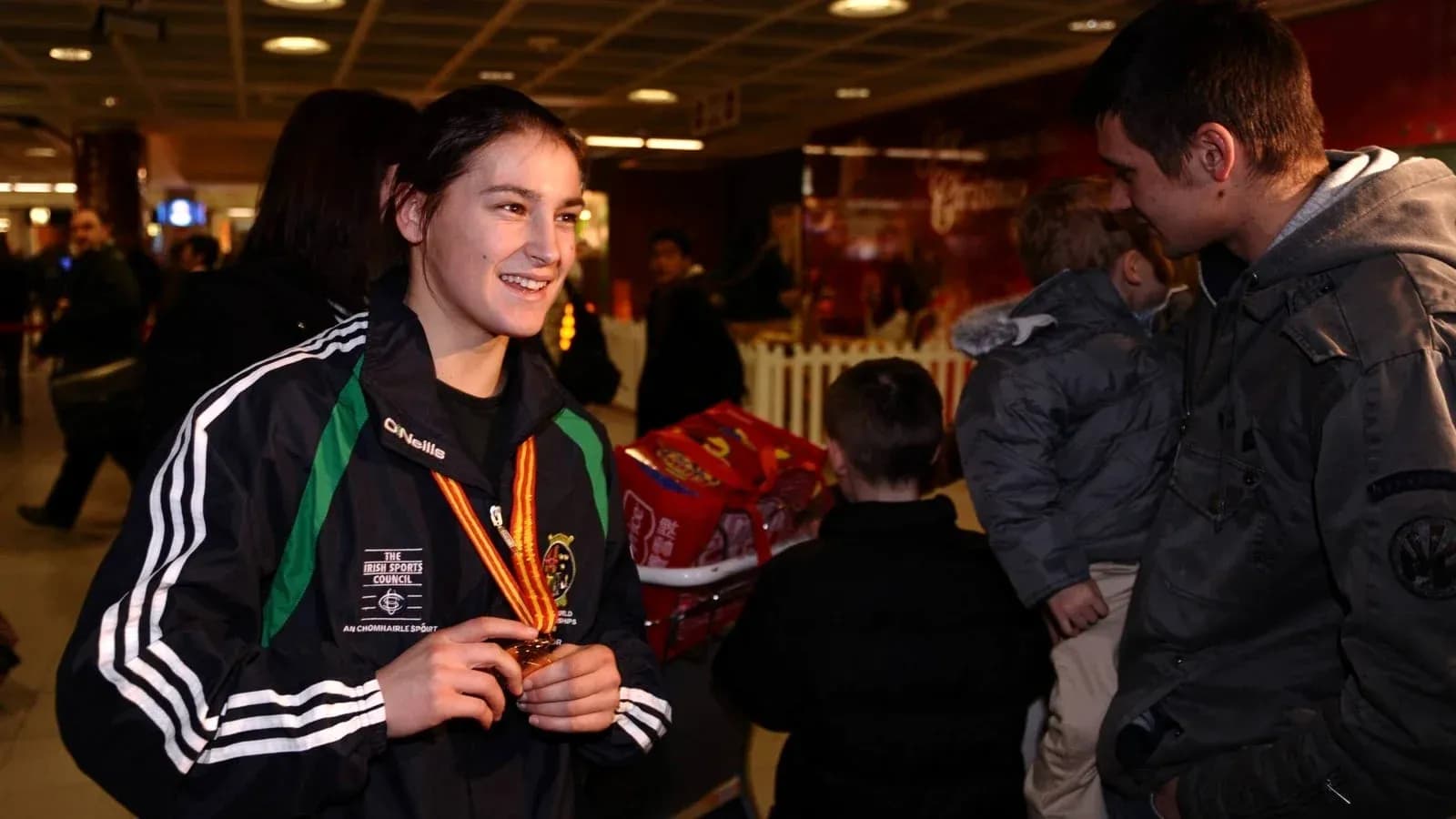
She was still only 18 when she won her first world title in 2005. By Beijing 2008, women’s boxing was still locked out of the Olympics. Donovan remembers how it broke her heart.
Two years later in Chicago, at the men’s world championships – which doubled as qualifiers for Beijing – she was invited to box an exhibition on the final night. In the dressing room, officials told her what was at stake: she was going out to fight for women’s boxing to be included in the London Olympic Games.
That was the burden they placed on her shoulders.
She walked out and delivered a masterclass.
A teenager in Tullamore and a dream that didn’t exist
By the time London 2012 arrived, Taylor had already become a five-time world champion. For a 16-year-old in Tullamore named Gráinne Walsh, that mattered more than she could have imagined.
Walsh wasn’t from a boxing family. She was a “full soccer head”, dreaming of a professional career with a ball at her feet. Boxing was curiosity, nothing more.
Then a new boxing club opened across the road from her house. Katie Taylor came to cut the ribbon.
Taylor had just returned from the World Championships in China, where she’d won her fifth world title. London was only a few months away. Walsh went along, met her, and something shifted.
It was the first summer Walsh wasn’t playing in a soccer league. She wanted something to keep her fit. A normal gym didn’t appeal. The boxing club did. Once she stepped inside, that was it.
“Once you get involved in boxing and it touches your heart, it’s hard to get out of it,” she says now.
She watched Taylor head to London as women’s boxing finally broke into the Olympic programme. A dream that hadn’t even existed when Taylor started suddenly became real.
Walsh still marvels at that. Taylor had chased a vision that wasn’t even on the horizon when she began – an Olympic podium that technically didn’t exist for her gender.
She fought until it did.
Walsh’s admiration quickly turned into obsession. Her coach knew Antia, and she begged him to ask if she could watch Taylor train. She would sit in the corner of the high-performance unit, just watching. Studying.
Four years later, the fan became a teammate.
Walsh started boxing in 2012. By 2016, she was at the World Championships in Kazakhstan, wearing Irish colours. Katie Taylor was in the same tracksuit, on the same plane, sitting beside her.
She was still a super-fan. She just had to hide it a bit better.
London, the Fields of Athenry, and a doctor’s coat
For Marty Morrissey, a man who has lived his life wrapped in the drama of GAA, the night Katie Taylor won Olympic gold in London stands alone.
Not Clare’s hurling miracles. Not anything else. Taylor in the ExCeL Arena.
The place felt less like an Olympic venue and more like a pressure cooker. The Fields of Athenry rolled around the stands, bouncing off the tight walls, turning the arena into a little pocket of Ireland on foreign soil.
Taylor climbed into the ring to fight Sofya Ochigava for gold. It was brutal, tense, and close enough that, when it ended, Taylor looked uncertain. She turned to her father Pete and to Antia, searching their faces for an answer.
They told her she’d done enough. Moments later, the announcement confirmed it. Olympic champion.
The celebration spilled into every corner of the building. Irish fans posed for photos with British army soldiers guarding the exits – a surreal image given the history between the two nations, but that night, nobody cared. They just wanted to mark the moment.
Up in the commentary positions, another little drama played out. Morrissey was on radio duty. Beside him, the late Jimmy Magee called the fight for television. Then Kate Middleton appeared beside them, watching from the commentary gantry. Prince William was somewhere in the arena, but they never saw him.
RTÉ’s bosses were desperate to get Taylor on television with Bill O’Herlihy. There was one problem: nobody could reach her. She wasn’t answering her phone. She had other priorities.
Her father told Morrissey they were doing no media. The night belonged to the Taylors. Private. Untouchable.
Morrissey didn’t give up. A tip from someone in the backroom team led him to the medical centre. Outside, a doctor’s coat and lanyard lay unattended.
He slipped them on and walked straight in.
Members of the Irish team burst out laughing when they saw him. “What the hell are you doing here?” they asked. But the ruse worked. He found Katie and Pete.
Pete said no again. Katie listened, looked at Morrissey, and intervened.
“Dad, I think we should do the interview,” she said.
They agreed. Before she appeared in the RTÉ studio, though, there was another detour. Pete told Morrissey they were due at the “Irish embassy”. RTÉ arranged transport. Half an hour later, Pete rang back, rattled.
The “embassy” turned out to be a pub.
The welcome was enormous, of course, but it wasn’t where they wanted to spend the night. Another car, another journey, and soon Katie and Pete were sitting with O’Herlihy on Irish television, the new Olympic champion speaking to the country she had just lifted.
From a Bray rumour to a global icon
Long before London, in the coastal towns of Bray and Greystones, Katie Taylor was a rumour that grew legs.
Hugh Cahill, now one of RTÉ’s leading commentators, grew up in Greystones. He heard the whispers about a girl from Bray who was “beating up lads in sparring” and more than holding her own. It sounded like local exaggeration. A novelty story.
He knew Pete Taylor first, working the door in Jim Doyle’s, a pub on the seafront that sponsored Greystones Rugby Club. Post-match pints turned into conversations. Curiosity turned into a trip to the gym.
Once Cahill saw her train, the myth became reality. The power, the relentlessness, the skill – it all made sense. The novelty tag disappeared.
By the time he sat in the ExCeL Arena for the Olympic final against Ochigava, he understood what he was witnessing. He ranks that night, alongside Bernard Dunne’s world title win in 2009, as one of the most defining sporting occasions he’s ever attended.
The atmosphere was feral. The arena was tight, almost claustrophobic, like a nightclub with a ring in the middle. Every roar ricocheted off the walls. Almost nobody in there wanted Ochigava to win. A handful of Russians tried to make noise. They were swallowed whole.
Cahill makes another point about Taylor that often gets lost in the avalanche of medals and belts. For all her fame, for all the surveys that show how admired she is, people still don’t really know her.
They know she is devout. They know she is a generational boxer. They might have heard whispers of her quiet charity work. But beyond the ring and her faith, much of Katie Taylor the person remains private, almost deliberately out of reach.
“She was good, she was deadly”
Before the Olympic gold, before the professional belts, before the sold-out arenas, there was a young girl walking into Mount Tallant Boxing Club in Terenure with her father.
Mick Dowling, two-time Olympian and twice a European bronze medallist, remembers her clearly. Pete Taylor was a friend. He brought his daughter to Dowling’s club, looking for the best.
The first impression stuck.
She was relentlessly dedicated. She threw punches in bunches. She wasn’t a one-punch knockout artist, but she was outrageously fit. She fought in perpetual motion – bobbing, weaving, slipping, sliding. Dowling loved that style. All-action. No hiding place.
Her father’s influence, he says, was enormous. Pete’s role in those early years, in shaping her, pushing her, cannot be written out of the story.
Dowling could see it early. The way you can spot a young footballer and know he’ll go far. Taylor had that same obvious, raw promise. She was “good” – and then he pauses on the word that really matters – “she was deadly”.
She could take a shot too. Plenty of fighters can’t. Taylor could. She didn’t go looking for punishment, but she didn’t flinch when it came. She might take a couple, but she always gave back more.
Dowling was travelling constantly with the Irish team then, watching talents rise and fall. With Taylor, there was never much doubt.
He knew he was looking at a future star. She proved him right, and then some.
From the teenage girl being told she was fighting for the future of her entire sport, to the young woman inspiring kids in Tullamore to swap football boots for gloves, to the Olympic champion who needed a fake doctor’s coat to be tracked down for an interview, Katie Taylor’s story has never been just about titles.
It has been about doors forced open, minds changed, lives quietly redirected.
Now, as she prepares to walk out in Croke Park for what feels like the closing chapter of a fairytale career, those who shared the gyms, the planes, the commentary boxes and the pubs along the way know the truth.
They didn’t just witness a great fighter. They watched a sport, and a country, bend around her.