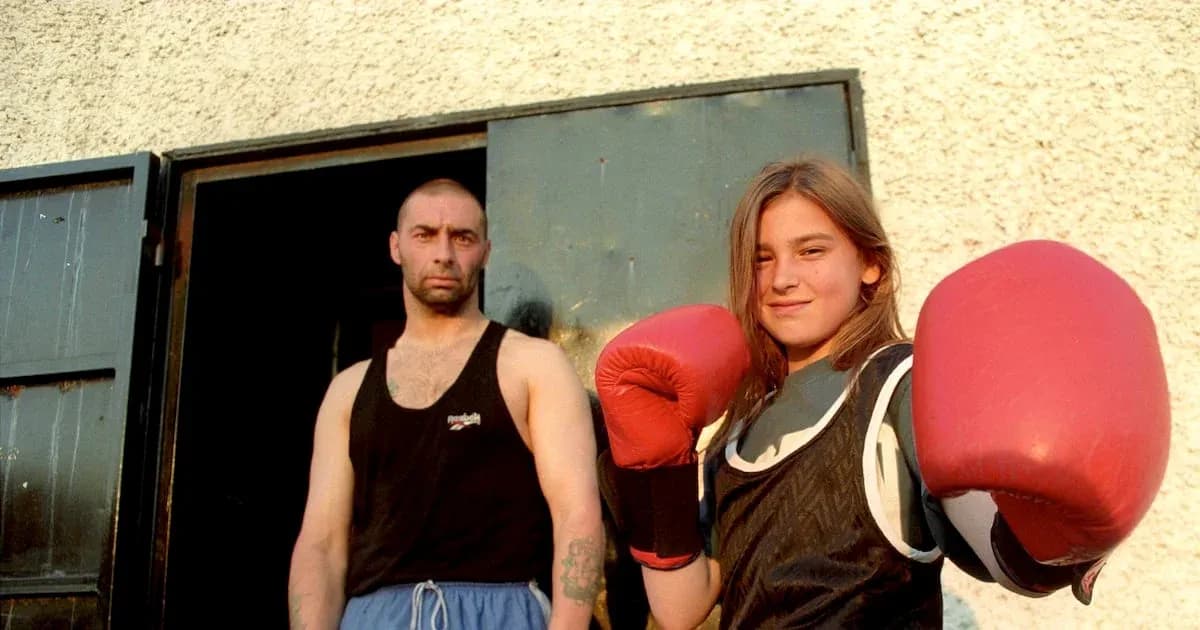
The first time I saw Katie Taylor, she was not a world champion, not an Olympic icon, not a flagbearer for Irish sport. She was a 10-year-old in Bray boxing club, gloves too big for her wrists, eyes already too sharp for her age.
I was on assignment for The Big Issue, the street magazine built on the simple idea of “A hand up, not a hand out”. The job was straightforward: travel to Co Wicklow, photograph a young girl who loved boxing, file the pictures, move on. It sounded like a human-interest footnote, not the prologue to a phenomenon.
Inside the Bray gym, Pete Taylor greeted me with the ease of a man at home in his own four walls. He pointed me towards his daughter. Katie stepped forward, shy in that first instant, then utterly transformed once the gloves were on.
She started on the pads with Pete. No fuss, no theatrics. Just sharp, snapping shots, each punch thudding into his hand pads with a force that didn’t quite match her size. There was a rhythm to it, a tempo she seemed to own. The more she hit, the more the shyness peeled away.
Then came the moment that changed the tone of the entire visit.
Katie moved into a spar with a boy from the club. This wasn’t play anymore. Her expression hardened, her eyes lit up, and the air in the gym seemed to tighten. She didn’t circle cautiously or wait to see what he had. She went after him.
He spent most of the round on the back foot, edging away, trying to keep her off. She hunted him, step by step, punch by punch, cutting down the space, refusing to give him a second to breathe. Every time he thought he had a way out, she was already there, gloves in his face, feet driving forward.
It was relentless. Not reckless, not wild. Relentless.
You could see the instincts that would come to define her career even then: the refusal to yield ground, the hunger to dictate the fight, the complete absence of intimidation. She wasn’t there to take part in a nice story about a girl who liked boxing. She was there to win a round.
When the sparring ended, the gym noise slowly returned to normal. The spell broke a little. Katie smiled again, the child reappearing where the fighter had stood moments earlier.
We stepped outside as the evening began to fade. Bray softened in the low, golden light, the sort of gentle backdrop photographers pray for. Katie posed for a few frames, gloves up, chin set, the sea air just visible in the distance. The town looked calm. She did not.
In those photographs, even at 10, there is something unmistakable in her eyes. A hardness, but not cold. A focus that seems to look straight past the camera, past the street, past the small gym in Co Wicklow, towards something far bigger.
At the time, all I knew was that this young girl hit like she meant it and moved like she had somewhere to go. Years later, when Katie Taylor stood on the Olympic podium with a gold medal around her neck and then climbed through the ropes as a world champion, that day in Bray came sharply back into view.
The signs were there from the start. You just had to be paying attention.