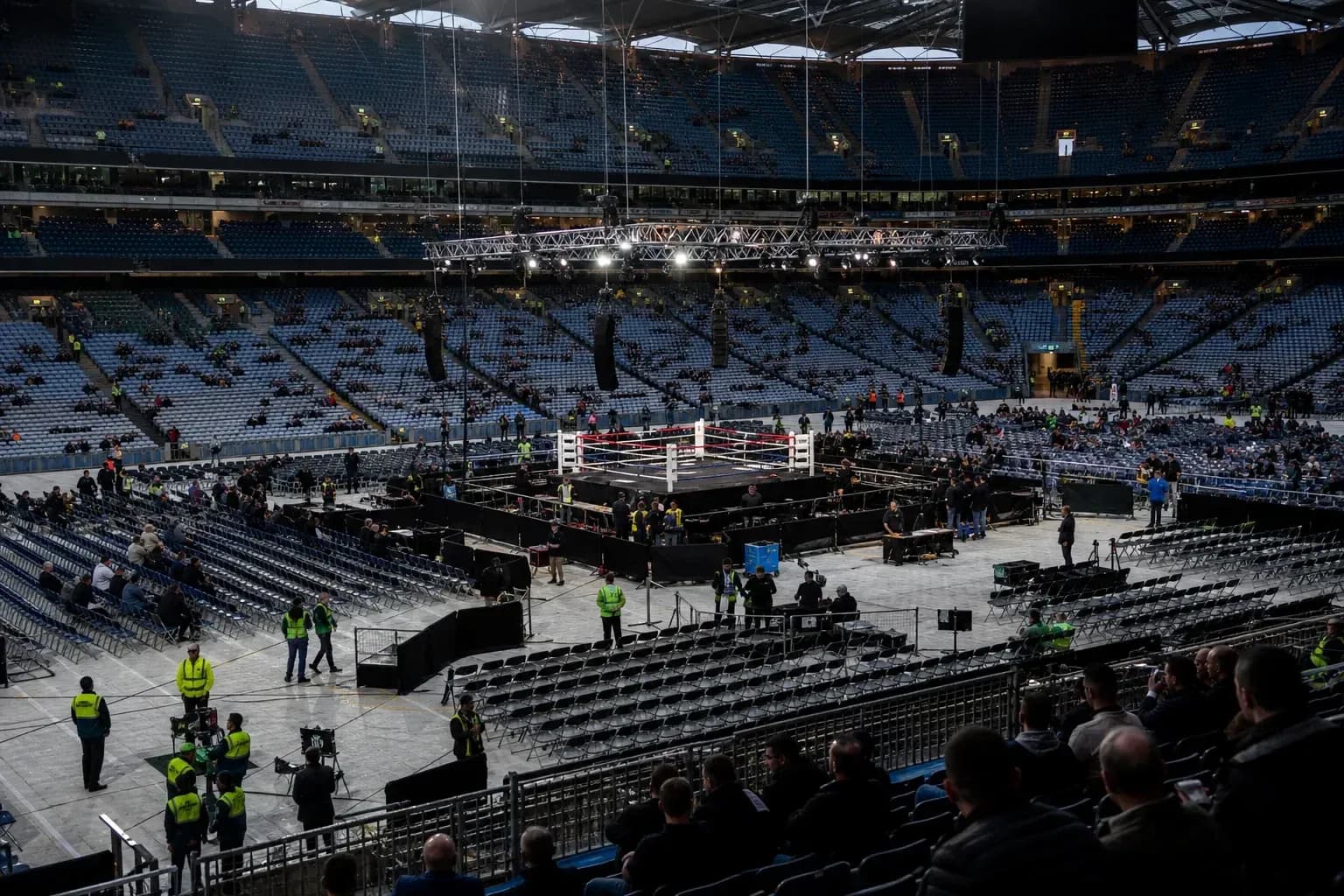
Katie Taylor will step through the ropes for the final time on Saturday, and Ireland is treating it like a state occasion. The 40-year-old Olympic champion and undisputed trailblazer for women’s boxing will close out her career at Croke Park in Dublin, defending her light welterweight titles in front of 80,000 people.
The scale tells its own story. Tickets vanished in 17 minutes when they went on sale in June, snapped up by a public that has followed Taylor from obscure amateur shows to the very top of the sport. National broadcaster RTÉ will screen the event free-to-air, turning the capital into one vast, shared viewing arena. Music acts, including Westlife, are on the bill, but everyone knows who the real headliner is.
This is not just another fight night. It’s a curtain call.
Croke Park Returns to the Fight Game
Croke Park has not staged a major boxing event since 1972, when Muhammad Ali fought Alvin Lewis. For half a century the stadium has belonged to Gaelic games, concerts, and national ceremonies. Taylor’s farewell drags it back into the boxing spotlight for one more epic night.
Her brother-in-law, Trevor McMahon, founder of Liberty Boxing Gym, has called it the end of an era. He’s right. Taylor’s career has run in parallel with the rise of women’s boxing itself, from outlawed sideshow to Olympic and world championship stage. Saturday is a celebration of that journey, but it carries a sting. Once the final bell sounds, one of the sport’s defining figures will be gone from active competition.
The mood around Dublin reflects that mix of pride and impending loss. This isn’t just about a title defence. It’s about saying goodbye.
Bray Dresses for Its Hero
In Bray, County Wicklow, where Taylor grew up, the build-up feels personal. The town has long claimed her as its own; now it is dressing itself accordingly. Shops are selling hats, flags, and posters bearing her image. Windows are turning into shrines. Streets are filling with the green, white, and gold of a country that watched a shy teenager become a global champion.
Local resident Catherine Hill captured the feeling when she spoke about what Taylor means to the next generation. For young girls who want to box, or simply to take sport seriously, Taylor is not an abstract icon. She is proof. A living example that a girl from Bray can walk into the biggest arenas in the world and headline the show.
On Saturday, many of those girls will watch her last fight, some in the stands, many more at home in front of the RTÉ cameras. They will see the end of one story and, perhaps, the start of their own.
From “K Taylor” to Olympic Gold
Taylor’s path to Croke Park began in far less glamorous surroundings. As a child she trained in a modest gym called Tin Can. At the time, women and girls were banned from entering the ring in Ireland and the United Kingdom. The rule did not stop her. It forced her to improvise.
She registered for bouts under the name “K Taylor,” posing as a boy just to be allowed to compete. It was a small act of rebellion that hinted at a much larger fight. Alongside her father Pete, she pushed against the system until the ban on women’s boxing in Ireland was lifted in 2001, when she was only 15.
From that moment, the sport could no longer ignore her. Taylor surged through the amateur ranks, and when women’s boxing finally reached the Olympic programme in London in 2012, she was ready. She took gold, delivering one of Ireland’s defining Olympic moments and putting women’s boxing on a global stage it had long been denied.
Her professional career followed the same pattern: barriers, then breakthroughs. She headlined at Madison Square Garden, the spiritual home of big-time boxing, and engaged in a gripping trilogy with Amanda Serrano that helped cement women’s fights as must-see events, not undercard curiosities.
Every step widened the path for those coming behind her.
One Last Test: Flora Pili
A farewell fight at Croke Park could easily have been a parade. It is not. Across the ring will stand Flora Pili, a 29-year-old French fighter who has quietly built a perfect professional record: 12 wins from 12 bouts and the IBO light welterweight title to her name.
Pili arrives without the fanfare that surrounds Taylor, but she brings something more dangerous than hype: momentum. She is younger, unbeaten, and has nothing to lose in front of a partisan crowd. For her, this is the chance to turn a decorated champion’s farewell into a career-defining upset.
Taylor, as ever, will carry the weight of expectation. The stadium, the television audience, the years of history behind her — all of it presses in. She has spent a lifetime thriving under that pressure, but this time there is no next camp, no next opponent, no chance to correct the record. Whatever happens at Croke Park will sit forever at the end of her story.
The Night the Ring Comes Full Circle
From sneaking into boys’ bouts under a neutral initial to filling Croke Park for a prime-time send-off, Taylor’s journey has stretched the limits of what women’s boxing could be. The ban she helped overturn now feels unthinkable in a world where her fights anchor major broadcasts and sell out stadiums in minutes.
On Saturday, Dublin will watch her walk out one last time, belts on her shoulders, legacy already secure. The result will matter, of course. It always has with Katie Taylor. But as she climbs through the ropes at Croke Park, the question lingering over the stadium will be bigger than a scorecard.
When the final bell rings and the gloves come off, who will take up the space she leaves behind?