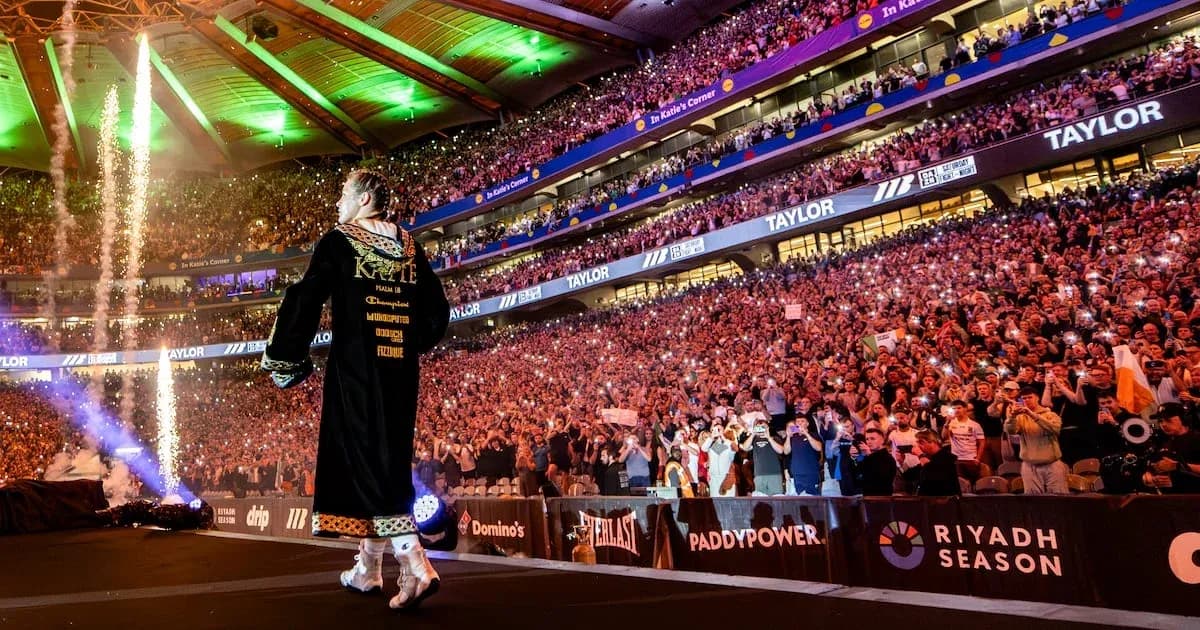
Croke Park has seen some nights. This one belonged to Katie Taylor.
No lawnmower. No gold watch. Just 80,000 people on a soft September evening, standing in a stadium that pulsed more like a pilgrimage than a prizefight. A retirement party, Irish style: tears on tap, anthems with scars, and a fighter who has carried a nation for more than a decade walking out for one last dance.
Natasha Jonas, once an opponent and now an admirer on RTÉ duty beside Bernard Dunne, summed it up simply. “It’s unreal.” She wasn’t talking about the lighting, or the fireworks, or the celebrity video messages. She meant the scale of what Taylor has become.
Jonas told a story from another life, another continent. Trying to qualify for London 2012 “in the middle of nowhere in China,” she heard a roar from some distant corner of the venue. When she went to investigate, she found fans who had travelled from Beijing just to watch Taylor box. “People just follow her wherever she goes,” she said. On Saturday night, they followed her home.
A stage fit for a farewell
Some in Croke Park assumed they were witnessing a record crowd for a fight. The internet, ever the killjoy, pointed instead to Tony Zale v Billy Pryor in Juneau Park, Milwaukee, where 135,132 supposedly turned up in 1941. No Jumbotrons then, of course, so about 134,132 of them presumably never found out who actually won.
No such confusion in Dublin. Croke Park looked magnificent, a cathedral of light and noise. Whoever signed off on the lighting show deserved a bonus. Beams swept across the old stadium, fireworks carved colour into the night, and the soundtrack came straight from the Irish sporting songbook.
Grace. The Fields of Athenry. Zombie. Each one belted out with the full-throated gusto of a nation that insists on marrying its greatest sporting occasions to its saddest songs. Visitors must have been baffled. A woman on the brink of retirement after a glittering career, serenaded by ballads of execution, famine and The Troubles. We do joy differently here.
RTÉ leaned into the emotion. Montage after montage rolled, Bernard Dunne visibly battling to keep his composure. “This is more than just a boxing match,” he told Jacqui Hurley. “It’s a celebration, a thanks for what Katie’s given us over the years.” As My Way thundered around the stadium, you could feel 80,000 throats tighten.
Then came the phones. A galaxy of tiny lights as three quarters of Westlife delivered You Raise Me Up. A stadium full of people, many of whom had grown up with Taylor’s Olympic exploits, now raising her up in return. Moments later, Marty Morrissey and Michael Flatley were dancing to Olé Olé Olé, the whole thing tipping into a delirious, slightly surreal carnival. “It’s like a rave that meets a football occasion,” Hurley said. Hard to argue.
A festival, not just a fight
Ringside, Paul O’Flynn bumped into Shane Lowry and grabbed a few words. On the big screens, tributes rolled in from Bono, Ed Sheeran, Niall Horan and Rory McIlroy – global names saluting a woman from Bray who changed their sport. Just before the national anthem, Barry Keoghan’s voice cut through the noise with a final, cinematic flourish.
“All stories begin at home. The rare ones end there, too. And so, Katie returns for every fan who walked the journey beside her ... for all Ireland. When they ask you about Katie, you can begin with four simple words. Once upon a time.”
If Kleenex weren’t official sponsors, they missed their moment.
Then, finally, the boxing.
Flora Pili walked out first, emerging into a wall of sound and light that would have tested the nerve of any fighter. She took one look around Croke Park and her expression said everything: mon Dieu. To her credit, she stayed. Many would have been tempted to head straight for Rosslare and the first ferry out.
Taylor followed, making her entrance to All Hail King Jesus, a choice that left large pockets of the crowd humming along rather than singing. Fireworks exploded overhead, the stadium roaring her name. She paused, puffed out her cheeks, and drank it all in. Madison Square Garden suddenly felt small. This was bigger. This was home.
“I’m feeling pretty emotional myself here and it hasn’t even started,” admitted commentator Hugh Cahill. Beside him, Eric Donovan could only gasp: “Oh my gosh, this is extraordinary.”
Business, as ever, taken care of
When the bell finally rang, the mood shifted. The festival became a fight.
Pili tried to play her part but rarely troubled the great champion. Taylor, roared on by every punch, dictated the tempo, picked her shots, and kept the crowd exactly where she wanted them: on their feet, bellowing, living every exchange. If Pili had landed anything of note, she’d have had 80,000 people to answer to.
The judges’ unanimous decision came as no surprise. The roar that greeted it felt less like celebration of a single win and more like a collective exhale. One last victory, signed off in the place she had always wanted.
Then came the moment that truly ended it.
After addressing the crowd, Taylor walked back to the centre of the ring and carefully laid her gloves down. No speech could match that gesture. Years of toil, sacrifice and success distilled into two gloves resting on the canvas – on top of Lidl’s logo, as it happened. Somewhere in a marketing department, people were likely as giddy as Nike were when Tiger Woods’ ball paused on the lip of that Masters hole, swoosh perfectly framed. Aldi, you suspect, were less amused.
O’Flynn asked the obvious question. “What now?”
Taylor didn’t hesitate. “I’m just going to enjoy the fruits of my labour,” she said. “I’m going to eat chocolate.”
After all the belts, all the medals, all the nights when she carried Irish boxing on her shoulders, the greatest fighter the country has produced is finally taking a Time Out.
She has earned every bite.