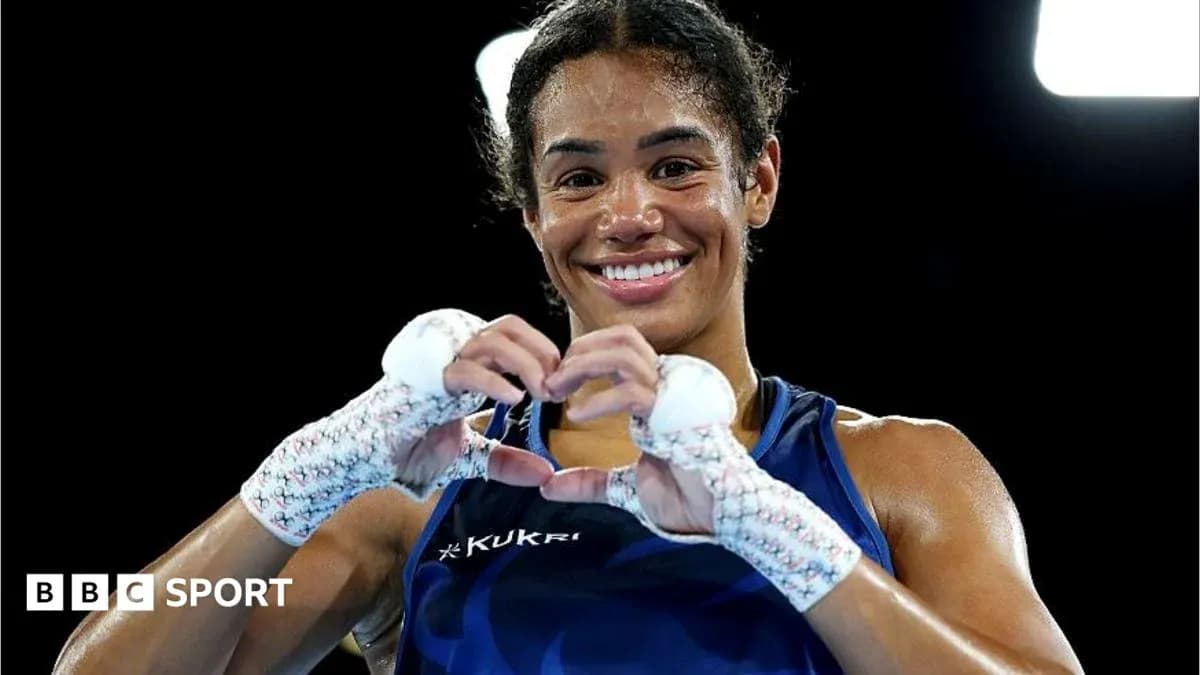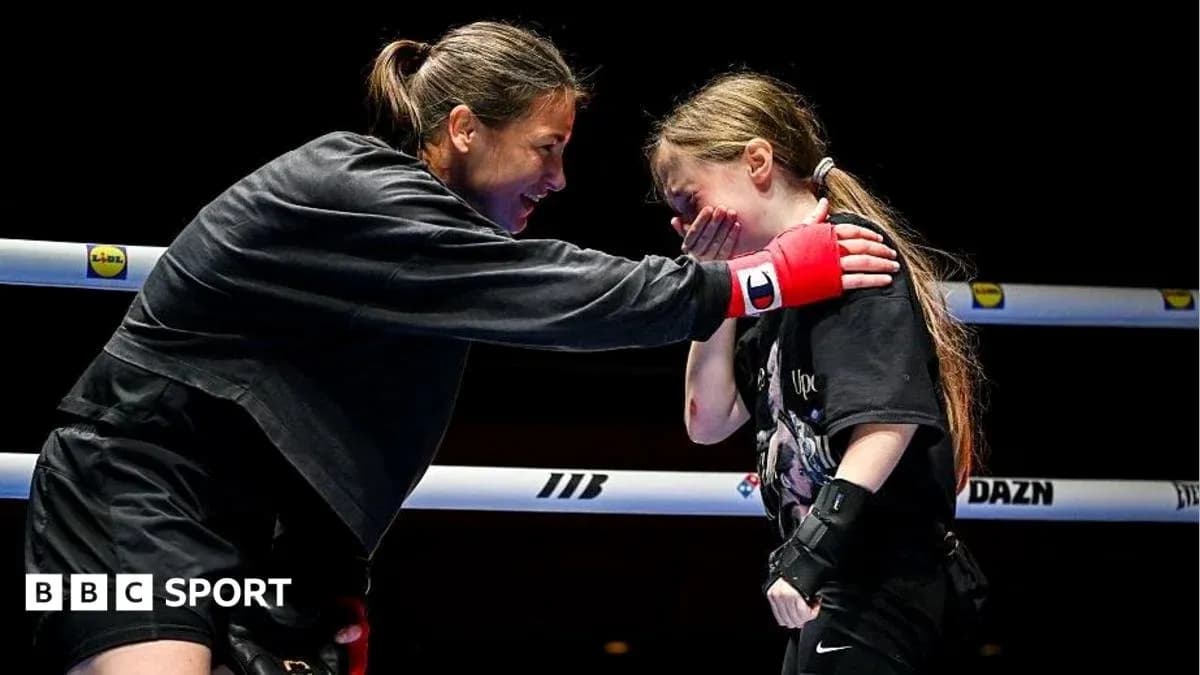
Katie Taylor sits down and smiles, but her eyes tell the truth.
On Saturday at Croke Park, she walks to the ring for the last time, facing unbeaten French challenger Flora Pili. An Irish sporting life that began with a young girl disguising herself as a boy just to box, that soared to Olympic gold and undisputed world titles, is about to close on the biggest stage her country can offer.
The weight of it all is finally pressing in.
"I thought I was handling all the emotions until today," the 40-year-old tells BBC Sport.
For once, the armour is slipping. The fighter who has spent a career blocking out noise and ignoring the circus of fight week suddenly finds herself at the centre of a national goodbye. There is no next opponent lurking in the background, no whispered talk of rematches or new divisions. Just 80,000 people, a wall of sound, a sea of tricolours and a final walk to the ropes.
"This is the stuff of dreams and I'm pinching myself that it's happening," Taylor says.
"I look back at my career and think how remarkable it has been. The highs, the lows, the failures, the disappointments and the successes."
She has always loathed the theatre that comes with big fights, preferring the quiet grind of the gym. The cameras, the questions, the staged face-offs – all of it usually met with polite efficiency and little more.
This week has been different. The eyes have glossed over. The face-offs have lasted that fraction longer, as if she is trying to freeze-frame the moment, to bank it forever.
"Every fighter in the world wishes they were in this position," she says.
"I'm just blown away from the support from this country. I don't think there are many other countries where 80,000 show up for a female athlete.
The crowd - hearing 'ole ole ole' one last time - feeling the atmosphere, seeing the tricolours all over the place..."
The emotion has spread through her inner circle. Eddie Hearn, the promoter who helped turn Taylor from amateur icon into professional trailblazer, found himself choking up mid-sentence during the final news conference when the reality landed: this is the last Katie Taylor fight week he will ever stage.
"When it's all said and done you will look at your belts, you might look at your bank balance. But you will sit there, close your eyes and recall all those incredible moments in your life that made you cry," he later told BBC Sport.
"I will cry on the ring walk. I will cry in the [post-fight] interview."
Taylor, usually reserved and relentlessly serious, has allowed a different side to peek through. She joked about flipping the table at her final media duties, just to break the monotony of the ritual she has never enjoyed.
"Katie Taylor is one of the funniest people I've met. Unexpectedly funny. She's so strong and determined. But people who know, she's very jovial, she's got great energy and I think she's soaking all that up," Hearn says.
Inside her camp, one theme has echoed all week: she is Ireland's greatest ever sportsperson. Manager Brian Peters even jokingly offered an apology to Roy Keane, assuring him he was a close second.
The country seems to agree. Taxi drivers stuck in gridlocked traffic, bar staff pulling pints in Temple Bar, fans in every corner of Dublin – all of them asking the same question: "Any spare tickets?"
Even with Taylor’s immense popularity, filling Croke Park is a monumental task. She has never chased celebrity, never been a natural self-promoter. Yet for this farewell, she has thrown herself into the grind of selling the event. And, by the sounds of it, she might even have enjoyed parts of it.
Peters led a punishing 1,500-mile bus tour, crossing all 32 counties, hitting local radio stations and community events in a blur of handshakes, photos and interviews.
"No-one works as hard as Katie," Peters says. "Those four days she did not stop working. These stadiums don't sell out on their own."
At one stop in Kilkenny, the schedule screamed to keep moving. Thousands had swarmed the gates, hoping for a glimpse, a photo, a moment. The easy option was to roll on.
"Ah Brian, we can't drive past them," Peters recalls Taylor insisting, as the bus pulled over and the champion stepped out to pose for group photos.
That decision, and countless others like it, has turned Saturday into more than a boxing match. Around 80% of the crowd will be watching live boxing for the first time. Some 65% of tickets have gone to fans outside Dublin. This is a pilgrimage, not just a night out.
On top of that, the fight will be broadcast free-to-air across Ireland. Westlife will provide the soundtrack. Taylor’s final ring walk has been elevated into a national celebration.
Somewhere in the middle of all this, Flora Pili has been quietly moving through the corridors, away from the cameras and the emotion that swirl around the home fighter. The Frenchwoman is unbeaten in 12, a 29-year-old challenger with her own ambitions.
"I have nothing to lose and everything to win," Pili says.
She will step into a cauldron built for someone else, hoping to tear up the script.
Taylor’s team have done what they can to protect her from overload. Media duties have been packed into the early part of the week, giving her space to shed a few tears before retreating into the familiar routines of fight preparation.
"I don't think I can prepare for what happens on Saturday, but I'm going to try and keep emotions in check and try and enjoy the ringwalk. But the most important thing is to win," she says.
Asked what Sunday morning might feel like, when the gloves are off and the noise has gone, she doesn’t hesitate.
"Probably a bit relieved - I don't have to take any more punches again."
The tears may return when the final bell rings at Croke Park. This time, when the sound echoes around the stadium and fades into the Dublin night, it will not be the prelude to another camp, another challenge, another climb.
This time, it really is the end.