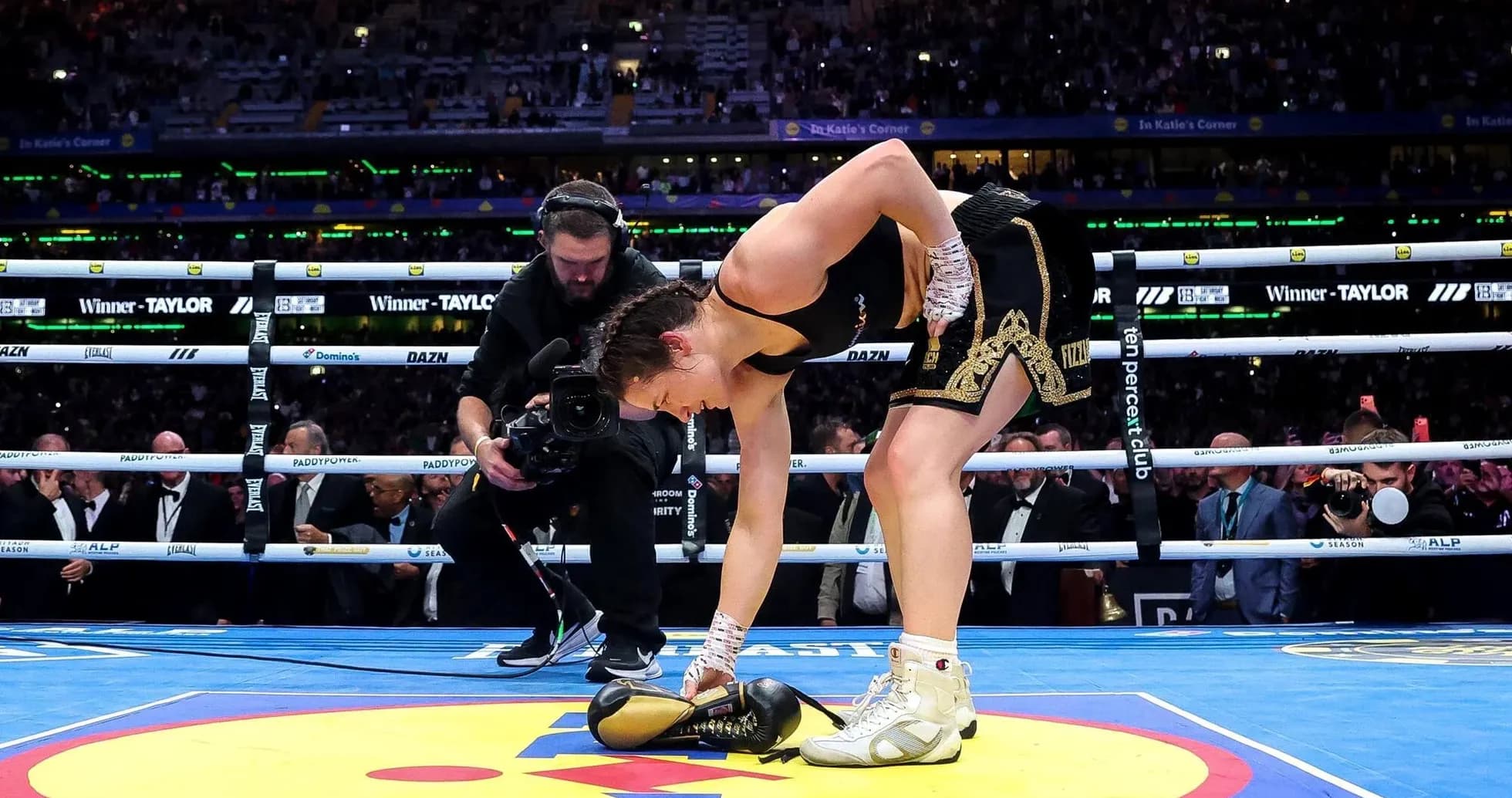
Katie Taylor steps away from the ropes and into the same void that has swallowed so many greats before her.
The stories are everywhere in sport. Premier League and NFL players burning through fortunes, marriages collapsing, identities crumbling once the lights go out. Athletes talk about retirement as their “first death” for a reason. The numbers back it up; the anecdotes are even more brutal.
Boxing has always understood that better than most.
“When a jockey retires he becomes just another little man,” Eddie Arcaro once said. The only rider to win the US Triple Crown twice knew what it meant to be reduced, to be ordinary, after a life lived at speed. Ray “Boom Boom” Mancini, a former WBA lightweight champion, put it another way: “Since I’ve retired I eat less, weigh less, train less and care less.” Both men built decent second lives. Both carried the scars.
Retirement, in its own way, is the toughest opponent of all.
A send-off like no other
So what does Katie Taylor do next?
Alan Minter, the undisputed middleweight king of the early 80s, once joked that boxers only ever come back for two reasons: “They’re either broke, or they need the money.” Taylor sits outside that grim punchline.
A purse of roughly €3m is expected to drop into her account for Croke Park alone. She earned over €7m from the last of her three fights with Amanda Serrano. And that is only the headline figure. Her career has not been a scramble for paydays. She leaves with her finances intact and her legacy gilded.
Because as Irish sporting farewells go, this one stands alone.
Croke Park gave her something close to perfection. The night, the noise, the opponent, the performance, the occasion. It nudged Brian O’Driscoll’s 2014 long goodbye – capped with a Six Nations title – down to a distant second in the national memory. Taylor didn’t just walk away; she ascended.
Now comes the strange part.
If Brian Peters gets his wish, the next time Ireland sees her won’t be under bright lights but in parish halls and community centres. Inisbofin, and a string of other unlikely venues, sit on a proposed map for a nationwide stage production called “Her Story”, with Taylor on stage alongside Steve Bunce.
“It's going to be quite magical,” the promoter said.
The thought of Taylor voluntarily touring the country to talk about herself jars with the version Ireland has known for years. The quiet champion. The reluctant star. The woman who seemed happiest when the bell rang and conversation stopped.
But second acts rarely follow the script.
Roy Keane, once the most reluctant of interviewees, has become a television phenomenon and advertisers’ favourite. Bill Belichick, the grey hood of New England, has seen his public image unravel in strange, uncomfortable ways since stepping away from the Patriots. Reinvention can be graceful. It can also be chaotic.
Finding a voice
In the final week of her career, Taylor sounded different. More open. More expansive. More willing to let people in. Eddie Hearn even joked about how long she spoke in the ring after outclassing Flora Pili in her last fight.
She has a voice. The world just doesn’t know yet how, or even if, she intends to use it.
“I determined very, very early on in my career not to talk but to show my boxing skills and just to let my excellence do the talking and let my talent do the talking,” she said on Sunday morning. “And I've kept to that throughout my whole career.”
Those skills do not have to be boxed up and stored away. She will almost certainly stay in the sport in some form. The options, though, are as wide as the unknown that now faces her.
Coaching is the obvious path. She has already shaped one generation of Irish fighters, men and women alike. They say it openly. They credit her with their belief, their standards, their sense of what is possible. The image of her sparring with 10-year-old Clodagh Keating last week captured that influence in a single frame: the national icon trading shots with the future.
Taylor was asked whether she might take up a role in Irish boxing. She smiled and pointed to a practical problem: convincing her husband to swap their life in Connecticut for a permanent move across the Atlantic had not “gone down very well”. Six children sit at the centre of that decision. Any next step has to fit around them.
Boxing will remain a thread in her life. It cannot not. But it will not be the only one.
Faith, family and a divided audience
Family stands alongside something else that has always driven her: faith.
Croke Park heard it and saw it as she walked to the ring for the final time to the sound of “All Hail King Jesus”. The declaration was not subtle. It was not meant to be. After the fight, she spoke plainly about how that belief had held her together through her darkest nights, including the heartbreak of the 2016 Olympics in Rio.
“Look what God's done. He's done the impossible in my lifetime and he's came through time and time again. And that's what I was saying in the ring afterwards and giving him all the glory and the honour for all that I've achieved.”
Whether that faith shapes a more public role, or whether it remains something largely personal, is one of many unknowns. So too is the question of whether she will even have a public life beyond the stage show that was being mapped out around her while she was still wrapping her hands.
In America, where she now lives, that open expression of belief sits easily within the sports culture. It is familiar, almost expected. In Ireland, the relationship with religion is more complicated, more fluid, more contested. Taylor has walked that tightrope without ever slipping.
It says something about the depth of affection for her that faith has never become a dividing line. No backlash. No real pushback. Just an acceptance that this is part of who she is, absorbed into a broader admiration that rolled down from the horseshoe stands of Croke Park and spilled into the September night.
Her standing in Irish life is hard to frame. She is not simply an athlete. Not merely a champion. She exists in that rare space where public love feels almost unanimous, and yet no-one can quite explain why in a single sentence.
Not even Taylor herself.
“I don't know, to be quite honest,” she admitted. “I think people, the whole country, has seen me and my good times and they have also seen me during my devastations as well. I think people really resonate with your vulnerabilities as much as your successes.
“They see me cope with the heartbreak of Rio. They see me cope with the heartbreak of the shadow of loss. They see me in the, just, personal difficulties as well. So yeah, I think my story is the story of everybody in the whole country.”
Her story is not finished. The gloves are off, the crowd has gone home, the ring is being dismantled. Now comes the hardest round of all.