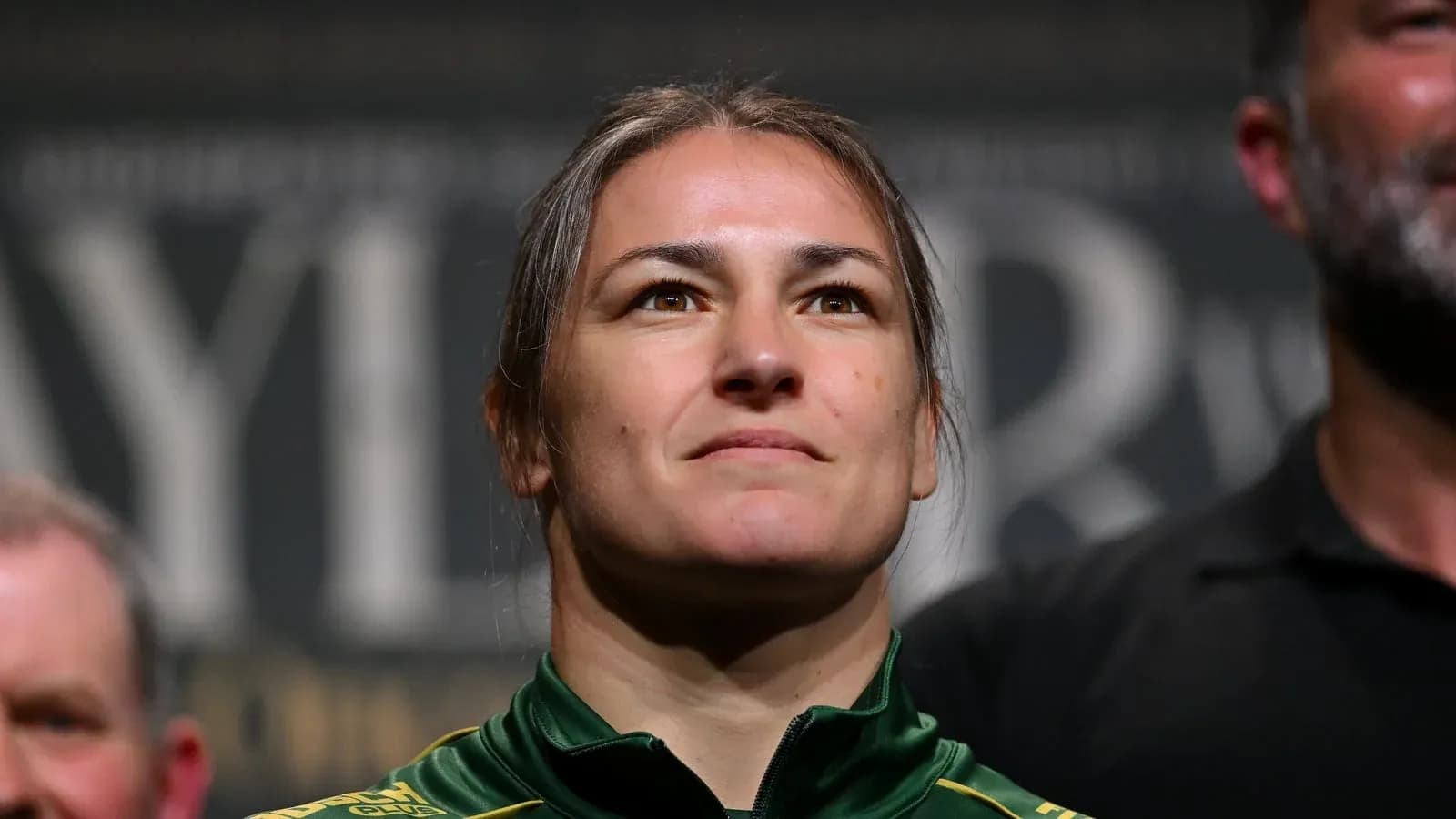
Katie Taylor stood on the brink of walking away long before Ireland ever claimed her as a national treasure. Before the Olympic gold, before the sold-out arenas, before Croke Park. Back when women’s boxing didn’t even have a lane, never mind a main event.
In a revealing conversation on RTÉ Radio 1's Inside Sport, Taylor traced the jagged path from a nine-year-old girl sneaking into the ring as “one of the boys” to an 80,000-seat farewell at Croke Park on Saturday night against Flora Pili. The arc sounds inevitable now. It was anything but.
A dream with no stage
When the International Olympic Committee announced new events for the 2008 Beijing Games, women’s sport was clearly edging forward. Women’s 3000m steeplechase, BMX, new fencing events, marathon swimming – all added. Women’s boxing, after years of lobbying, was left outside the door.
Taylor was just climbing to the top of the amateur ranks in 2006 when that decision landed. For her, it wasn’t a bureaucratic footnote. It was a gut punch.
She had started in a country where women’s boxing wasn’t even sanctioned, where she had to disguise herself as a boy just to get bouts. Now, staring at another four-year wait before she could even think about an Olympic ring, she came closer than ever to quitting.
She watched Beijing from a studio instead of a corner, analysing the boxing for RTÉ, wondering if her own chance would ever come. Four years, she knew, is a lifetime in an athlete’s body.
Quiet excellence, loud barriers
Taylor never tried to talk her way into history. She built it in silence.
“I determined very early on not to try and progress my career through talking,” she said. She chose to let her performances drag the sport forward, to force open doors by the sheer weight of her excellence. The words came later; the punches came first.
The journey, as she put it, was “very, very tough”. There were moments when the campaign to get women’s boxing into the Olympics felt futile. She had been told it was heading for Beijing, then told it wasn’t. That was the breaking point. That was when she thought, genuinely, this might never happen.
Instead of walking away, she waited. She trained. She carried on without any guarantee that the sport would meet her halfway.
A year after Beijing ended, the tide finally turned. Women’s boxing was added to the Olympic programme for London 2012. Even then, the opportunity came with caveats. Only three women’s weight classes were included. Taylor needed one of them to fit.
Lightweight at 60kg did. The opening appeared, and she sprinted through it.
London, the roar, and the rise of “Katie-mania”
By the time London 2012 began, Taylor had already become a symbol for Irish sport. Inside the ExCeL Arena, the noise confirmed it.
Her quarter-final win over Great Britain’s Natasha Jonas generated a staggering 113.7 decibels. Not far off a jet engine. Not far off the sound of a country roaring for one of its own.
The gold medal that followed didn’t just validate a career. It detonated it. “Katie-mania” wasn’t a marketing line; it was the lived reality of packed arenas, tricolours, and a soundtrack of Amhrán na bhFiann echoing around a London venue that suddenly felt like Dublin.
From there, the support never really dipped. It travelled.
From heartbreak to headliner
Rio brought disappointment, the kind that lingers. Taylor felt it, the country felt it. But the bond didn’t break. It shifted with her into the professional ranks.
Wembley. Madison Square Garden. Manchester, Leeds, Boston, Brooklyn, Dallas, New York. Every time she walked to the ring, Irish voices followed. They had been there before London, they were there during London, they stayed after Rio. Her pro career didn’t unfold in isolation; it unfolded with a travelling crowd that treated every fight like a homecoming.
Now those same supporters will cram into Croke Park, a stadium where boxing history has long belonged to one man: Muhammad Ali, who fought Alvin Lewis there in 1972. Ali drew 18,000. Taylor has filled the place.
Eighty thousand tickets. Gone in minutes. Estimates shattered, expectations made to look timid.
For Taylor, that reaction was never a surprise. Not in Ireland. Not in a country that, in her eyes, doesn’t care whether the fighter is male or female, only that they are one of their own.
A nation in her corner
She speaks about the crowd with the same mix of awe and gratitude that others reserve for world titles.
Blown away. That’s the phrase she returns to. Blown away by 80,000 people snapping up tickets. Blown away that a nation would turn out like this for a female athlete. Blown away that the same fans who stood with her in London, who absorbed the heartbreak of Rio, who crossed oceans for nights in Boston and Brooklyn, will now pack Croke Park for one last walk.
For Taylor, this isn’t just a send-off. It’s proof of something bigger: that Ireland hasn’t just supported her, it has helped build the very idea of a female professional boxing star.
“You can’t have a pro career in a vacuum,” she said. You need people. You need stadiums. You need a country willing to follow you from the small halls to the super arenas.
Ireland did that. It followed her everywhere. It gave her the platform to drag women’s boxing into the mainstream and keep it there.
On Saturday night, under the lights at Croke Park, Katie Taylor will try to repay that faith the only way she knows how – with a performance she wants to be the best of her career, on what she says will be her last night in the ring.
From a girl pretending to be a boy just to get a fight, to a woman selling out one of the great stadiums of world sport, the question now is not what she has left to prove.
It’s how long her impact will echo after that final bell.