Kawhi Leonard Returns to Toronto Raptors in Blockbuster Trade
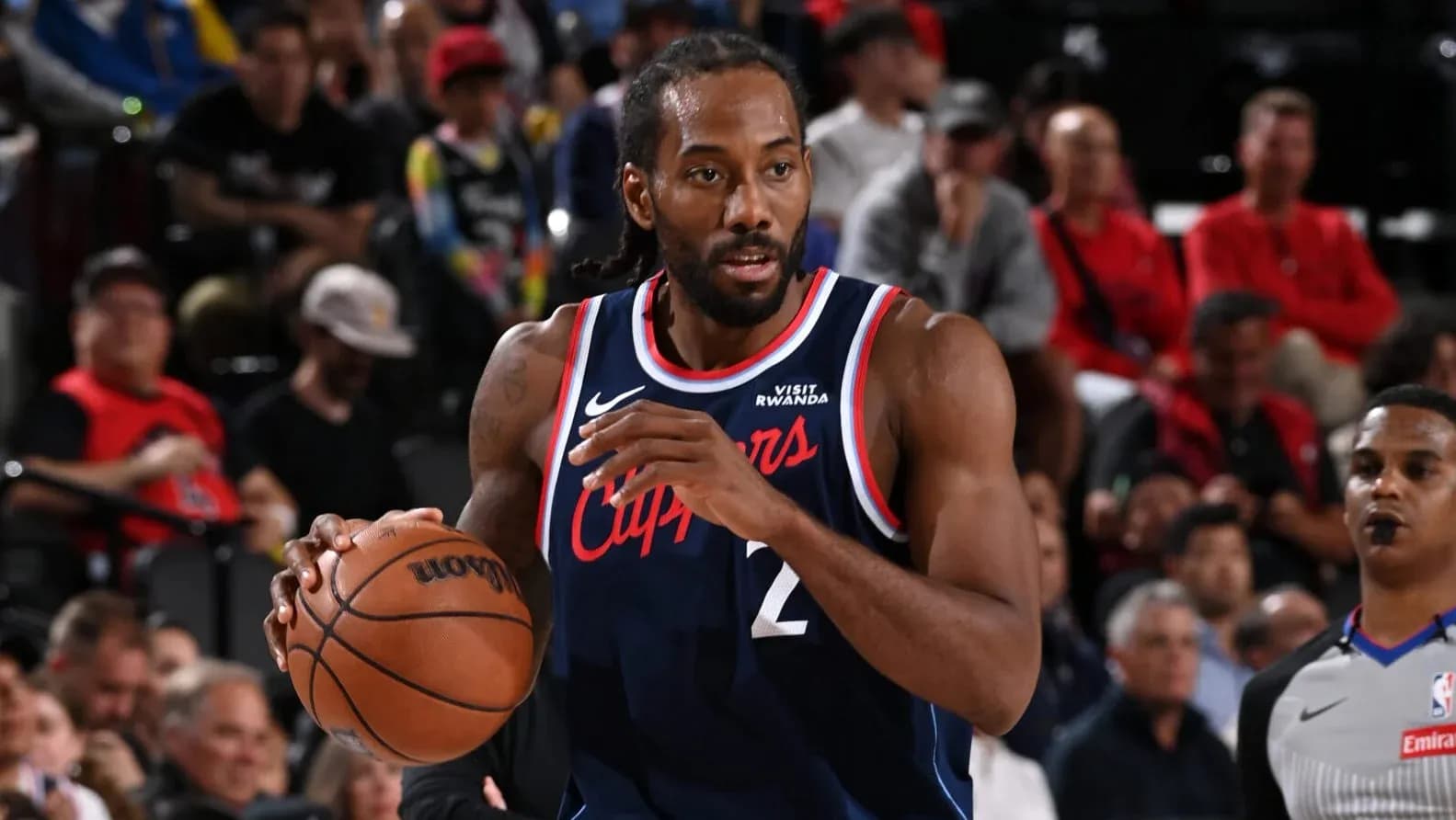
Kawhi Leonard is coming back to Toronto, and this time the Raptors are paying a champion’s ransom to bring him home.
Seven years after delivering the franchise’s only title and walking out the front door in free agency, the 2019 Finals MVP returns via a blockbuster trade with the LA Clippers. Toronto sends Gradey Dick and Brandon Ingram, two unprotected first-round picks, a first-round pick swap and two second-rounders to Los Angeles in a move that screams intent: the Raptors believe their window is opening again, and they want the same man closing it.
This isn’t nostalgia. It’s a calculated bet that the version of Leonard who just left LA is still good enough to tilt a playoff series — and maybe an entire conference.
Raptors double down on defense
Toronto quietly turned a corner last season. Sixteen more wins than in 2024-25. Their best statistical profile in six years at plus-2.9 points per 100 possessions. Fifth in the league on defense, allowing just 112.1 points per 100. Long, aggressive, disruptive.
They hounded ball-handlers, flew at shooters and turned mistakes into fuel. The Raptors finished third in transition scoring at 28.6 points per game, a number that reflects exactly how they want to live: out in the open floor, running off deflections and steals.
But when the competition stiffened, the armor cracked. Against the league’s top 10 offenses, that fifth-ranked defense slipped to 12th, giving up 117.3 points per 100. In the first round of the playoffs, same story: only the 12th-best defense in that field. And there was a recurring problem they never really solved — fouls. Toronto ranked 23rd in opponent free throw rate in the regular season, and that number ballooned in the playoffs, with opponents attempting 31.8 free throws per 100 shots.
Enter Leonard, still one of the cleanest, most disciplined defenders in basketball.
He’s no longer the terror who swallowed entire wingspans for 48 minutes, but he remains a plus defender with elite instincts and hands. The numbers from last season are stark: 122 steals, 27 blocks, only 78 personal fouls. Among 378 players who logged at least 500 minutes, Leonard posted the best ratio of combined steals and blocks per foul — by a wide margin. He takes the ball without giving away free points.
That matters for a team that already has length and energy but too often bailed opponents out at the line.
There’s another layer. Jakob Poeltl, once a reliable anchor, struggled badly at the rim and in space. Opponents shot 63.9% at the basket with Poeltl as the primary protector, the worst mark of his career. In the playoffs, the coaching staff’s trust reflected that drop-off: Poeltl started all seven games, but rookie Collin Murray-Boyles played 191 minutes to Poeltl’s 134.
You can see the outline of the new identity already. A frontline of Leonard, Scottie Barnes and Murray-Boyles would be undersized on paper, but on the floor it would be hell to navigate — switchable, physical, relentless. Swapping Ingram’s length and scoring for Leonard’s two-way edge gives Toronto a real shot at not just staying in the top five defensively, but holding up against the league’s best offenses when it matters most.
Finding the closer they never had
For all the defensive gains, one weakness kept dragging the Raptors back to earth: half-court creation when the clock bled out.
They could run. They could force turnovers. But when the ball slowed and the last six seconds of the shot clock arrived, the offense often froze. Only the Indiana Pacers posted a worse effective field goal percentage in those late-clock situations than Toronto’s 43.3%. Over the last three years, the Raptors own the league’s sixth-worst offense overall. That’s the ceiling they’ve been banging their heads against.
Leonard changes that equation.
Over the past three seasons, he’s hit at a 53.0% effective field goal rate in the final six seconds of the shot clock, ranking ninth among 131 players with at least 250 such attempts. When the play breaks down and somebody has to manufacture a shot, he’s one of the few players in the league who can consistently do it without hemorrhaging efficiency.
The isolation numbers underline the gap between what Toronto had and what it just acquired. Leonard and Ingram both rank among the 28 players who’ve isolated at least 1,000 times over the last three seasons. But the results are not close. The Clippers scored 1.07 points per chance when Leonard went one-on-one, sixth-best in that high-usage group. Ingram’s teams — first in New Orleans, then Toronto — generated just 0.99 points per chance on his isolations, placing him 24th.
That’s the difference between a possession you can live with and one that slowly drains a playoff offense.
Toronto doesn’t need Leonard to recreate the 2019 magic every night. What they need is a star who can own the final eight seconds of a possession and the final two minutes of a game. If they keep torching teams in transition and let Leonard handle the late-clock grind, this could be their sharpest offense since his first, unforgettable year in Canada.
A playoff giant returns
Leonard’s legend in Toronto is built on that 2019 run, but his postseason résumé stretches far beyond one spring.
Across 146 playoff games, he’s averaged 21.5 points with a true shooting percentage of 62.1%. Among the 89 players in NBA history who have averaged at least 20 points over 10 or more playoff games, only Anthony Davis edges him in efficiency — and Davis has played in less than half as many postseason games.
Zoom in on the modern era of his career and the numbers get even louder. Since 2017, Leonard has put up 28.6 points per game in the playoffs on 63.2% true shooting over 71 games. He’s one of just five players ever to have three separate postseasons — 2017, 2019 and 2021 — with at least 25 points per game and 60% true shooting across 10 or more games.
The Raptors just bowed out to the Cleveland Cavaliers in seven games, scoring 111.9 points per 100 possessions — slightly better than the first-round average, but not enough to swing the series. They didn’t crumble offensively, but they lacked a primary scorer who could bend a defense over and over again in a long series.
Leonard has done exactly that, repeatedly, against the best defenses in the world. That’s what Toronto is buying: not a memory, but a proven, high-volume, high-efficiency playoff engine.
Clippers hit reset after the Leonard era
On the other coast, the deal lands like the final chapter of a story that never quite reached its climax.
During Leonard’s seven-year run with the Clippers, they posted the league’s fourth-best regular-season record. On paper, that’s elite. In reality, it made them the best team of the era that never actually won anything.
The last year tells the tale. Twelve months ago, LA pushed all their chips in again, adding Bradley Beal, John Collins, Brook Lopez and Chris Paul to a core of Leonard, James Harden and Ivica Zubac. It looked like a veteran supergroup built to chase the title that had always hovered just out of reach.
Now? Lopez is the only one of those seven still on the roster.
Paul’s return to LA was brief. Harden and Zubac were moved at the deadline. Leonard is on his way back to Toronto. Beal and Collins are both unrestricted free agents and, at this point, unlikely to return. What once felt like a final push has instead turned into a full-scale teardown.
As of Tuesday night, with Kobe Sanders expected back, the players under contract or committed for 2026-27 account for just 42% of last season’s minutes. No other team in the league is close to that level of change. Even if restricted free agents Bennedict Mathurin and Jordan Miller re-sign, the continuity rate would rise only to 52%, still the second-lowest mark in the NBA, just above the Lakers.
Five months ago, the Clippers were a veteran outfit clinging to contention. They ranked 24th in the percentage of minutes given to rookies and second-year players — just 12%. Today, the franchise is staring at a different kind of future, one built around Darius Garland and rookie guard Keaton Wagler.
The Leonard trade is not a tweak. It’s a declaration. The era of star-studded, title-or-bust Clippers basketball is over. The experiment produced regular-season wins, flashes of brilliance and constant “what ifs,” but never the parade.
Toronto, meanwhile, knows exactly what it looks like when Kawhi Leonard delivers one. The question now is simple, and ruthless: at this stage of his career, can he do it again?