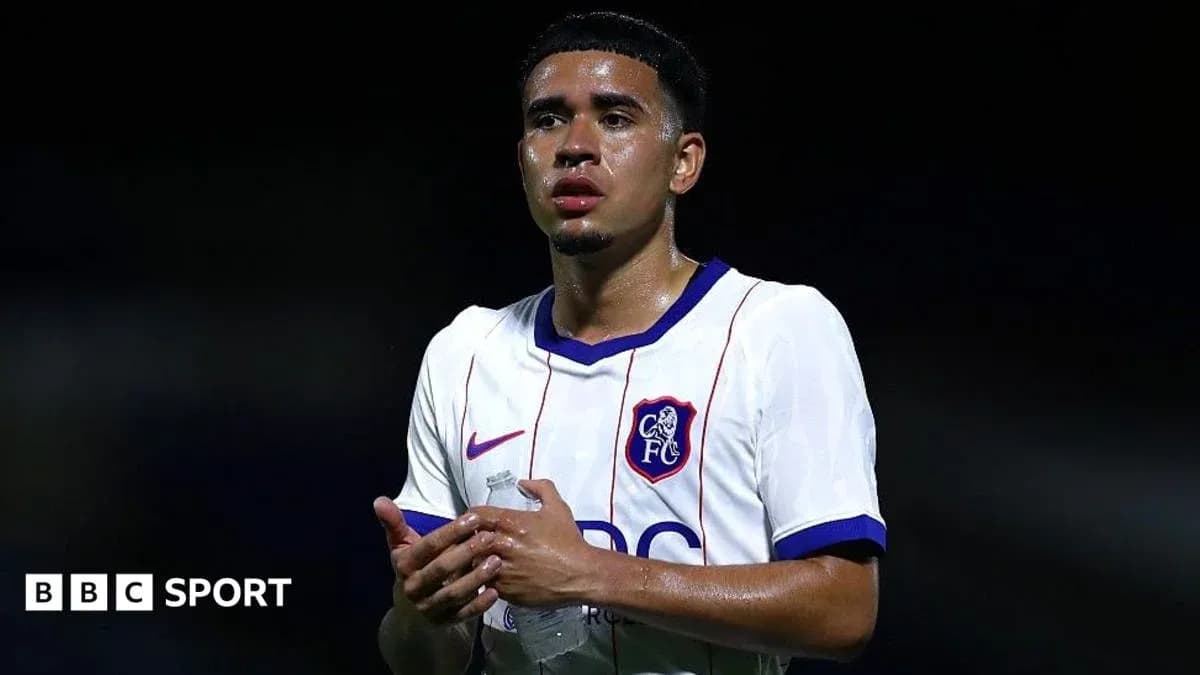
Kendry Paez finally wore Chelsea blue at the weekend. Not under the Stamford Bridge lights, not in front of a global audience, but in a low-key Under-21 fixture away at Arsenal, three years after the club first moved to sign him.
It was a quiet entrance for a player once billed as South America’s next great showman.
Signed in 2023 from Independiente del Valle for £17.27m when he was just 16, Paez arrived in European football with a trail of broken records and breathless predictions behind him. Chelsea thought they were getting a prodigy. Ecuador thought they were sending out their future.
Now 19, he came off the bench in the 12th minute for Cobham Next Gen – Chelsea’s newly rebranded Under-21 side – in a 4-1 win at Arsenal on Saturday. It was his first competitive outing in Chelsea colours, a debut that felt more like a reset than a coronation.
From wonderkid to waiting game
The story was supposed to be straightforward. Paez, the youngest debutant and goalscorer in Ecuador’s top flight at 15. Paez, the teenager thrown into the Copa Libertadores that same year. Paez, who at 16 years and 131 days became the second-youngest South American to play in a World Cup qualifier, behind only Diego Maradona.
A month later he became the youngest South American ever to score in a World Cup qualifier, away to Bolivia in a 2-1 win. By the time Chelsea agreed the deal, he already had 18 caps and two international goals. The path looked lit.
Chelsea invested early. They brought him to Cobham to train regularly with the first team before he could officially join after his 18th birthday. They went beyond football too, arranging security for Paez, his family and the family of Moises Caicedo when violence flared in Ecuador in early 2024.
This was a club preparing the ground for a star.
What followed has been far messier.
Loans, lessons and a stalled rise
Paez’s first serious test in Europe came at Strasbourg, the French club linked to Chelsea through shared ownership. He started brightly, winning September’s Young Player of the Month award in Ligue 1. The talent flickered into view.
Then the tone changed.
Manager Liam Rosenior publicly demanded more. “We expect more, clearly,” he said later in the season. “I’m tired of using the excuse of the player's youth.” The message was blunt: reputation no longer counted. Output did.
One goal in 21 appearances told its own story. The loan ended early.
Chelsea then sent him into the furnace of River Plate on a two-year deal, a club where the shirt weighs heavy and patience wears thin. In Argentina, the same concerns surfaced. Sources questioned his attitude, pointing to a flat performance in the Superclasico defeat to Boca Juniors at the Monumental in April – the sort of stage where River legends are usually born.
Shortly after that, club president Stefano Di Carlo named Paez among 15 players training away from the first team. Some insiders argued he deserved more chances; the numbers were unforgiving. One goal in 14 games, just 461 minutes on the pitch. The loan was terminated by mutual consent.
Around the same time, a video emerged of Paez in a New York strip club while on international duty. For a teenager already under the microscope, it fed into a growing narrative of distraction and missteps.
Back home, the unease grew louder. Ecuador had built him up as the next great attacking talent. Now they were asking what had gone wrong.
Michel Deller, owner of Independiente, summed up the concern in an interview with Hincha Amarillo. “He's like a son to us. We care about him deeply,” he said. “He's a good kid who's had a tough time and has made decisions that have complicated his life. We are always hopeful he'll show his exceptional talent once again but right now, it's up to him to decide what to do with his life.”
Chelsea pull him close
Chelsea and those around Paez do not dismiss those worries, but they see a different picture. To them, the issues are real but exaggerated, the noise drowning out the context: a teenager thrust into senior football, into expectation, into a new continent, all before his 20th birthday.
So the club have gone back to basics. No more complicated loans. No more halfway houses.
They wanted to send him on loan in England this season, but Fifa rules blocked another overseas move after Chelsea had already used their six international loan slots. Instead, Paez has been brought back to Cobham and officially listed as an academy player on the club website.
New head coach Xabi Alonso has been clear: Paez is “not in my plans” for the first team right now. That sounds harsh, but it also strips away any ambiguity. The route back is simple: perform, mature, earn trust.
For now, that means minutes in the Under-21s, training in an elite environment, and being watched closely by staff who see both the flaws and the ceiling.
A glimpse of the old spark
The setting could hardly have been more modest: Wycombe Wanderers away in the EFL Trophy, just 778 fans in the ground. Cobham Next Gen were losing. Paez looked distant before kick-off, standing slightly apart from the other academy players, joining the warm-up but keeping largely to himself.
When he came on in the 62nd minute, playing as a right-sided No 10 in a shape mirroring Alonso’s back three, he drifted on the fringes of the game. Chelsea lost. For a while, he looked like another talented youngster feeling his way through a match that was passing him by.
Then, late on, the old touch appeared.
From a short corner, Paez whipped in an outswinging cross with real venom. Harrison Bettoni tapped it in. In added time, he delivered another ball that caused chaos in the Wycombe box as Chelsea chased an equaliser that never came.
It was a small cameo, but it mattered. A reminder – to himself as much as anyone – that the left foot that lit up Ecuador has not gone anywhere.
A career still in the balance
Strip away the hype and the headlines and one fact stands out: Paez has already played more than 100 senior games, including 70 for Independiente, before his 20th birthday. That experience is not easily lost. It is something he can lean on now, when the narrative has turned and the questions have sharpened.
Inside Cobham, the mood around him is cautiously upbeat. Coaches have been encouraged by his attitude since returning. Family members have been in the stands, offering a layer of stability that was missing during the turbulence of his recent loans.
Academy matches draw scouts from across the English Football League and beyond. Every touch, every run, every decision is now part of a new audition. If he strings performances together, a first loan in English football in January is a realistic prospect. If one of Chelsea’s six international loan slots opens up, another move abroad could be back on the table.
For now, the picture is clear. The boy who broke records in Ecuador is no longer the poster child of a project, nor the guaranteed star of tomorrow. He is a 19-year-old midfielder trying to rebuild his reputation on training pitches and in lower-profile games, one cross, one decision at a time.
The talent that drew Chelsea to him has not disappeared. The question, as Michel Deller put it, sits squarely with Paez now: what does he decide to do with it?