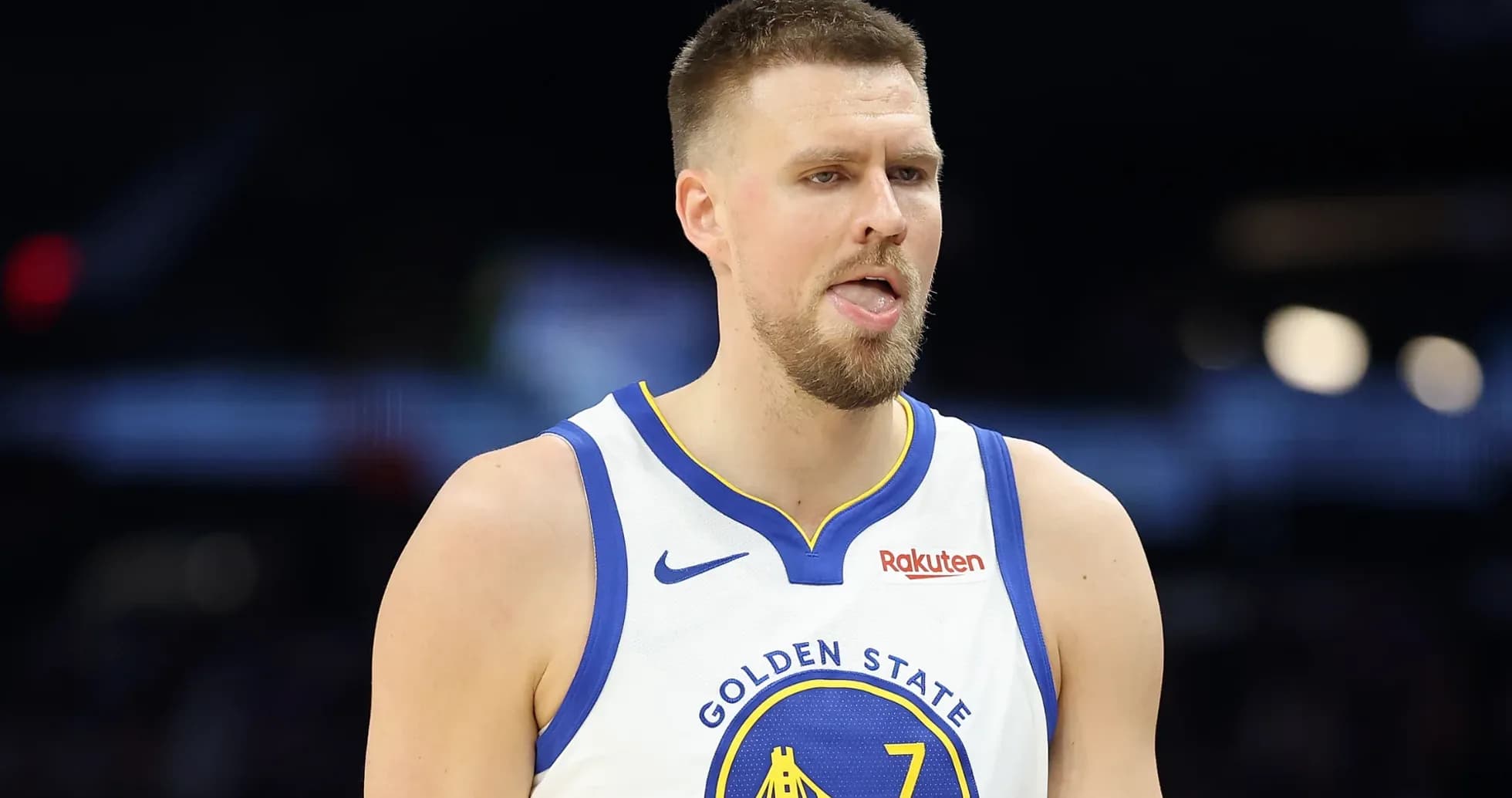
Kristaps Porzingis: The Warriors' High-Stakes Gamble
Kristaps Porzingis arrived in the Bay with questions trailing him like a shadow. The Golden State Warriors answered one of them early in the offseason: they doubled down.
A two-year, $40 million commitment for a 7-foot-3 big man who played just 15 games last season is not a tentative move. It’s a bet. On health. On fit. On upside the franchise clearly believes is still there.
A High-Stakes Investment
Golden State didn’t stumble into this. Porzingis cost them Jonathan Kuminga and Buddy Hield in a deadline deal with the Atlanta Hawks, a swing that signaled a shift in roster construction and timeline. The Warriors wanted size, spacing, and a genuine rim presence. Porzingis, even in limited action, reminded everyone why.
In those 15 games, he averaged 16.1 points, 5.3 rebounds, 2.3 assists and 1.1 blocks per night. Not gaudy numbers, but efficient and impactful enough to justify the Warriors’ belief that, if he can stay on the floor, he can tilt matchups in their favor at both ends.
That “if” has defined his career.
Porzingis hasn’t played 70 games in a season since his rookie year with the New York Knicks in 2015-16. Since then, every promising stretch has been undercut by another medical report, another rehab, another reset. Golden State walked into that reality with eyes open.
This summer, they watched him make a choice that told them plenty.
Skipping Latvia, Betting on the Warriors
Porzingis opted out of Latvia’s FIBA World Cup qualifying windows to focus on his recovery. For a player who has always worn his national team pride openly, that’s not a casual decision. It’s a calculated one.
He chose the long NBA grind over the short-term emotional pull of international play. He chose to protect the leg, the back, the joints that have betrayed him before, and in doing so tried to protect the Warriors’ investment.
Inside the organization, that landed well. The message: he understands the stakes. He understands what $40 million means in a cap-strapped environment. He knows this can’t be another season of “what if.”
Vogel’s Blueprint: From Hibbert to AD to KP
If there’s a coach who knows what to do with a shot-blocking big, it’s Frank Vogel.
Vogel joined Steve Kerr’s staff this offseason after the departures of Terry Stotts, Jerry Stackhouse and Chris DeMarco. His reputation precedes him: defensive structure, rim protection, discipline. In Indiana, it was Roy Hibbert anchoring the paint. In Los Angeles, it was Anthony Davis destroying schemes from the back line. The pattern is clear.
Now, it’s Kristaps Porzingis’ turn.
“We feel like Kristaps can fill that role,” Vogel told Luca Evans of the San Francisco Chronicle. The words are simple; the implications are not. Vogel doesn’t just want a center who blocks shots. He wants a system piece, a fulcrum.
“And I’m really excited about putting him in my defensive system,” Vogel added. “Because there’s a lot of details I believe in with my defensive system and how I use shot-blocking bigs that really gets a lot out of ’em on that side, and I really look forward to putting KP in those spots.”
That’s the plan: Porzingis as the defensive spine, the last line that lets the Warriors’ aging perimeter rotate, gamble, and recover without getting punished at the rim every trip down.
Age, Depth, and a Thin Margin for Error
The idea is sound. The execution will be fragile.
Golden State’s roster is heavy on experience and light on youthful legs. The core names that built a dynasty are now battling time as much as opponents. That reality makes the margin for error with Porzingis’ health even thinner.
The depth chart at center underlines it. Al Horford, the second-oldest player in the league, brings savvy and spacing but cannot shoulder a primary workload for 82 games and a playoff run. Charles Bassey, still searching for a major role in his career, is more question than answer at this level.
If Porzingis misses extended time, the entire structure Vogel wants to build wobbles. The Warriors don’t have a like-for-like replacement. They don’t have another 7-foot-plus shooter who can also erase mistakes at the rim. They have patchwork options, not solutions.
So the season, in many ways, rests on the health of a player who hasn’t been reliably healthy in nearly a decade.
Front Office Belief
Inside the front office, though, there is no public wavering.
Warriors general manager Mike Dunleavy Jr. spoke with conviction about Porzingis’ outlook when he addressed the San Francisco Chronicle’s Luca Stevens last month.
“We looked at it extensively, what’s going on, how we can help him, how we can be better,” Dunleavy said. That’s not a throwaway line; it’s an admission that the organization has dug into every medical file, every training approach, every pattern that has derailed Porzingis in the past.
“And I just think the things we’ve discussed and look at and worked through lean in the direction of him having a healthier year.”
That’s the bet. Not on miracles, but on process: targeted recovery, smarter load management, a system that protects him as much as he protects the rim.
A Season Defined by a Seven-Footer
Strip it all down, and the Warriors’ gamble is clear.
They traded a young, ascending forward in Kuminga and a proven shooter in Hield for a towering, fragile, game-changing big. They re-signed him despite another season cut short. They brought in a defensive architect tailor-made to maximize his strengths.
Now they need Kristaps Porzingis to do something he hasn’t done since he first arrived in the league: stay upright, stay available, and carry that promise from October through spring.
If he does, the Warriors’ defense can look like something new again. If he doesn’t, this bold, expensive experiment may be remembered as the moment they pushed their chips in on the wrong hand.