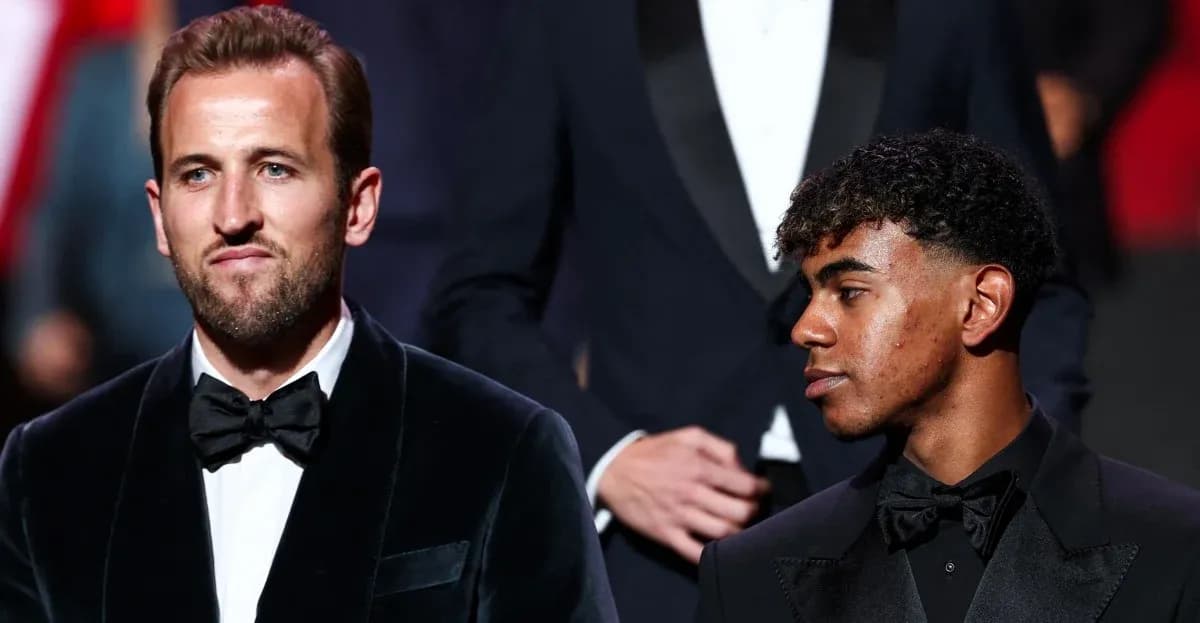
Lamine Yamal has never looked short on self-belief. The FC Barcelona prodigy has spent the last few weeks talking up his Ballon d’Or credentials, but his latest comments have pushed the conversation into a different territory altogether — straight into the path of Harry Kane.
Speaking to Movistar Plus Deportes, Yamal laid out his vision of what the Ballon d’Or should represent, and he did it in a way that many will read as a direct swipe at Bayern Munich’s goal machine.
“I think the Ballon d’Or should go to the best player in the world, period. Not to a player who’s scored 80 goals, because when you score 80 goals, you get the ‘top scorer’ award for that,” he said, in remarks captured by @iMiaSanMia.
No names. No need. In a season where Kane has turned scoring into a weekly habit, the target of that line feels obvious.
“These are very different things that people aren’t understanding,” Yamal continued. “The best player in the world is the one that, as a commentator, you’re watching a game and enjoying — you see him and think, ‘He’s a player who is very different from everyone else.’”
It is a classic playmaker’s manifesto. The idea that artistry, influence, and sheer individuality should outweigh the cold, brutal numbers of a striker’s tally. For a young attacker at Barcelona, it is also a familiar echo of a club culture that has long worshipped the all-round genius over the pure finisher.
Yamal did not stop there. He went on to argue that the award has drifted away from its original spirit.
“When the award goes to the best, not the one who scores the most goals or the one who has won the most titles, then it will regain its true value,” he said.
That line lands with weight. It questions not just Kane’s case, but the entire modern logic of the Ballon d’Or: goals, trophies, and the dominance of forwards who rack up staggering numbers in super teams.
For Kane, whose career has often been judged through the prism of statistics and the absence of major silverware, the subtext is sharp. Yamal is effectively drawing a line between “top scorer” and “best player,” and placing the England captain firmly on the wrong side of that divide.
Is it confidence from a rising star who believes he belongs in that conversation already? Or does it cross into something more abrasive, a calculated attempt to frame the debate on his terms and diminish a rival’s achievements?
What is clear is that Yamal is not interested in playing the diplomatic game. At an age when many players are still learning to navigate media training, he is already shaping narratives around the sport’s most prestigious individual prize — and he is doing it loudly.
The Ballon d’Or race will be decided on the pitch and in the voting rooms, not in interviews. But as Yamal talks about “true value” and Kane keeps piling up goals, the clash of footballing philosophies is out in the open: numbers versus nuance, finishers versus creators, volume versus virtuosity.
The next few seasons will reveal which vision the game chooses to reward.