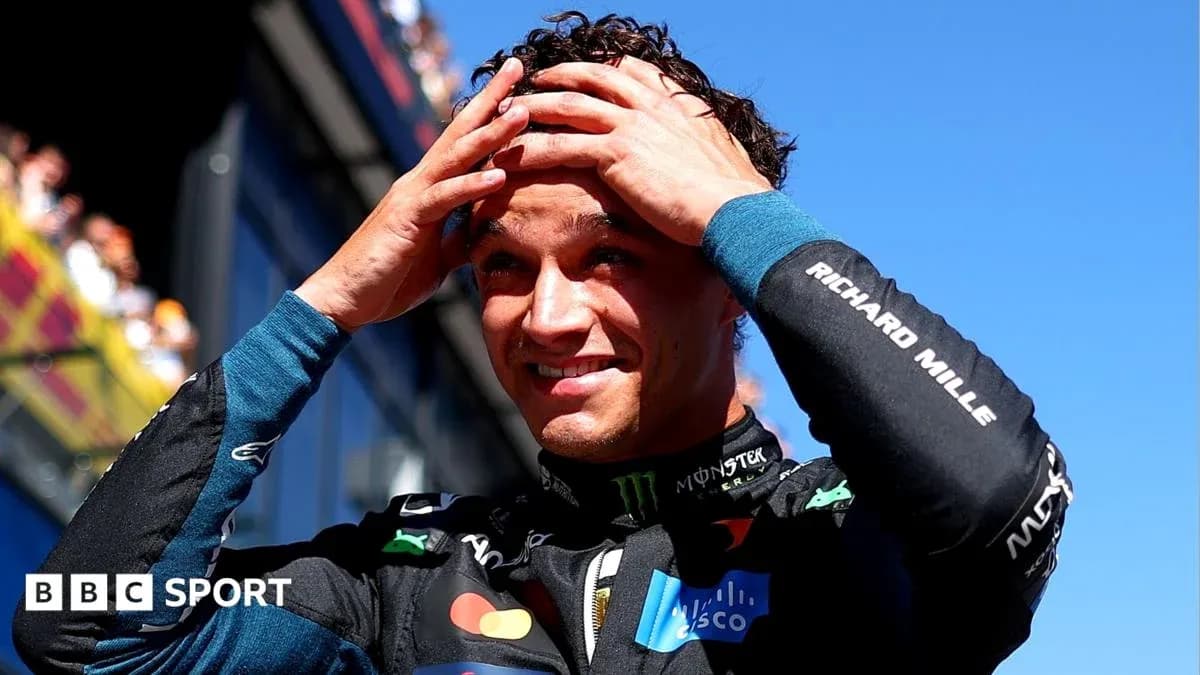
Lando Norris didn’t just steal pole in Madrid. He ripped it out of a race that was already being pencilled in as another Kimi Antonelli procession, and did it with a lap that left even hardened paddock veterans shaking their heads.
Two numbers tell the story, and it’s hard to know which is more outrageous. Norris found 0.701 seconds between his two laps in the final part of qualifying – a chasm at this level – to drag a McLaren that had no business fighting for pole to the very front. And he still beat runaway championship leader Antonelli by 0.011 seconds despite a mistake at the final corner that cost him more than three-tenths.
Pole position with a major error. On a new, punishing street circuit. Against the dominant car of the season.
No wonder Andrea Stella, a man who has sifted through telemetry for Michael Schumacher and Fernando Alonso, called it “a masterpiece” and “one of the most impressive laps that I witnessed… because we were not honestly performing to the level of scoring pole position”.
When someone with that résumé says a lap is special, you listen.
A near-perfect lap – until it wasn’t
Norris knew immediately he had done something out of the ordinary.
“Most tracks, you know what is perfect, what you really want to achieve in a perfect lap,” he said. “Until the last corner, I think I matched that perfection level in pretty much every corner.”
He called it “easily one of the best laps” of his life. The detail in his description matched the precision on the timing screens: the kerb hits, the brake points, how aggressively to ride the bumps without crossing the line. On a day like this, on a circuit like this, one misjudged input usually ruins everything.
Instead, everything aligned on the lap that mattered most.
“Everything came together perfectly,” he said. “I got the timing of everything so dialled in… it’s so easy to make a mistake on a day like today and a track like this, but really I just got it right on the most important lap I had to do.”
Then came that final corner.
Norris admitted he thought he was “in the wall” after over-driving the entry. He’d simply pushed too hard, carried too much speed, and expected to pay for it with carbon fibre and regret. Somehow, he got away with it – but the data later showed he had bled away around 0.35 seconds.
Stella could scarcely believe what the numbers told him.
“The most impressive thing is the fact that it's a pole position despite having lost 0.35secs in the last corner,” he said. “Which means that it would have been a pretty convincing pole position without this issue.
“The thing that makes the lap unique when you look especially at the telemetry is the precision – the braking, the speed you carry in entry, the striking of the kerbs, the going on power. Everything is executed with a pretty unique level of precision.”
No delta, just feel
There is another layer to the performance. Norris does not use a live delta time on his steering wheel, the rolling reference that tells most drivers instantly whether they are up or down on a previous lap.
“I don't need my delta,” he said. “I can feel when I do what I need to do and when I get a good exit, when I'm on the limit of things.
“When I'm kind of a bit uncomfortable in corners is normally when it's going pretty well. So, I could feel it and I feel like I just made all the right things. My feet were doing what I wanted, and that's normally when things are going well.”
In a sport obsessed with numbers and live readouts, Norris trusted his instincts on one of the highest-risk tracks of the season. And on Saturday in Madrid, that instinct was razor sharp.
A brutal new arena
The new Madring street circuit is not much to look at. It threads its way around an exhibition centre near Madrid’s international airport, a functional strip of asphalt about a quarter of an hour from the city when the roads are clear.
As a driving challenge, it is anything but bland.
“Very high risk” and “less margin than Monaco,” was George Russell’s verdict. The walls sit close, the barriers often angle back towards the racing line on corner exits, and any misjudgement can end with a sickening thud of carbon against concrete.
Final practice backed up the warnings: two red flags, one for Lewis Hamilton, one for Oliver Bearman in the Haas. Qualifying, somehow, passed without incident. No crashes, no stoppages. Just drivers walking the tightrope at frightening speed.
Whether the race can survive in the same way is another question entirely.
A third pole, but a different fight
This is Norris’ third pole of the year. The previous two – in Hungary and the Netherlands – turned into dominant wins. McLaren were the benchmark at both venues; once Norris led into Turn One, the outcome never felt in doubt.
Madrid feels different.
“Tomorrow is going to be a very tough day,” he warned. “It's not going to be as straightforward as in Zandvoort and Budapest. There we were the quickest car. Yes, I'm on pole now, but we're not in the quickest car. It took a perfect lap to get me on pole by 0.011secs today.”
The preparation for that fight has been far from ideal. Norris missed virtually all of second practice with a gearbox problem, losing the session that teams lean on most heavily for race simulations and tyre data.
On a brand-new surface with unknown behaviour over a full stint, that’s a serious handicap.
Tyre degradation is expected to be high. The fresh, high-grip asphalt should, on paper, combine with the longest pit lane of the season to push teams towards a one-stop race. Norris joked that the pit lane is “6km long”, split in two by a building.
Reality may be messier. The wear rates seen so far suggest a two-stop could become unavoidable if drivers push too hard too early, and Antonelli predicted cautious opening laps.
“Probably is going to be grandmother driving in the first 10 laps,” he said, pointing to how steep the degradation can be if you attack from the start.
Overtaking nightmare, golden chance
If there is a major card in Norris’ hand, it is track position. Nobody expects overtaking to be easy.
The Madring’s short straights and awkward, combined braking zones leave little room for bold moves. As Max Verstappen, who lines up third, put it: “There are no corners where you can pass.”
Drivers like the technical challenge. Norris called it “a little bit of everything”, a layout that tests bravery, rhythm and car placement. But they are almost unanimous on one point: the corner entries need work if this place is going to host proper racing.
Verstappen didn’t mince his words: “You can't overtake. So, in some places, the braking zones, like, they need to learn that it should never be that you have to steer, that you have to combine under braking, because it doesn't allow any kind of overtaking.”
Antonelli had already felt the problem in real time.
“It's going to be tight,” he said. “I spent two laps behind the Williams, trying to painfully get past. But it's just really difficult.
“And when you're behind, it's tough. Yeah, the only thing you can do is try to put pressure on the car in front, trying to make them do mistakes or make them deg a bit more.”
For Norris, that difficulty is an opportunity. McLaren may not have the fastest car in pure pace, but clean air and track position on a circuit like this can be worth more than a couple of tenths.
“As he put it: “It's a long race, it's a new track. You've got to know what corners to push, what corners not to push, all of these different things, what the battery's then going to do.
“There's a lot of stuff that I've got to spend my time doing tonight. So, it's probably going to be a late one to try and get ahead of the game in some sorts. But the main part of the job was done today, so that's the bit I'm most happy about.”
The masterpiece lap is in the books. Now comes the real examination: can Norris turn a moment of near-perfection into a win against the season’s benchmark car, on a circuit built to punish the slightest misstep?