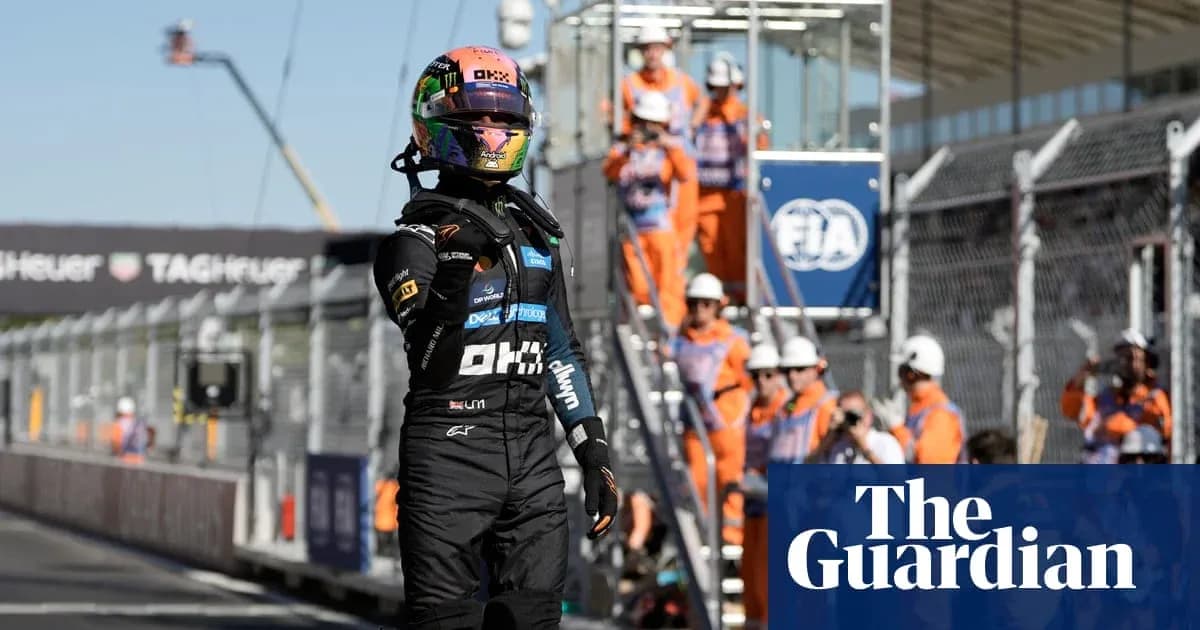
Lando Norris found perfection in the very last place it usually lives in Formula One: the final corner of a brand-new, unforgiving street circuit, with everything on the line and nothing in his weekend to suggest it was coming.
On the Madring, the sport’s newest and already notorious high-speed maze, the McLaren driver produced a qualifying lap for pole that stunned even himself. He had been anonymous on the timesheets until Q3’s dying seconds. Then, from nowhere, he strung together a lap that left the paddock blinking at the timing screens.
It was that kind of lap. The kind drivers talk about years later.
A lap from nowhere
The Madring has teeth. High walls, brutal concrete, and almost no margin for error. Across the weekend it had already bitten hard, with big crashes and red flags underlining how little space there is between commitment and catastrophe.
To take pole here, you cannot simply be neat. You have to lean on the car, trust your instincts and dance with the walls. Norris did exactly that. He threaded the McLaren through the circuit’s blind kinks and angled braking zones with a mix of nerve and precision that left him just one-hundredth of a second clear of championship leader Kimi Antonelli in the Mercedes, with Max Verstappen third for Red Bull.
Norris admitted it felt like one of those rare, almost surreal laps when everything clicks – vision, feel, reflex, judgement – and the car seems to shrink around you. He knew what he wanted to do. The question was whether he would dare to actually do it on the last run of the session. He did. Almost to perfection.
Almost.
At the final corner, he pushed so hard he brushed the wall with his left-rear tyre. For a heartbeat he thought he was in it, not on it, already imagining the McLaren mechanics rebuilding his car deep into the night. Instead, the contact was a kiss, not a punch, and the lap held together.
Andrea Stella, McLaren’s measured, quietly spoken team principal, does not hand out superlatives easily. His verdict cut through the usual qualifying noise. This was, he said, “a bit of a masterpiece.” Stella revealed that Norris actually lost around three-tenths of a second with that last-corner mistake. Until then, the lap had been on an even more staggering level. It was, in his eyes, one of the best laps of Norris’s life, and a revelation of what the car had in it.
Beating the benchmark
What makes this pole so striking is not just the venue, but the opposition. Antonelli, fresh from a remarkable victory from 19th on the grid at Monza, has been the benchmark this season. He leads George Russell by 66 points in the championship, with Lewis Hamilton 76 back in third and Norris 96 adrift.
Antonelli had looked sharp again here, attacking the Madring with his own brand of controlled aggression. Verstappen, always dangerous over one lap, was lurking. Hamilton, after the first Q3 runs, had put himself in the fight too and would eventually line up fourth.
Yet when it mattered most, when the track was at its quickest and the pressure at its highest, Norris found something none of them could match. One-hundredth of a second was the official gap. On a circuit like this, it felt like a chasm.
Track position is king
Pole at the Madring may prove more valuable than almost anywhere else on the calendar. The circuit is billed as a street track, a hybrid of public roads and purpose-built sections, but it behaves like the most claustrophobic of city layouts.
It is narrow, relentlessly fast, and unforgiving. Drivers have voiced real concern that overtaking will be close to impossible. Several braking zones feed into corners at awkward angles, killing the natural racing line for a pass. Leading cars can simply park themselves in the middle of the road and dare anyone behind to try something reckless.
That points to a familiar danger: a Sunday procession. If it comes to that, track position becomes everything, and Norris has the prime real estate. From pole, with clean air and the ability to dictate the pace, he holds the one advantage everyone wanted and almost no one expects to give up.
Strategy will be a knife-edge exercise. The surface offers high grip but chews through tyres. Pit windows will be tight, and any misstep could be punished. Yellow flags will shape the race; red flags may define it. Given the crashes already seen this weekend, stoppages feel less like a possibility and more like an expectation.
A brutal new test
Qualifying itself managed to avoid fresh chaos, but only after the circuit had already made its point. At 3.365 miles, the Madring has been designed to be fast and spectacular, a modern showpiece. It is also, by common consent, a serious and potentially dangerous examination of a driver’s nerve.
Final practice underlined that reality. Hamilton locked up at the last corner and speared nose-first into the barriers, triggering a red flag and a flurry of concern in the Mercedes garage. He walked away, but the incident showed how quickly a lap here can turn from brilliant to brutal.
Britain’s Oliver Bearman suffered an even heavier hit at turn 10. A spin sent him sliding side-on into the concrete, ripping apart the left side of his Haas. He emerged unhurt, but the damage was so extensive the team could not rebuild the car in time for qualifying. His weekend was effectively over before the grid had even been set.
All of which throws Norris’s lap into even sharper relief. On a track that punishes overreach with wreckage, he danced right on the edge and, bar that final-corner scrape, got away clean.
Now comes the real test. On a circuit where overtaking may be a fantasy and mistakes are rarely small, can he turn one of the laps of his life into the win that drags him back into a title fight that looked to be slipping away?