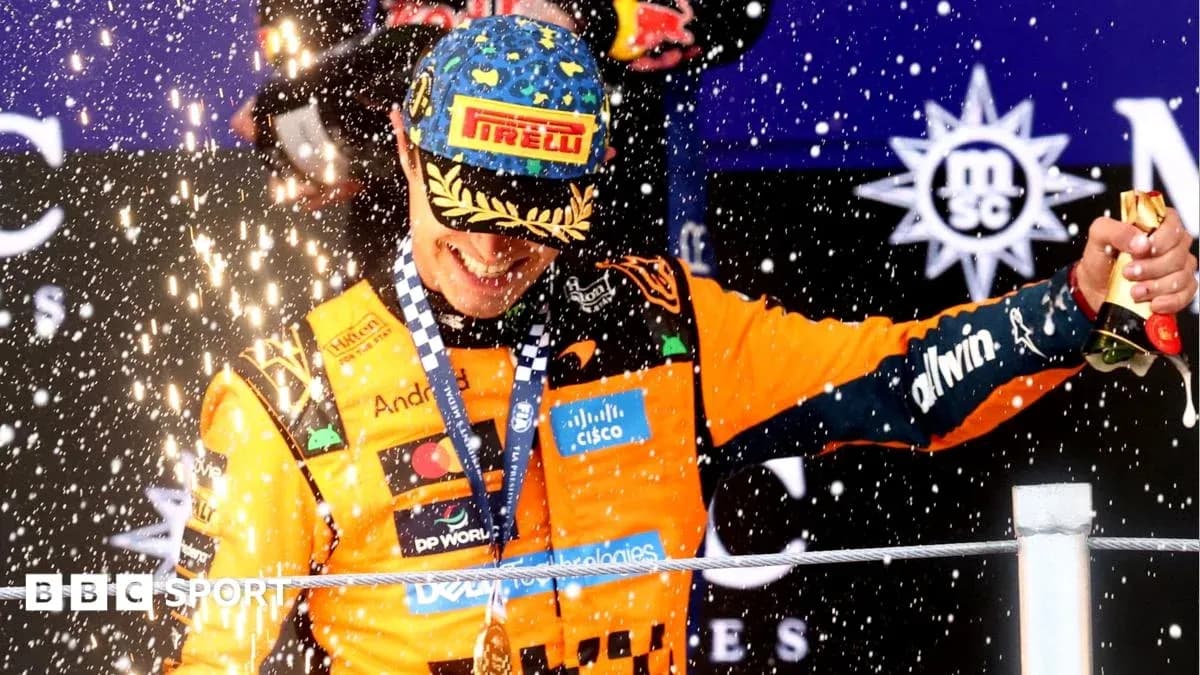
Lando Norris had survived 71 laps of chaos at Interlagos. It was the podium that bit back.
He leapt from the top step, went for his trademark champagne smash, and misjudged it. Glass everywhere. Then, as he lifted the jagged bottle neck to the crowd, he stepped into the plume of fireworks and caught a face full of sparks. Max Verstappen and Isack Hadjar showed no mercy, soaking him as he flinched away.
No harm done. Andrea Stella confirmed Norris was fine, and the McLaren driver soon sat down, calm and clear, to dissect what he called “one of the hardest races of the year” – and, by his own measure, one of his very best.
A race that threw everything
Interlagos offered the full test. Damp grid. A drying line. Rain again at the end. Grip that moved corner by corner, lap by lap.
Through it all, Norris barely put a wheel wrong.
He made freshly crowned world champion Kimi Antonelli look human for the first time this season, then shut the door on a Verstappen charge that for a while carried that familiar air of inevitability. Verstappen came from 21st on the grid to second, yet walked away overshadowed. That says everything about the quality of Norris’ afternoon.
It had not started perfectly for the man who surrendered his title to Antonelli this year without a proper defence. From pole, Norris was sluggish compared with the Italian. Antonelli launched like a rocket and, in the early laps, looked untouchable.
Within 13 laps, the Mercedes driver had built an eight-second cushion. Norris, though, stayed calm as the track dried. The pressure built quietly, then all at once.
McLaren rolled the dice first. Norris stopped for slicks a lap before Antonelli. The undercut was brutal. A seven‑second deficit disappeared in a handful of corners. Three laps later, with the old champion harrying the new into Turn One, Antonelli spun. No contact. Just pressure. Norris swept past into a lead he never looked like relinquishing.
“A lot was thrown at everyone,” Norris said. “We boxed one lap early on to the slicks. I came out and was right behind him and forced him to push a little bit more, and obviously he went into a mistake and I could capitalise on it.”
He did more than capitalise. He controlled.
On a day when a single misjudged braking point could end a race, Norris didn’t flinch. No off-track excursions. No lock-ups of note. Just relentless, inch-perfect pace in conditions designed to expose weakness.
McLaren’s response
For Norris and McLaren, this was a badly needed reminder of what they can be. The reigning double champions had stumbled into the year, their 2026 project delayed by the effort it took to close out both titles last season. Others stole a march. By spring, they were on the back foot.
They recovered through the summer. Norris took back-to-back wins around the break and came within touching distance of another in Madrid. Then the tide turned again. Ferrari, Mercedes and Red Bull all found steps. McLaren slipped, especially on Saturdays.
Sao Paulo changed the mood. Fresh parts on the car, a circuit that played to their strengths, and a driver who thrives when grip is uncertain brought them roaring back into the fight.
Stella, never one for hyperbole, was emphatic.
“When Lando operates at his best, he's definitely one of the best drivers on the grid,” he said. Mixed conditions, he pointed out, are Norris territory. In qualifying and again in the race, the Briton read the track quicker than anyone.
“When the track was in the middle between dry and wet,” Stella added, “it was when he was probably gaining most throughout the races on anybody else.”
The praise went deeper than raw speed. Stella talked about sensitivity to grip, about how Norris uses the tools at his disposal to adapt when the car is far from perfect. In modern Formula 1, he argued, adaptability is the currency that counts. On Sunday, Norris spent it lavishly.
Verstappen’s charge, then frustration
For a while, the script threatened to flip. Verstappen, armed with a grid penalty for exceeding his engine allocation, started 21st. Two years earlier he had won here from deep in the pack in similar greasy conditions. When the clouds closed in again over Interlagos, a repeat didn’t feel far-fetched.
The opening stint fed that belief. Verstappen carved through the field, into the top 10 in short order, then up to fifth. By lap 15, as the crossover to slicks loomed, he sat less than 15 seconds behind Antonelli with 56 laps still on the board and more rain on the radar. It looked ominous.
Then the race changed.
Once onto slick tyres, Verstappen discovered a car that no longer wanted to cooperate. High-speed corners became a wrestling match. He complained of “an extreme amount of oversteer”, hinting at possible damage or aero loss.
The threat faded. Even when the rain returned heavily in the closing laps, Verstappen could not touch Norris on pace. Second place, given the state of his car, felt like a salvage job rather than a missed opportunity.
“I sit here, of course, very happy with second,” Verstappen said, “but at the same time, I know there was more in it if the car had been in good shape.”
He left with 18 points, a question mark over his RB, and a familiar wish: to start a little closer to the front next time.
Antonelli’s rare error and Mercedes’ bigger prize
For Antonelli, the day cut both ways.
Fresh from sealing the title in Mexico as the youngest world champion in history, he looked set to mark it with a statement win. He dominated the early laps, managed the damp track beautifully, and appeared in total control.
Then came the spin.
Under pressure from Norris, on tyres that had not yet fully come in, Antonelli lost the rear at Turn One without warning. No dramatic slide, no long save. Just a sudden snap and a slow, helpless pirouette off the line. His race for the win ended right there.
“Very disappointing because we were on for the win up to that point,” he admitted. Even once on slicks, he said, once he found temperature he felt strong – but the mistake left him playing catch-up.
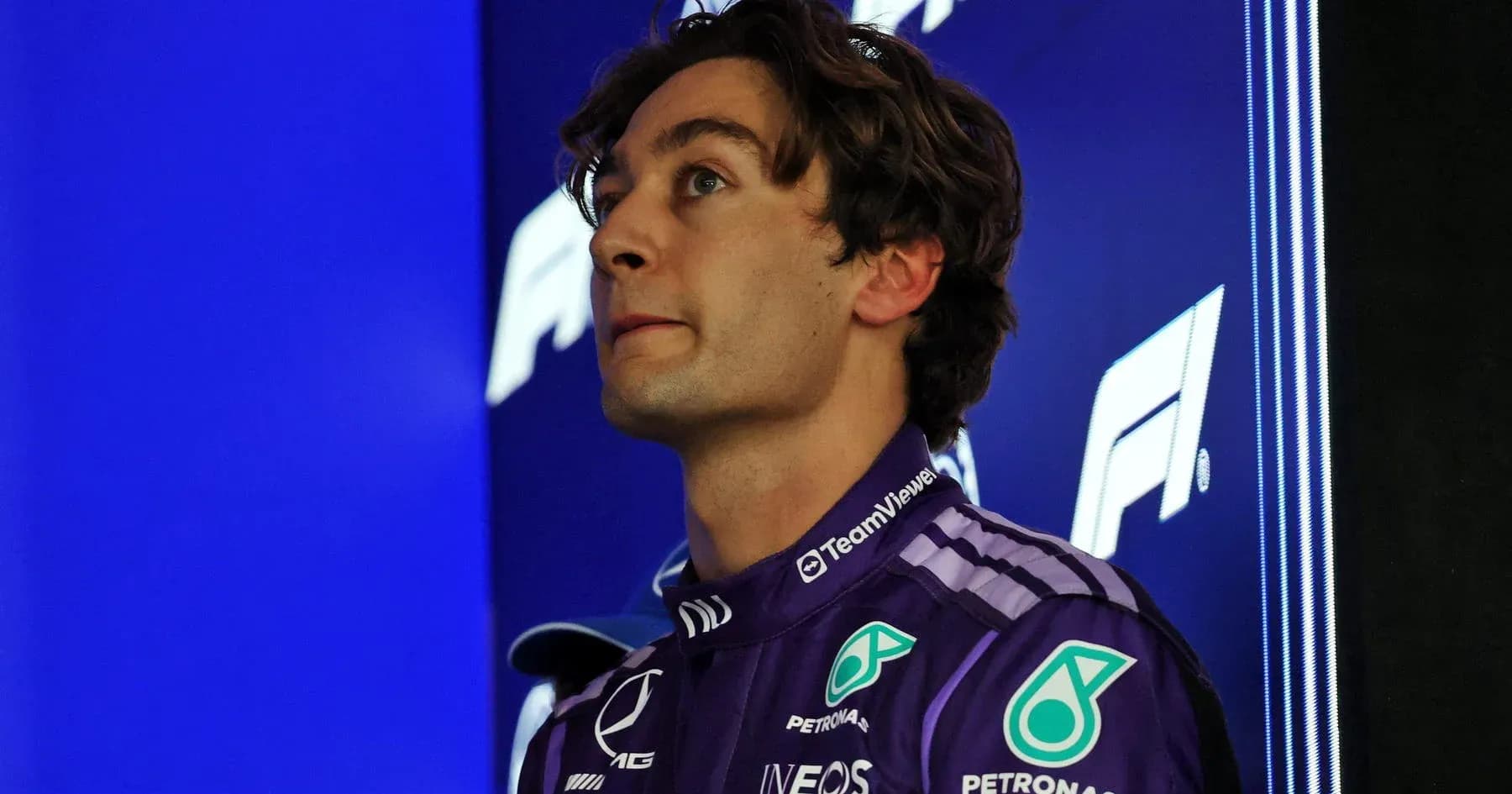
He was not alone in his frustration. George Russell had put in some of his sharpest work of the year to climb from seventh to third, right on Norris’ tail. On raw pace, he looked the most likely to challenge the McLaren.
Then he threw it away on pit exit. A spin on cold tyres turned a 1.2‑second gap into a 20‑second chasm. His chance was gone in a heartbeat.
Yet the bigger picture at Mercedes told a different story. Fourth and fifth for Russell and Antonelli were enough to clinch the constructors’ championship. Title number nine. Their first since 2021. A return to the summit after years of bruising lessons in the ground-effect era.
Antonelli parked his own disappointment quickly.
“The team, you know, take the title, we take the title for the team and they all deserve it,” he said. Pride in the group trumped frustration over the spin.
Wolff’s warning about the new era
Toto Wolff, too, allowed himself a moment of satisfaction before turning back to the hard questions.
He pointed to the second half of the season as a reality check. Mercedes had dominated early, but Ferrari, McLaren and Red Bull all reeled them in. Recent upgrades had not delivered as expected. Interlagos underlined the shift: four teams now arrive at each race believing they can win.
“Look at the last few races,” Wolff said. “We haven't won.” At the start in Brazil, Antonelli “was just storming away”, and it looked like their day. By the flag, the margins told a different story.
Wolff does not see this as the start of another Mercedes steamroller. The era of runaway seasons, he believes, is gone. The field is too professional, too well resourced, the development race too tight. One wrong upgrade and you slide from dominant to third-best in a matter of weeks.
He knows that story well. The last four years, he said, were spent lurching between thinking they had understood their problems and realising they had not. The numbers were not disastrous, but the feeling inside the team was.
That is why this double – drivers’ and constructors’ titles – carries weight. It proves they have found their way back. It also underlines how hard staying there will be.
“It looks like the most maybe competitive era that is about to start,” Wolff said. Four teams, four philosophies, one razor-thin margin for error.
Norris, on Sunday, lived on that edge and never slipped. If this is the new normal – four giants trading blows in changing conditions, with no one able to break free – then Sao Paulo may not just be one of his best wins.
It may be a glimpse of the kind of perfection every champion will need just to survive the next generation of Formula 1.