Think back to Sochi, 2021. The story has already hardened into cliché: Lando Norris, on the brink of a first Formula 1 victory, throws it away with terrible judgement as the rain falls.
That version is convenient. It is not accurate.
What happened that day did expose a McLaren weakness in the way the situation was handled, but it also showcased one of Norris’s greatest strengths. In the most treacherous phase of that Russian Grand Prix, when the track sat on the knife-edge between slicks and intermediates, he was finding grip where others tiptoed. He was lapping quickly enough to win that race in conditions that break lesser drivers. Only when a second, heavier band of rain swept in did the whole thing unravel.
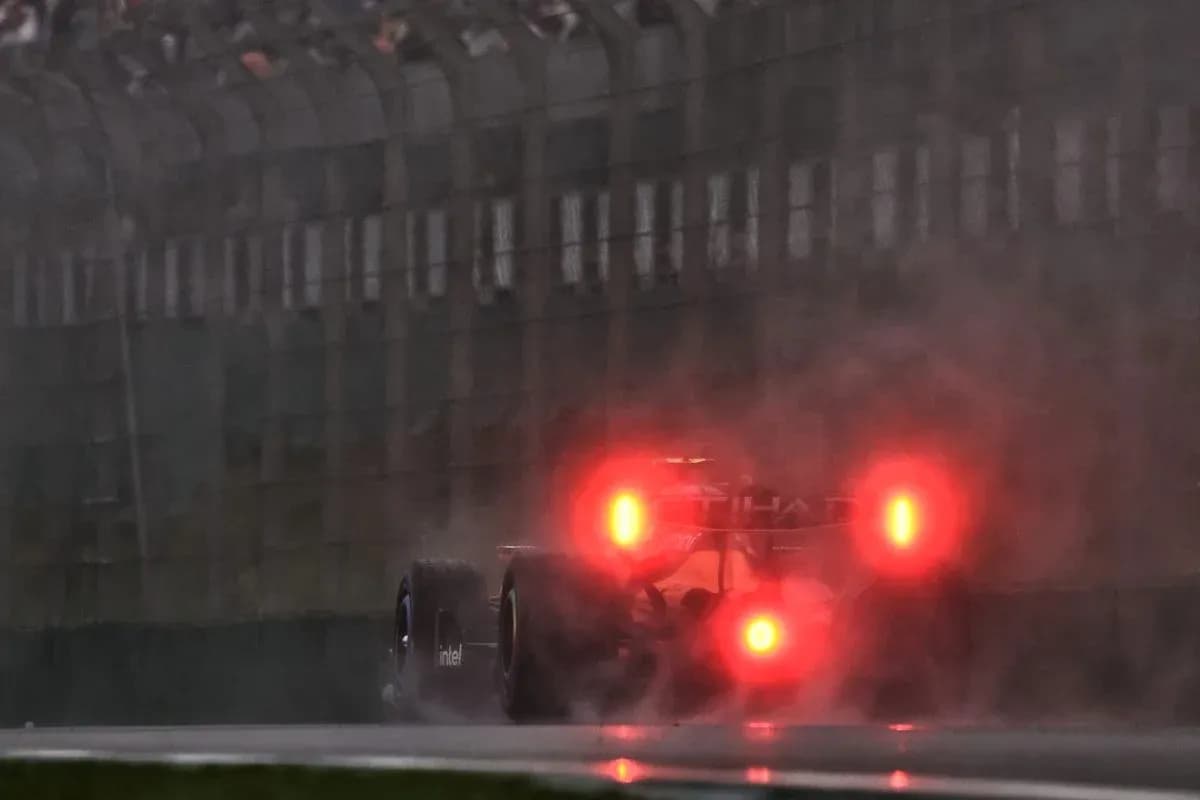
That drive came flooding back as Norris controlled a wet-dry-wet Brazilian Grand Prix from pole, underlining just how sharp his instincts are when the weather turns spiteful. This time, the judgement matched the speed.
He had some luck. George Russell’s final Q3 lap was compromised by traffic in the shape of Alex Albon. Kimi Antonelli, who had led early, faded with problems of his own. But the core of the story at Interlagos was familiar: Norris reading a changing track faster than almost anyone else and bending the car to his will.
He wasn’t the outright quickest at every phase of the race. He didn’t need to be. When the surface hovered in that awkward middle ground – too dry for full wets, too greasy for full commitment – that’s when Norris did his damage, time and again.
It fits a pattern that stretches across his Formula 1 career. Count the wet or rain-affected grands prix: four of his 14 wins have come with the weather as a major character, with this year’s Zandvoort victory sitting on the extreme edge of that category thanks to a patchily damp track at the start. Around those wins sit a string of soaked or slippery cameos: the 2024 sprint in China, his Brazilian Grand Prix pole the same year, the ferocious but ultimately ill-timed charge in mixed conditions in Canada two seasons ago, even that Las Vegas pole lap a year earlier when he was so rapid for most of the lap that a huge slide late on still couldn’t keep him from the top spot.
Inside McLaren, this isn’t seen as a coincidence or a quirk of timing. It’s part of the driver they believe they have.
“When Lando operates at his best, he’s definitely one of the best drivers on the grid,” said team principal Andrea Stella after the Interlagos win. “When you have mixed variable conditions, he is one of the fastest in finding the limit.
“You have seen this [at Interlagos] as well. When the track was in the middle between dry and wet was when he was probably gaining most on anybody else.
“He’s very sensitive in understanding how much grip is available. Very, I would say, even complete as a driver from a technical point of view in terms of understanding how to deploy his tools to use the grip that is available, or to adapt to the balance of the car.”
Yes, Stella has a vested interest. Team bosses are not known for underselling their lead driver. But the timing and the weight of the evidence on track, built up over eight F1 seasons, give his words substance.
Outside the McLaren garage, the perception lags behind the reality. A poll of newsletter subscribers recently asked who is the best wet-weather driver in Formula 1. Just under 6% chose Norris. Max Verstappen dominated the vote with 74%, Lewis Hamilton followed on 13.6%. Norris barely scraped into the conversation.
That’s the gap: reputation versus record.
He is a world champion now, with 14 grand prix wins, yet still somehow treated in some quarters as an overachieving understudy rather than a fully-fledged leading man. Verstappen remains the benchmark for relentless, week-in-week-out brilliance. Hamilton’s catalogue of rain-soaked masterclasses is part of modern F1 folklore. But on the pure, raw driving side – on days when the track offers no grip, no rhythm and no mercy – Norris belongs in that same breath.
He is not flawless. No one who races on the edge in the wet ever is.
Critics don’t have to look far for ammunition. Spa 2021 is the obvious one: after dominating Q1 and Q2 in appalling conditions, he crashed heavily at Eau Rouge in Q3, a brutal reminder of how narrow the margin can be when you chase that final fraction of performance. Or take the 2024 Brazilian Grand Prix, when a miserable wet race from pole unravelled with repeated brake-locking. Stella was quick to stress that the problem lay more in the car’s traits than the driver’s decision-making, but the result still sits in the record books as a missed opportunity.
Those blemishes, though, sit among a growing collection of days when Norris has looked like the man you’d want in the cockpit when the clouds darken and the radar turns ugly.
Verstappen and Hamilton will continue to carry the “regenmeister” labels, and with good reason. Their portfolios in the rain are thick and decorated. Yet Sunday at Interlagos served as a sharp reminder of something the numbers and the narratives have yet to fully acknowledge.
When the circuit is half-soaked, the lines are improvised, and the brave find time where others find only standing water, Lando Norris is not just in the mix.
He is a threat. Every single time.