Lionel Messi walked alone.
After 120 minutes in suffocating heat, at 39 years of age, he stood on the podium with a silver medal around his neck, eyes glazed, tears threatening but never quite falling. No outburst. No grand gesture. No replay of that broken night 12 years ago. No theatre for the cameras that had hounded him for half his life.
He just stood there and absorbed it. One last time.
Then he sat down on the grass – the same patch of green he once left convinced that international glory would always be someone else’s story – and slowly unlaced his boots. The final act of Lionel Messi, Argentina player.
No farewell tour, no script
He slipped out of the international game exactly as he lived most of it: quietly, on his own terms. No “Last Dance” production, no farewell interviews, no rolling tribute campaign. Silence until the football was finished.
That has always been the pattern. From the boy in Rosario, too small to be allowed to play with the older kids, to the man who bent World Cups and Champions Leagues to his will, Messi let the ball speak. When it stopped, he finally did too.
After more than 20 years, 207 caps, nine finals and four major trophies with Argentina – capped by the World Cup in 2022 – he has called time on his international career. The last line of the story is a defeat to a superior Spain, but that coda cannot touch the body of work that came before it, nor the way he dragged one more glittering tournament out of a 39-year-old body.
We sit in 2026 with Messi having completed the set. Every dream ticked. Every mountain climbed. It almost feels distant now that for so long the loudest accusation against him was that he could not do it for his country.
He can do it for Barça, but not for Argentina.
That was the refrain. It came from rivals, from pundits, and, more painfully, from sections of his own people. His family heard it. He heard it. The criticism turned to scorn, then to something uglier. The same voices now falling over themselves to praise him once dismissed him as a foreigner in his own shirt.
It took four straight lost finals. Years of watching other captains lift trophies. A tearful, short-lived retirement after Chile in 2016. Only then did the tide begin to turn.
The birth of La Scaloneta
Messi stayed. Others arrived.
Lionel Scaloni on the bench. Rodrigo De Paul, Cristian Romero, Emiliano Martinez in the spine. The old guard of Angel Di Maria and Nicolas Otamendi refused to leave. Argentina built something different, something hard, something united around the number 10.
In 2021, at the Maracana, against Brazil, the dam finally burst. Argentina, in their rival’s fortress, with Messi carried off the pitch in tears of joy rather than despair. Once that barrier shattered, the flood was merciless.
Enzo Fernandez, Julian Alvarez and a new wave joined the cast. Argentina turned from nearly-men into a machine, steamrolling almost everything in front of them – Saudi Arabia the lone shock on an otherwise relentless march – to three more trophies, including the 2022 World Cup. La Scaloneta became a nightmare draw. Nobody wanted that dressing room, that anthem, that captain.
By the time this last tournament arrived, Messi was no longer chasing Argentina’s history. He was presiding over its greatest era. A generation of schoolchildren had never seen their country lose a knockout match with him on the pitch. The man once branded an international failure now owns so many medals that his critics have been reduced to muttering that the game must be rigged in his favour.
Numbers that barely scratch the surface
The sport is losing its central figure. The numbers alone feel like fiction: 91 goals in a calendar year. Eight Ballons d’Or, four of them before his 26th birthday. More than 1,300 goal contributions. Forty-four trophies.
They will stand for years, perhaps decades. Yet for all their weight, they still miss the point.
Football is not a lab experiment. It is not solved on a whiteboard. It is an art, and nobody painted with the ball quite like Messi.
Talent explains only part of it. It does not explain how, with his father on his deathbed, he still dragged Argentina back to a World Cup final and outplayed opponents closer to his children’s age than his own. It does not explain how a man who has conquered everything still plays every match as if someone might take the ball away from him tomorrow.
Writers have spent entire careers trying to pin him down in adjectives and metaphors. None of it quite lands. Maybe that is the point. The statistics tell you what he did. They do not tell you what it felt like.
A shared memory bank
Ask 100 fans what they will remember and you will hear 100 different answers.
Some will go straight to the solo runs – against Real Madrid, Athletic Club, Getafe – when he seemed to slalom through a different gravity. Others will picture the familiar patterns: the cutback from Jordi Alba, the whirring geometry of MSN, the triangles with the greatest midfield trio of their era.
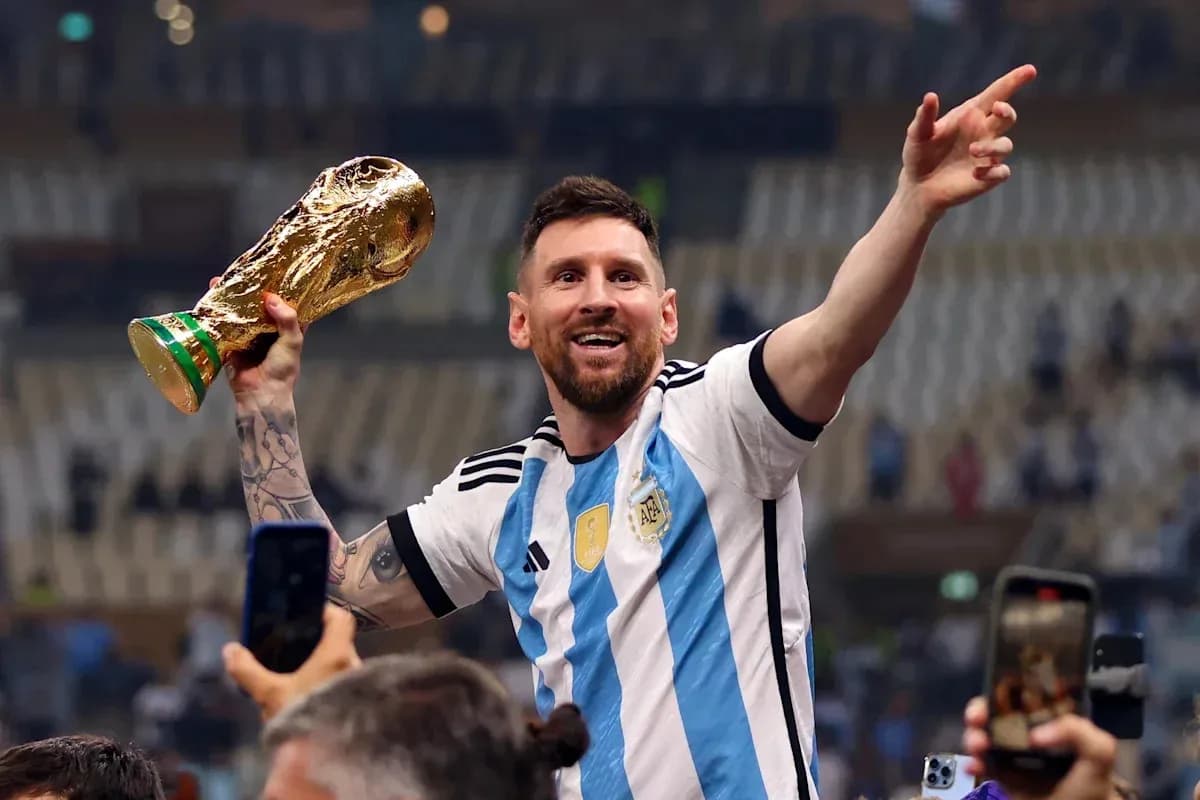
Many will see him in the air in Berlin, in Rome, in London, in Doha. Champions League trophies hoisted to the sky. La Liga titles stacked like novels on a shelf. The World Cup finally in his hands, blue and white confetti sticking to his hair.
La Pulga gave the sport thousands of freeze-frames. For some, though, the real gift was simpler: the sensation of watching someone who had mastered his craft so completely that the game seemed to slow to his tempo. A first touch into space that opened a new angle. A wall pass played with the wrong foot at the right moment. A feint that sent a defender towards a ghost.
He made the impossible look inevitable.
Then came the passes only he could see, the seams in a back line only he could find, the locked doors that opened because he decided they would. On top of that, he just happened to be the most prolific scorer the sport has known.
The childlike reaction of grown adults
His retirement from the international stage triggers a reaction usually reserved for toddlers. Tears, confusion, refusal. No amount of growing up, schooling or degrees makes it easier to process.
At its core, football is still a kids’ game. Adults dress it up with tactics, data, conditioning, corporate boxes and broadcast rights. One man cut through all of that. Messi reminded people why they fell in love with it in the first place.
He made adults feel like children again, yelling at a television, begging for one more goal, one more season, one more dance down the right flank. Nobody wants him to stop, because nobody wants that feeling to end.
Very few players have possessed both the talent to become an icon and the temperament to carry it. Messi did. He led with his feet, but also with a quiet authority, a humility that never quite matched the scale of his genius.
He inspired a generation that shaped their lives around him. They sold possessions and crossed oceans to see him live. They sprinted home from school to catch kick-off at Camp Nou. Some of them grew up, pulled on the Argentina shirt and ran for him, not just with him, in Qatar and beyond.
They had watched him suffer, lose, come back again and again. When the moment finally came to repay him, they emptied themselves on every blade of grass.
The man behind the legend
The tributes that flood in now are not just about the goals or the trophies. They are about the person. Former teammates talk about the captain who listened, the star who stayed late, the friend who shielded them from the glare.
He redefined what it meant to be a superstar in a team sport. He did not just raise his own level; he lifted those around him. That selflessness, that willingness to share the light, is a large part of why he walks away from international football as an undisputed champion in the eyes of almost everyone who watched him.
His career is not over. Far from it. He is still in Miami, still scoring – four goals just last week – still playing alongside friends, still drawing crowds who want to say they saw him once. But the World Cup final, and now this last deep run with Argentina, feel like the final high-stakes chapters.
There is an injustice in that, in a way. At 39, he again showed the world he remains the best player on any pitch he chooses to grace. Yet there is nothing left to prove. Not to his country, not to his clubs, not to himself.
He arrived as a shy teenager with a left foot that did not make sense. He leaves the international stage as the defining figure of his sport.
The next World Cup will kick off without him. The anthem will play, the cameras will pan across new faces, and somewhere in the stands or on a sofa, a child will ask a question that has never been asked before:
“Who plays Messi’s role now?”