Only a year ago, Liverpool opened the Premier League season with five straight wins and looked nailed on to defend their title under Arne Slot. The first of those came against Bournemouth, coached by Andoni Iraola, on a warm, optimistic opening night.
No one in the ground that evening was sketching out this twist: Slot gone, Iraola in his place, and the Basque returning to the south coast as Liverpool manager before the next season was out.
Football moves fast. Brutally fast.
From home dugout to away dressing room
Twelve months on, Iraola walks back into Bournemouth not as the home architect of a survival story, but as the visiting coach of a club that expects trophies, not tales of plucky overachievement.
Liverpool under Iraola are six points worse off than at this stage last season, yet still unbeaten in the league. That paradox sums up his early months: sturdy, promising, but not yet convincing a fanbase raised on Jurgen Klopp’s heavy-metal certainty.
The trip will feel strange. Bournemouth have even had to renovate the away dressing room to meet Europa League regulations, a small but telling reminder of how far the Cherries have come and how much the landscape has shifted since Iraola left.
He’ll step into a slightly smarter, more comfortable space. The emotions will be anything but.
A coach who lives on the grass
Iraola has traded the south-coast seaside for the sand dunes of Formby, following a path Klopp and Brendan Rodgers also took. Away from the pitch he is settling in, spotted around the city centre, taking to the coastal cycle routes that cut along the Merseyside shoreline.
But his real habitat is Kirkby, not Crosby. Cones, not coffee shops.
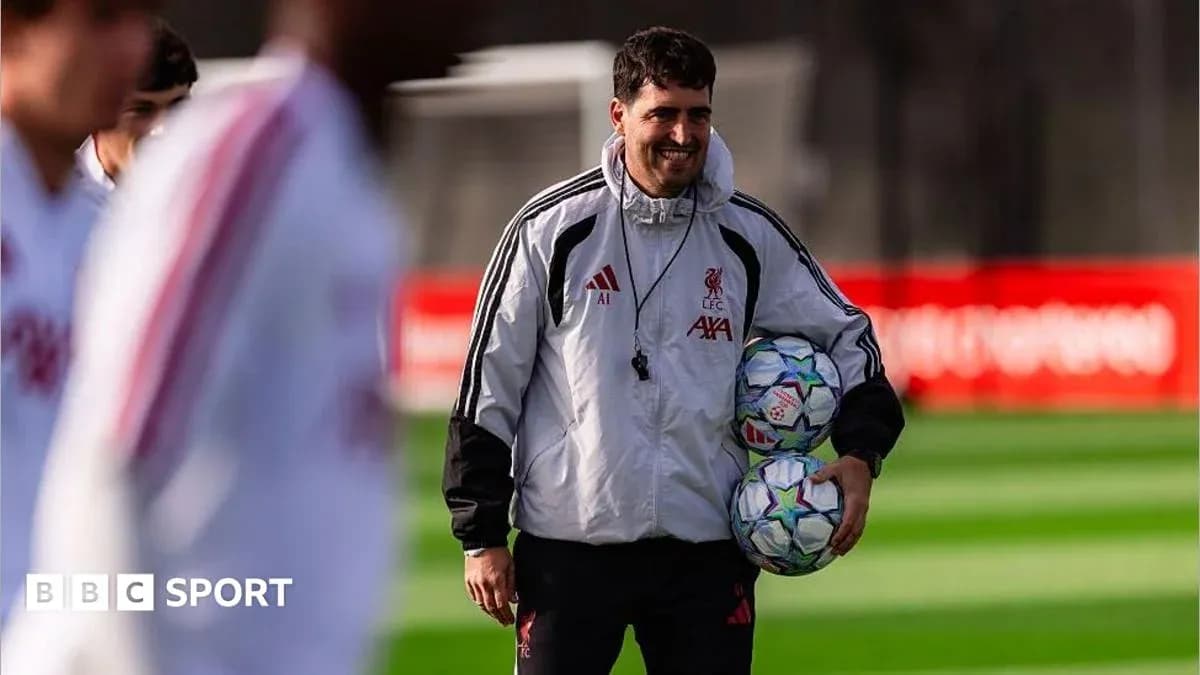
At Liverpool’s AXA Training Centre, staff talk about a “six days a week” coach who lives for sessions. He is often the first one out on the pitch, marking out grids and lanes himself. No delegation, no shortcuts.
“It’s really intense. There’s a lot of hard work and no sort of light days. Everyone’s putting in 100%,” said forward Lewis Koumas. That single sentence captures the new regime more neatly than any tactics board.
Inside the building, Iraola keeps a lower profile than some of his predecessors. He rarely shuts himself away in his own office, preferring the coaches’ room alongside Tommy Elphick, Shaun Cooper and long-time ally Pablo de la Torre. The image is clear: a head coach in the thick of it, not perched above it.
De la Torre, who followed him from Rayo Vallecano to Bournemouth and now to Liverpool, is central to the project. His job is to ensure the players can actually sustain the ferocious physical standards Iraola demands, rather than just talk about them in theory.
Learning Liverpool’s calendar the hard way
The change at Liverpool is not as radical as it might look from the outside. The club’s head coach model is tightly structured; the framework was built long before Iraola walked through the door.
Where he is on a steep learning curve is the calendar. Bournemouth’s schedule and Liverpool’s are not cousins. They’re from different planets.
This season Liverpool will play at least 49 matches, with the total potentially pushing into the 60s depending on cup runs. That load has forced Iraola into constant dialogue with the medical and fitness departments at Kirkby, a daily balancing act between intensity and survival.
The training timetable reflects it. Rather than a fixed daily slot, sessions now slide around the clock, tailored to the next kick-off. Late afternoon and early evening workouts have become a feature. Under Slot, Liverpool tended to train at roughly the same time each day. Iraola has torn up that routine in search of marginal gains in freshness.
He has also opened clear lines with the academy and Rob Page, who leads the Under-21s. The aim is simple: one idea of football, from kids to first team.
“We have an understanding of how the first team play and key principles, like how we press, how he wants his number 10 to press, how he wants his number eight to press, how he wants his centre-backs to press – we mirror that absolutely,” Page explained. The phrasing is telling. This is not just a vague alignment; it is a carbon copy.
A clear structure, a young squad
Earlier this week, Dominik Szoboszlai laid out the blueprint in public: Liverpool play with a number six, a number eight and a number 10. It sounds simple, but it comes with a condition. In Iraola’s system, the collective has to tighten up to compensate for the lack of a traditional destroyer, despite supporters calling for a defensive midfielder in the summer window.
The club backed Iraola because of his track record with young players. The numbers already reflect that faith. The average age of Liverpool’s Premier League squad this season is 25.3, with only five teams in the division fielding younger groups.
The names are starting to surface. Rio Ngumoha, 18, Trey Nyoni, 19, and Koumas, 20, all started against Tottenham in the Carabao Cup. None of them are expected to drift back into the shadows. All three are pencilled in for larger roles than they had last season.
Intensity is non-negotiable. That word follows Iraola around every club he touches. Yet he knows the Premier League and Europe will not allow Liverpool to sprint through every minute of every game.
The reality hit last weekend. Liverpool top the league charts for sprints this season, but three days after beating Atletico Madrid in the Champions League, they looked flat in a goalless draw with Fulham. The legs were heavy, the press dulled, the final third blunt.
Sunday’s match at Bournemouth will be their fourth in 12 days. After the international break, they face four games in 10 days. Between 11 October and 7 November, Liverpool will play nine times. Even the fittest squad bends under that kind of strain.
Iraola understands that some matches will have to be decided by a set-piece routine or a flash of individual brilliance rather than the full-throttle press he idealises.
Managing the message
If the physical demands have been steep, the media glare has been just as sharp.
A pre-season interview with LFC TV after a friendly against Monaco offered an early lesson. Iraola admitted Liverpool had “run out of steam” after 30 minutes and didn’t yet have the energy levels to play with his desired intensity. Inside the camp, it was understood as an honest assessment of conditioning.
Outside, the line travelled fast and lost context. At a club the size of Liverpool, every phrase is a headline waiting to happen.
Since then, Iraola has handled his press conferences with a calm, pragmatic tone. He answers questions, invites discussion, but he knows every word can ricochet around social media within seconds.
His approach with the squad has its own quirks. He prefers to name the team on the morning of a game, not days in advance. The post-match debrief waits until the following day, once emotions have cooled and data has been sifted. It is his way of keeping the group focused on process rather than noise.
Unbeaten, but not satisfied
For all the talk of systems and sprints, one statistic will follow him into the Vitality Stadium: Iraola has not lost a Premier League game since January, spanning his time at Bournemouth and Liverpool.
Yet the mood on Merseyside is not one of celebration. Last season’s 12 league defeats scarred the club. Becoming hard to beat is a necessary correction, but not the end goal.
Alisson, the vice-captain, cut through the diplomacy last week. Draws are not good enough for Liverpool. Not for a club that measures itself against titles and finals.
That is the standard Iraola has walked into. Not just to stabilise, but to compete at the very top, while overhauling the age profile of the squad and embedding a demanding style in the most congested season of his career.
On Thursday night, he will have watched Bournemouth’s Europa League debut win over Real Sociedad with a quiet sense of pride. A club he helped reshape, winning on European soil in the Basque region where he grew up. It would have stirred something.
Now comes the return. The flight from Liverpool to the south coast on Saturday will offer him a rare pocket of stillness. A chance to look back at the journey from Rayo Vallecano to Bournemouth to Anfield, and ahead to what comes next.
Liverpool’s start under Iraola has been solid rather than spectacular. Unbeaten, yet under scrutiny. Respectable, yet restless.
On Sunday, in a familiar stadium and a refurbished away dressing room, he has the chance to turn all that running, all that intensity, into something more tangible.
A win on old ground would not just send Liverpool into the international break with momentum. It would mark the first real statement of what an Andoni Iraola Liverpool might become.