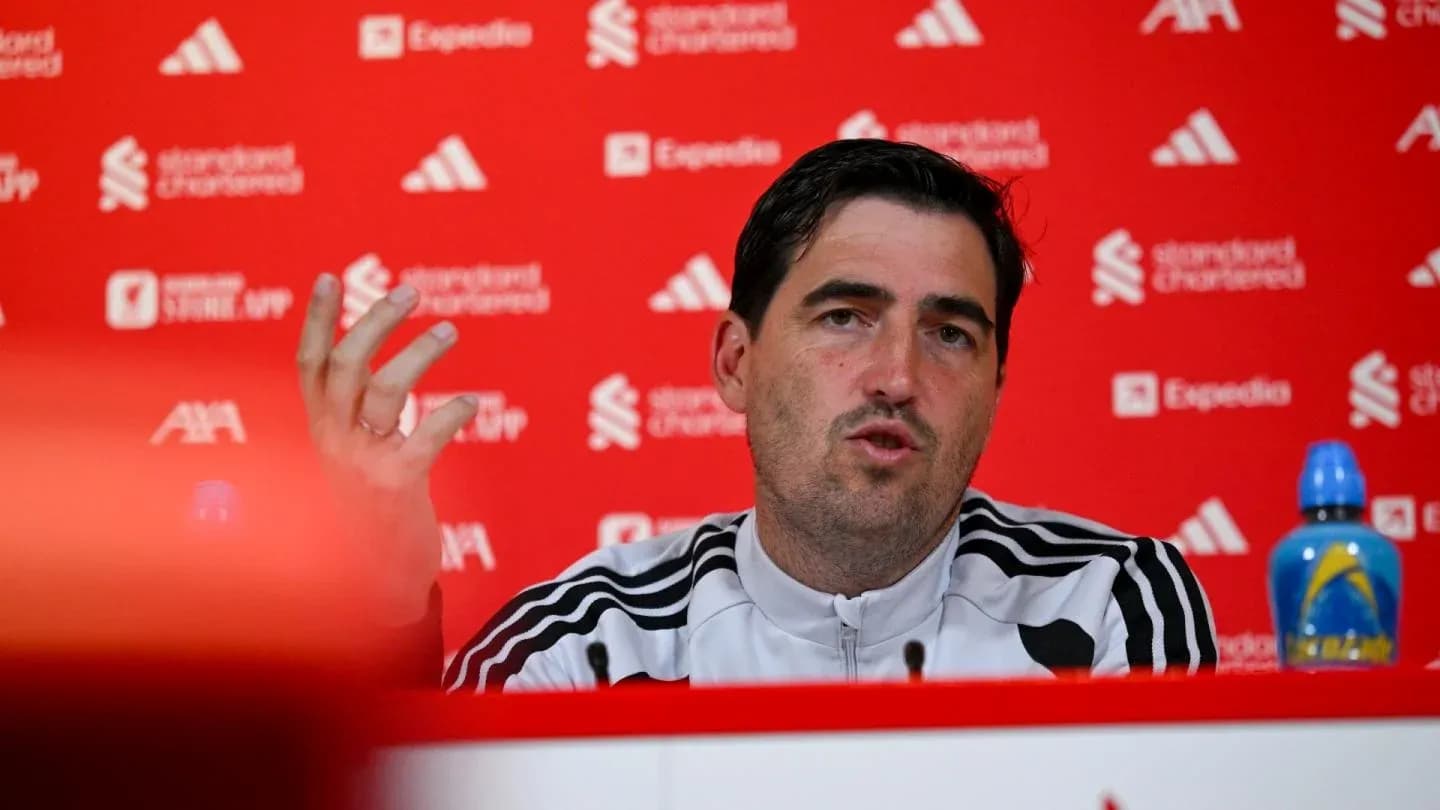
Liverpool’s head coach will walk out at Anfield for his first Premier League home game this weekend with two things on his mind: finding wingers and finding balance.
The setting is familiar, the role anything but. Speaking at the AXA Training Centre before Nottingham Forest’s visit, he cut a clear figure: ambitious, impatient for reinforcements, and absolutely unwilling to sacrifice Liverpool’s attacking edge in the pursuit of control.
“We don’t have the numbers” – the hunt for wingers
He did not dance around the transfer issue. Liverpool are short out wide, and everyone in the room knew it.
“As you know, we are trying to sign in that position,” he said. “It’s evident that we are trying to improve or try to fill that position because we don’t have the numbers. I hope we can have good news soon but we are still not there.”
No names. No hints. Just the blunt admission that the squad is light in a key area and the clock is ticking. Talks with the club have been ongoing “since the beginning,” he stressed, and he already has a clear picture of what he wants. Now it’s about execution.
“I don’t know what’s going to happen,” he admitted of the final days of the window. “We have to be patient – even myself – for another four or five days and then we will know. I will be comfortable the first of September, or the second in this case, when they tell me, ‘OK, this is who we are, this is the options we have.’”
Until then, he works with what he has. And what he has is a team still learning how to live on the edge without falling off it.
Walking the tightrope: attack, defend, repeat
Liverpool’s opener against Newcastle was a reminder of what this side can be with the ball – and what it can suffer without it. They drew 2-2, created plenty, but were stung in transition.
“Yeah, that’s the key – the balance,” he said. “You don’t want to lose this, the offensive side, the fluidity, the arrivals with numbers, but obviously we were punished the other day, especially in the first goal. I think we don’t do a proper lockdown.”
He was quick to point out this is not a new obsession suddenly born from one game. This is the work. Every day. Every session.
“There is a balance. We cannot go from one way where we send a lot of people forward to after we keep everyone so we don’t arrive with numbers, everything looks very stale.”
The answer, in his eyes, is not a rigid structure dictated from the touchline, but players who can read danger in real time.
“You cannot be with the joystick every time with the player,” he said. “There are players that are very good, they’re smelling, ‘OK, there is real danger, I can’t take the risk of going. Now I think I have to stay.’ This is also the quality of the player who takes those decisions.”
That applies especially in midfield, where he refuses to chain his most dynamic players to the centre circle.
He referenced a pre-season goal against Monaco: a one-two between Ryan Gravenberch and Dominik Szoboszlai, then a pass to Alex Isak and a finish that drew nothing but praise.
“No-one asked me, ‘Why are you leaving Ryan Gravenberch and Szoboszlai there on the edge of the box both together?’ No, they said, ‘Incredible goal, lovely goal.’”
He doesn’t want fear to replace that instinct.
“Obviously we cannot attack with everyone and then leave everyone at the back, but also there is a balance there. Sometimes you have to accept it… Depending on the situation and depending on where is your opposition.”
If the opposition sits deep, numbers can flood forward. If they leave runners high, the brakes have to go on. That recognition, he said, “is the job we have to do now.”
“Meaningful possession” – why he liked the Newcastle performance
For all the post-match noise about control, he pushed back at the idea that Liverpool were loose.
“I felt we controlled the game, honestly, quite well the other day,” he said. “Obviously you concede two transitions and you can tell me, ‘No, but you conceded…’ and it’s true, but I think we had a meaningful possession.”
This wasn’t sterile dominance for the sake of it.
“I felt like we were quite direct in our attack, we stayed most of our game very far,” he explained. “I was feeling during the game… we are closer to scoring than Newcastle are in most parts of the game.”
The scoreboard, of course, doesn’t care about feelings. It ended 2-2.
“It’s true that you don’t win, you draw 2-2 and you cannot change this, but I felt we did a lot of good things in the first game.”
The message is clear: refine, don’t rip up. The structure stays, the details sharpen.
Forest, Glasner and the battle for space
Any romantic notions about his first Premier League game at Anfield are tempered by the opponent. Oliver Glasner’s Forest are organised, stubborn and hard to break down.
“I think he has been very successful,” Liverpool’s head coach said. “You can see straight away the shape, they don’t concede a lot of chances.”
He pointed to Forest’s narrow defeat to Leeds, decided by a 90th-minute free-kick.
“It was a very tight game, not a lot of chances and Leeds won because they scored a free-kick in the 90th minute. But probably Forest even had more chances than Leeds until that moment.”
That is the warning. This is not a side that rolls over.
“We will have to earn every chance. They don’t give you anything for free,” he said. “You have to be very good on the ball, be patient sometimes because they defensively are very solid… And after they have also very good players up front – like every Premier League team – and we have to control those situations, especially in the transitions because they also have good threats in the counter.”
So the same themes return: patience, precision, protection. Attack with intent, defend with numbers, and don’t lose your head when the game slows.
An emotional first league step at Anfield
Amid the tactical talk, there was a rare personal moment. This will be his first Premier League match at Anfield as Liverpool head coach. That matters.
“It’s definitely a special moment for me,” he admitted. “I think I already felt it in pre-season. So when the competition starts for me, it’s going to be – I will be thinking of the game and the things that I need to think – but I think it’s going to be emotional and I think it has to be like this.”
He knows what it took to get here.
“It is a special place. I’ve had to fight a lot to arrive to this place and I hope everything goes well and I can enjoy also the game.”
Enjoyment, though, will depend on control – of space, of emotion, of risk.
Jacquet’s baptism and the demand for bravery
One of the more striking calls on opening weekend was the Premier League debut of Jeremy Jacquet, thrown in with only “basically 45 minutes of pre-season” behind him.
“I think overall he played very well, considering it’s his first game,” the coach said. The decision to withdraw him late on was about fatigue, not faith.
“It’s true that he finished tired; we had to sub him because I was feeling the last five minutes on the pitch he was tired. You can feel it, especially with centre-backs.”
The positives were obvious.
“He’s been very confident on the ball, good without the ball and he’s very young, a new signing. For sure he will make some mistakes, we have to accept this, but he’s performing and training very well for me.”
That line could apply to more than just Jacquet. This is a young Liverpool in certain areas, evolving under a new voice, encouraged to play on the front foot but told to grow up fast in their decision-making.
The head coach wants width from the market, control from his midfield, bravery from his defenders and patience from the stands. The window shuts in days. Forest arrive in hours.
How quickly Liverpool can stitch all of that together at Anfield will tell plenty about where this season is really heading.