
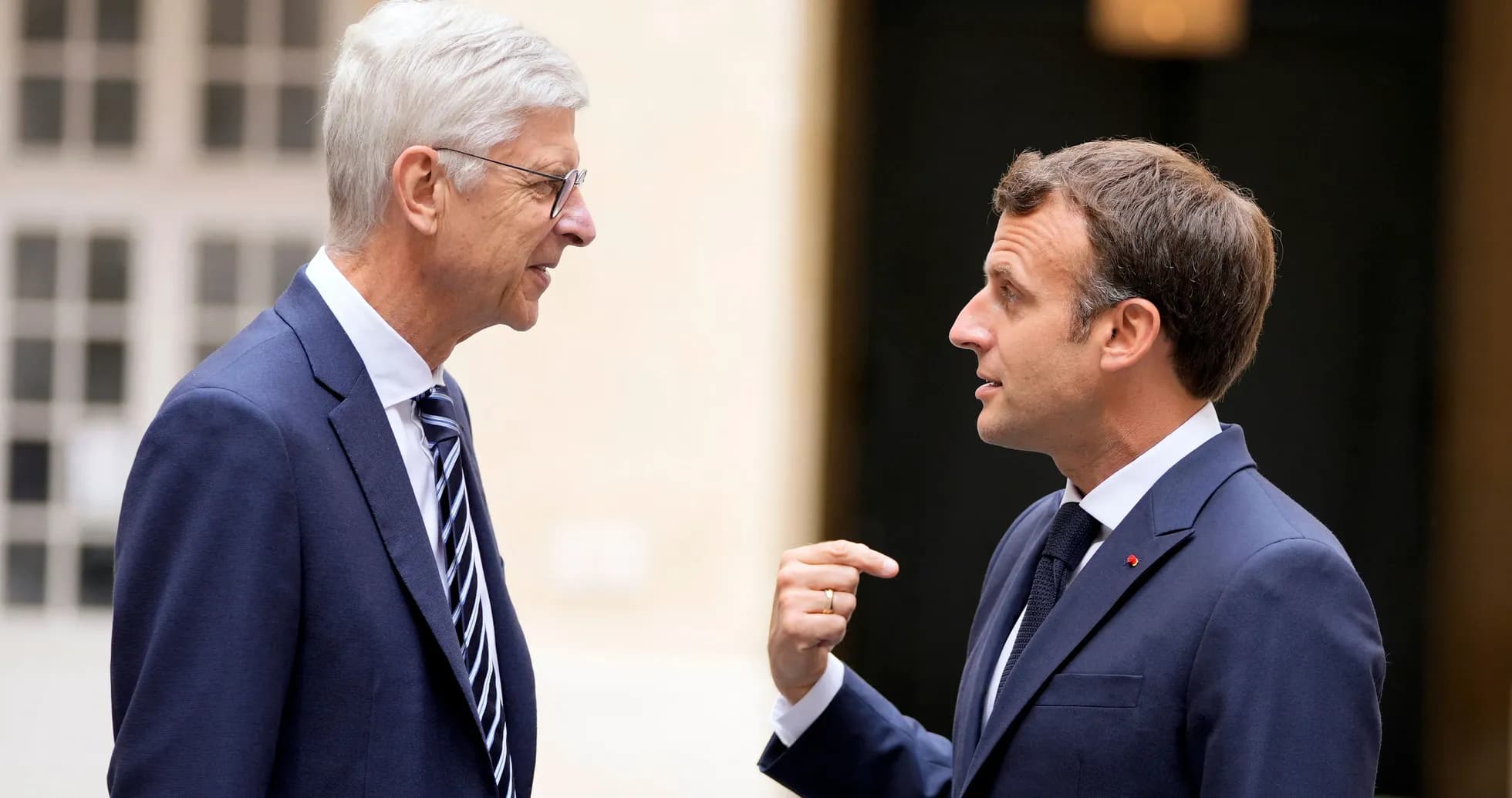
Emmanuel Macron has stepped directly into FIFA’s future. According to German newspaper Bild, the French president has privately pledged full backing to Arsène Wenger if the former Arsenal manager decides to run in the next FIFA presidential election – and has even offered to rally other heads of state and government behind him.
That is no routine endorsement. It drags world football’s most powerful office out of the confines of Zurich and straight into the arena of geopolitical muscle.
A Deadline, A Decision, And A Dilemma
The clock is ticking. The deadline for submitting candidacy papers is 18 November, just days away, and all eyes are on Wenger. His decision is expected this week.
Does “the Professor” step into the fiercest contest of his career and challenge the man who brought him into FIFA? Or does he stay in the shadows of power, shaping policy without owning the office?
The election itself is set for March 2027. Gianni Infantino wants another term. He has the machinery, the contacts, the institutional memory. This time, though, he may not face a token opponent or a fragmented field. He could face a figure who carries enormous respect across the game, armed not only with a reformist reputation but with heavyweight political cover from the Élysée Palace.
From Ally To Adversary?
The potential twist is rich with irony. Infantino personally brought Wenger to FIFA in 2019, a year after the Frenchman stepped down from Arsenal and retired from coaching. He handed him a grand title – Chief of Global Football Development – and a broad mandate. Wenger quickly became one of the most influential voices inside the federation, shaping debates on formats, calendars, and the sport’s long-term structure.
Now that trusted lieutenant may become the president’s most dangerous rival.
Tension between the two men has surfaced in recent months. Wenger publicly criticised Infantino’s controversial plan last summer to bring private sector investors into FIFA, warning that such a move risked reshaping the sport’s identity and bending it more aggressively to the logic of money.
Those comments cut close. They did not come from an outsider or a habitual critic, but from a senior figure inside the building.
The Reformist Who Divides Opinion
Wenger’s record within FIFA is complicated, and that is precisely what makes his potential candidacy so intriguing.
He emerged as one of the loudest advocates for a World Cup every two years, fronting an ambitious blueprint that would also see the European Championship played in odd-numbered years. The goal: rip up and rebuild the international calendar, concentrate national-team windows, and create a more regular rhythm for major tournaments.
The backlash was ferocious. UEFA, the global players’ union FIFPRO, and the Association of European Leagues and Clubs lined up against the plan. They attacked the already congested schedule and the physical and mental toll on players. By 2021, the project lay in ruins.
Yet Wenger did not walk away from change. He played a key role in the move to expand the Club World Cup and supported Infantino’s successful push to enlarge the World Cup to 48 teams. That mix – bold reform on one side, political pragmatism on the other – has defined his second career in football governance.
He is not the romantic purist some fans imagine. He is a negotiator, a builder, a man who understands that big ideas need votes, not just vision.
Contract Ticking Down, Stakes Rising
All of this unfolds against a personal countdown. Wenger’s contract with FIFA expires at the end of this year. No one yet knows if it will be renewed should he choose to stand against Infantino. That uncertainty only sharpens the sense of a looming break.
Remain inside the structure as a powerful technocrat? Or step outside it and try to take the top job?
If Wenger enters the race, he walks into a battlefield already tilted in Infantino’s favour. The incumbent has spent years stitching together alliances across the six continental confederations, cultivating federations large and small, and embedding his influence deep into the game’s political map.
Wenger would have to counter that with something different: a clean personal reputation, decades of high-level football experience, and the weight of French political power. Macron’s promise to rally other leaders behind him hints at a campaign that could stretch far beyond FIFA congress halls.
Football On The Edge Of A New Phase
Infantino’s calculations, Macron’s ambition, Wenger’s hesitation – they all converge on a single point: who truly runs world football, and on whose terms?
If Wenger steps forward, the 2027 election will not just decide a president. It will test whether the sport wants continuity under a seasoned political operator or a new era shaped by one of its great coaching minds, now turned power broker.
The papers are due on 18 November. Wenger’s answer will tell the game what kind of future it is ready to fight for.





