Formula 1 rolls into unknown territory this weekend. The Madring, wrapped around Madrid’s IFEMA Exhibition Centre and skirting the city’s main airport, is the championship’s first fresh layout since Las Vegas in 2023 – and it wastes no time announcing itself.
On paper it is a street circuit. In reality, only half of it feels that way. The rest has the permanence and flow of a purpose-built track, climbing and twisting its way towards a spectacular new landmark: La Monumental.
La Monumental: the amphitheatre corner
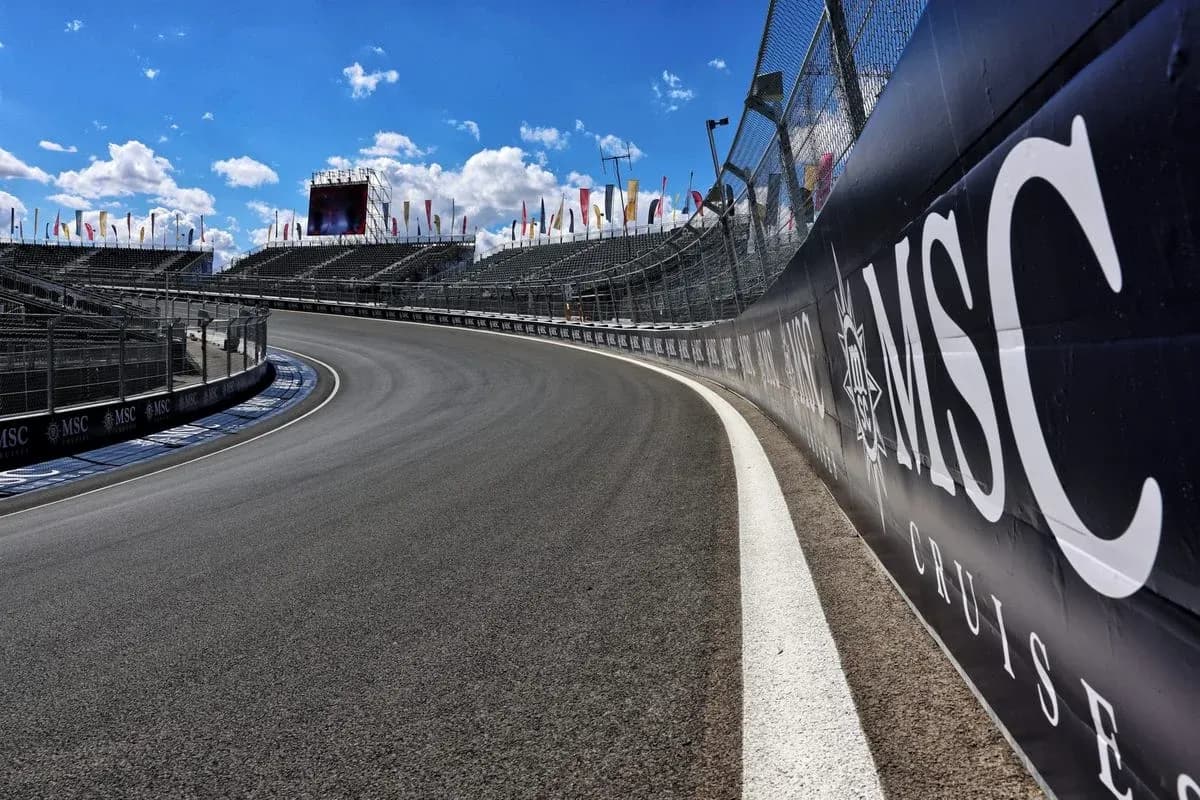
Everyone in the paddock is talking about it. The banked La Monumental corner has been the headline act ever since the first drawings leaked out, and now the full 550-metre arc stands finished and imposing.
From ground level, it’s dramatic. Grandstands tower above the banking, hospitality suites ring the inside, and the whole complex folds in on itself like an amphitheatre. It has the enclosed, fevered feel of Interlagos’ start-finish stretch – only this time the theatre is built into a single, sweeping turn.
Pirelli, teams and drivers have all circled it as one of the most technically demanding corners of the season. The banking will tempt aggression, but the real question is whether the surface and geometry will allow multiple racing lines. If it does, La Monumental won’t just look like a showpiece. It will decide races.
The sting at Turn 5
La Monumental may grab the photos, but the circuit’s nastiest surprise could lurk much earlier in the lap.
Turn 5/6, a chicane at the end of the track’s quickest stretch from Turn 3, already carries scars. F3 testing has left clear tyre marks that sketch out the story: misjudged entries, kerb strikes, and cars running out of room.
Drivers arrive there at the end of a long, sweeping blast, then are asked to thread a tight change of direction. The kerbs will demand respect. The real danger, though, is the barrier angle on exit, which narrows the available road into a pinch point. Get greedy with the throttle or bounce too hard over the kerb and the wall waits, uncompromising and close.
Add in the heavy braking Turn 17 right-hander, approached after a rapid left-hand sweep, and Madring starts to look like a circuit that punishes laps driven on instinct alone.
A smooth surface, sharp edges
For a layout billed as a street track, Madring’s surface is almost unnervingly pristine.
A walk of the circuit reveals silky, uniform asphalt, with none of the vicious bumps that have plagued other temporary venues. Teams should be spared the usual compromise of hiking ride heights to survive hidden undulations, which will please engineers and drivers alike.
The edges, though, are unforgiving. In many sections the walls draw the line for track limits. Where there is room to stray, painted kerbs and white lines set the boundaries, backed up by the familiar ribbed paint used at Jeddah, Miami and Austin. Those tiny ridges give drivers a tactile warning through the wheel and the seat – step beyond them and you’re flirting with penalties or concrete.
Smooth under the tyres, brutal if you misjudge it. Classic modern F1.
A paddock on a different scale
Away from the asphalt, Madring delivers another shock: the sheer size and oddity of its paddock.
The garages are buried within the IFEMA exhibition complex, which has forced a layout unlike anything else on the calendar. Instead of the usual continuous row of team bays, there’s a yawning 150-metre gap in the middle between Williams and Racing Bulls, filled by the media and TV pen.
Behind the garages, the picture becomes even stranger. Trucks and engineering offices scatter around the complex, while hospitality lives in its own zone entirely. Some teams operate out of air-conditioned indoor spaces; others, including McLaren and Mercedes, work outside in the heat.
The spacing is so extreme that a walk between Williams and Racing Bulls – usually neighbours – now takes more than two minutes. For teams used to tight, efficient paddock choreography, this weekend will feel like operating in a small town.
A punishing pitlane
The quirks don’t stop at the paddock gate. The pitlane itself is a monster.
Between the two speed-limiter lines, the official pitlane length is 562 metres – one of the longest on the calendar. That’s only part of the story. The exit drags on as cars accelerate towards a right-hand concrete barrier before finally blending back in at the exit of Turn 3, rather than at Turn 1.
Pirelli reckons a stop will cost around 25 seconds, a hefty number in modern F1. Strategy calls will carry real jeopardy: box at the wrong moment and a driver can see a race unravel before they’ve even hit the limiter.
A long, slow trundle, a tricky merge, and no margin for error. Even the pitlane demands commitment.
The Madring doesn’t arrive quietly. It offers spectacle at La Monumental, hidden teeth at Turn 5, and a paddock that feels more like a convention city than a race hub. By Sunday night, the question won’t be whether this circuit looks the part. It will be whether the drivers can tame it quickly enough to turn a daunting new arena into a genuine modern classic.