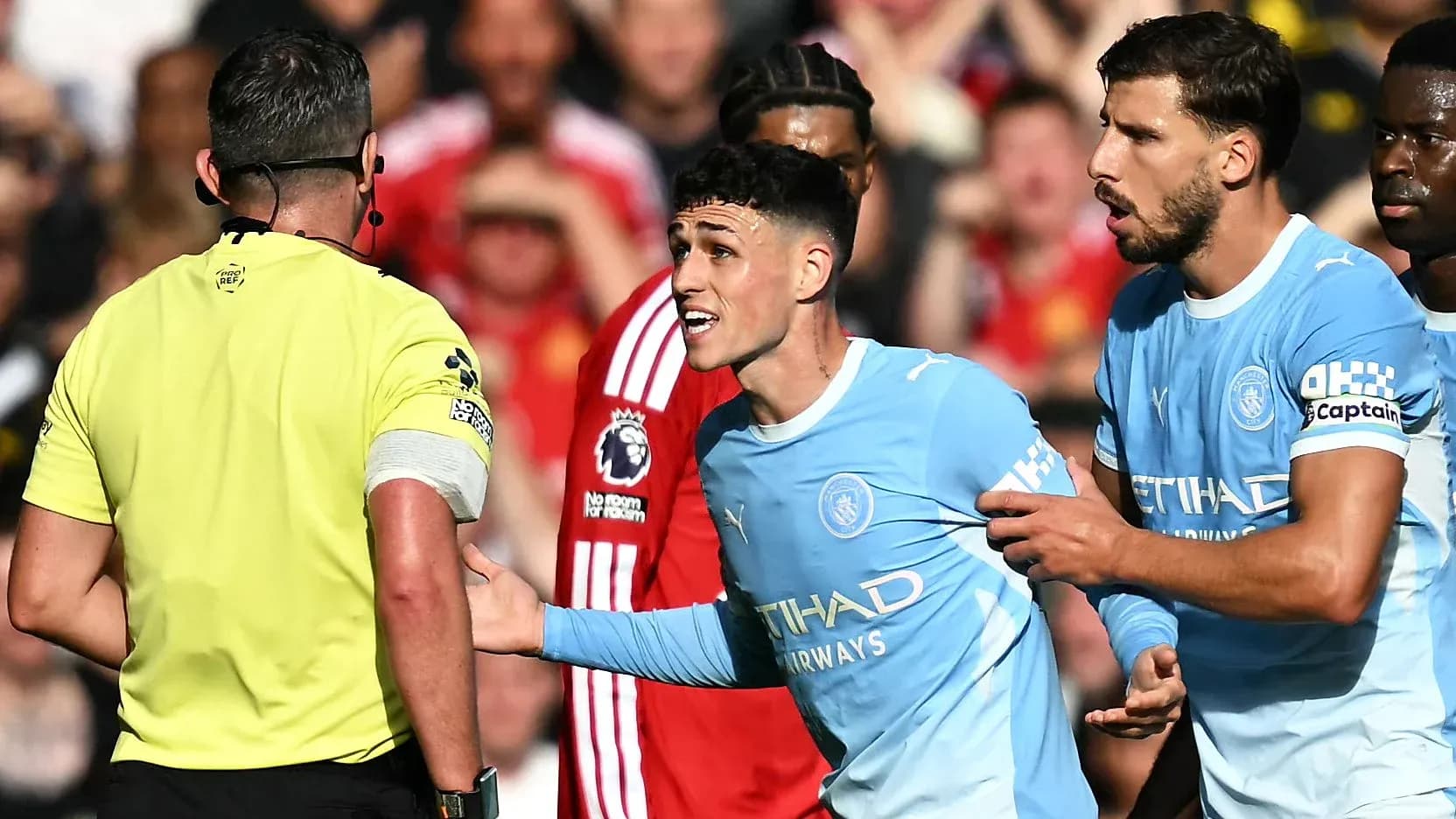
Ten men, one statement.
Manchester City walked into Old Trafford with a flawless record to defend and walked out with something even more valuable: proof that this new-look side can suffer, scrap and still find a way to win in the most hostile of surroundings.
Their first victory at Old Trafford in almost three years came the hard way. It had to.
Foden walks, City bend but don’t break
The match swung violently in the 23rd minute. Phil Foden, kicked while on the turf by Bruno Fernandes, reacted with a rash lash out at the United captain. The referee went straight to red. No delay, no debate.
City were suddenly down to 10, their English playmaker trudging off as Old Trafford roared at the chaos. For Enzo Maresca, this was the moment his early-season ideals faced their first real crisis.
City did not crumble. They recalibrated.
Lines dropped a few yards. Wingers worked as auxiliary full-backs. Erling Haaland became a lonely runner up top, living off scraps and half-chances. The ball, so often City’s security blanket, became a luxury. Possession turned into position, control into concentration.
And still, they held.
Anderson’s night in enemy territory
At the centre of it all, Anderson owned the night.
The £116 million summer signing, already no stranger to tormenting United from his Nottingham Forest days, took this derby and stamped his name all over it. He earned Player of the Match not with flicks and flourishes, but with tackles, duels and a relentless refusal to let United’s midfield breathe.
He snapped into challenges, stepped through the lines when City needed a breather and, crucially, stayed calm when everyone else seemed to be losing their heads. In a game that turned into a test of nerve, Anderson’s composure became City’s compass.
“I just gave everything for the team – duels and playing through the lines,” he said afterwards. “I thought I did quite well and just stayed calm in possession with the team and helped everyone.”
He had walked into this rivalry in July by calling City the “kings of Manchester.” Old Trafford did not forget. Boos followed him, jeers greeted every touch. His response? Let the football do the talking.
“I was just trying to let my football do the talking,” he said. “I think we came here and we played really well. There’s no doubt we have all the quality, but we’re showing real mentality in the first four games, especially in this one. Not giving up, fighting for every tackle, every duel, and waiting for our chance, and obviously Erling scores.”
Haaland finds the moment
The pressure finally told.
With United unable to make the extra man count, City waited for their opening and, when it came, Haaland did what Haaland does. His strike, controversial and hotly debated by the home crowd, settled the contest and ripped the air out of Old Trafford.
City’s No 9 had spent much of the evening isolated, chasing lost causes and battling centre-backs with minimal support. He needed one clear sight. He got it. Game over.
The goal crowned a performance built not on City’s usual dominance but on something more rugged. This was not a training-ground pattern repeated under the floodlights. It was a grind, a backs-to-the-wall job from a side that usually prefers the ball to do the running.
“We all fought for it”
Inside the dressing room, the mood was as wild as the away end. Foden, the man who left them a player short, was right in the middle of it.
“He was gutted to not play in the full game, but he was bouncing up and down the changing room. As we all were,” Anderson revealed. The early red had forced City into survival mode. It also pulled them together.
“[The red card] made the game a lot harder and we’ve all come together and it shows real fighting leadership from the lads,” he said. “It wasn’t ideal, Phil going off, but we all fought for it. It changed the way of playing, but we did really well at it.”
This was a different kind of City: less silk, more steel. They sacrificed their usual rhythm, spent long stretches without the ball and still looked strangely comfortable in the discomfort.
“I’ve been used to playing that way (without the ball) quite a lot,” Anderson admitted. “I find either way quite comfortable for me and I’ll just try to give my very best to help the lads around me. It hasn’t been easy. I’ve been obviously challenged in all the games, and yeah, I thought I’ve done pretty well. I’ve trained hard to put myself in the best place for the games and it has started ever so well.”
A new partnership, same edge
Alongside him, Enzo Fernandez quietly stitched the midfield together. The pair once stood on opposite sides of a World Cup semi-final in the United States. Now they are building the spine of Maresca’s City.
“I found that obviously before I was playing with him,” Anderson said of their past battles. “But no, he’s a brilliant guy. And he’s a real top player. He’s very good. He shows real quality on the ball and knowing you’ve got someone alongside you who’s got your back is a massive help. He’s top.”
Their understanding grew with every minute United failed to take control. When City needed a foul, Fernandez bought one. When they needed a pass, Anderson found it. When they needed time, both of them knew exactly how to steal it.
Late on, the derby’s darker side surfaced. Fernandez took his time over contact from Kobbie Mainoo, running the clock down and infuriating the home support. Anderson barely blinked.
“It’s a derby, isn’t it?” he said. “There’s always going to be that type of stuff in the game.”
Kings of Manchester – for now
City leave Old Trafford with their perfect start intact, a statement win banked and a deeper layer added to their identity under Maresca. They can still dazzle, but now they have shown they can dig in when the script turns against them.
Anderson called them the kings of Manchester months ago. On this evidence, and on this ground, who is going to argue with him right now?