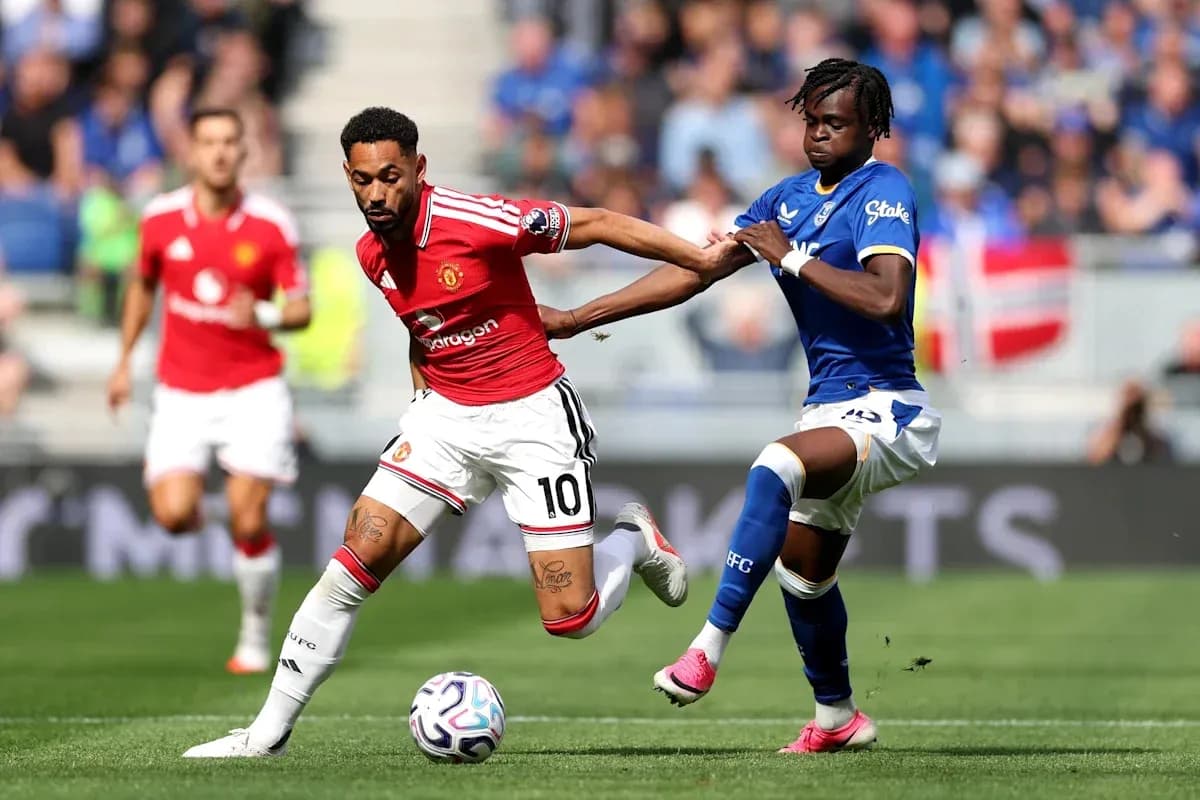
Manchester United walked out of Goodison Park with a point and a familiar feeling: they had done almost everything but finish the job.
They led twice. They scored from well-worked moves, looked brighter between the boxes, and still contrived to concede another pair of goals. Three league games into the season, six goals shipped to Hull City, Ipswich Town and now Everton. The pattern is starting to harden into something more worrying than early-season rust.
Goals Without a Killer
United’s attacking structure worked for long spells. Three creative forwards knitted moves together, dragging Everton around, creating space and angles. The ball often reached promising areas; it just rarely arrived to the right player in the right pocket at the decisive moment.
There is still a hole at the heart of the penalty area. The runs are not there often enough. The presence around the six-yard box is missing. When United did find a cross with real menace, it told: Luke Shaw’s late delivery, met by Benjamin Sesko in the 88th minute, looked like the winner. It was the classic centre-forward goal United have been crying out for.
But that moment felt more like an exception than the rule. Sesko’s return to fitness offers hope, and Bryan Mbeumo stepping back into a central role could sharpen the edge. The absence of Amad on the right has forced more improvisation, and while Shea Lacey is a name for the future, he may not yet be ready to shoulder that responsibility. Matheus Cunha on the right wing does not appear to be in the manager’s plans either.
United are crafting enough to win matches. They are just not ruthless enough to kill them.
A Back Four That Won’t Settle
If the attack is incomplete, the defense is unstable.
For the third straight match, United conceded twice. This time it came against an Everton side that has hardly been free-scoring. The sense of fragility is growing. Hull, Ipswich, Everton – different opponents, same story.
Shaw, at least, produced his best outing of the season. He overlapped Marcus Rashford, delivered several useful balls into the box and made important blocks. One of his crosses created Sesko’s late header. Yet his afternoon still carried the stain of a key error. On Tyrique George’s first goal, Shaw drifted too far into the middle, opening the channel for the Everton forward to lash a shot into the near-post top corner. Lammens got a hand to it, but not enough to keep it out.
That sequence summed up United’s back line: one good action, one lapse, and the punishment is severe.
Harry Maguire, Lisandro Martinez and Diogo Dalot all struggled. As a unit, they allowed Everton too many looks. Maguire was fortunate when Thierno Barry headed over from close range in the 42nd minute, a chance that should have punished United’s slack marking. Dalot’s attempted clearance in first-half stoppage time fell straight to Jarrad Branthwaite, who fired at Lammens when either corner would have beaten him. Later, Dalot’s mishit cross in midfield left Shaw and Martinez scrambling to recover against Brennan Johnson, just about forcing the ball over the bar.
United led 1-0 for much of the second half, but the way they protected that lead raised its own questions. They retreated. They stopped pressing the ball. Everton were allowed to dictate possession and build wave after wave of pressure. When you invite that many shots from distance, you invite the spectacular. Everton obliged.
After George’s equaliser, Michael Carrick turned to his bench. Noussair Mazraoui came on at left back, Leny Yoro on the right. The change did not steady anything. In the 90th minute, Mazraoui lost George again, allowing another near-post effort that Lammens saved, with the flag sparing United anyway.
The real damage came in stoppage time. Hayden Hackney glided past Yoro far too easily and slipped the ball to Kiernan Dewsbury-Hall. Mazraoui’s attempted clearance landed perfectly at the feet of Ainsley Maitland-Niles, who unleashed a stunning strike worthy of any Puskas shortlist. Everton salvaged their point. United watched another lead vanish.
Selection Questions and Structural Fears
Carrick’s substitutions at fullback backfired, but the uncomfortable question lingers: would keeping Dalot and Shaw on have changed much? Across three matches, with different combinations, the same issue persists. United cannot keep opponents out.
Matthijs de Ligt is edging back towards fitness and could feature soon for the first time since November 2025. His presence and leadership might stiffen the spine, but expecting one centre-back to fix systemic problems is a dangerous illusion. Ayden Heaven is another option who may force his way into the conversation if the current group continue to creak.
The wider concern runs beyond individuals. United spent the summer rebalancing their midfield and refreshing their attack. The ball circulation looks cleaner. The team can sustain attacks for longer. They create. They look more assured in possession.
Yet the squad still feels lopsided. The fullback positions are an obvious weak point. Shaw and Dalot no longer have the recovery pace to cope when United push high and lose the ball. That leaves centre-backs exposed in huge spaces, an open invitation for opponents to attack down the flanks and spin in behind. Better sides will target those channels relentlessly.
United can score enough to compete. They can dominate spells, as they did at Goodison Park. But until Carrick finds a defensive solution – tactical, personnel-based, or both – they will keep dropping points from winning positions.
Their first Champions League match of the season looms this week. Against sharper, more ruthless opposition, can this back line survive the step up in intensity, or is this just the beginning of a much bigger problem?