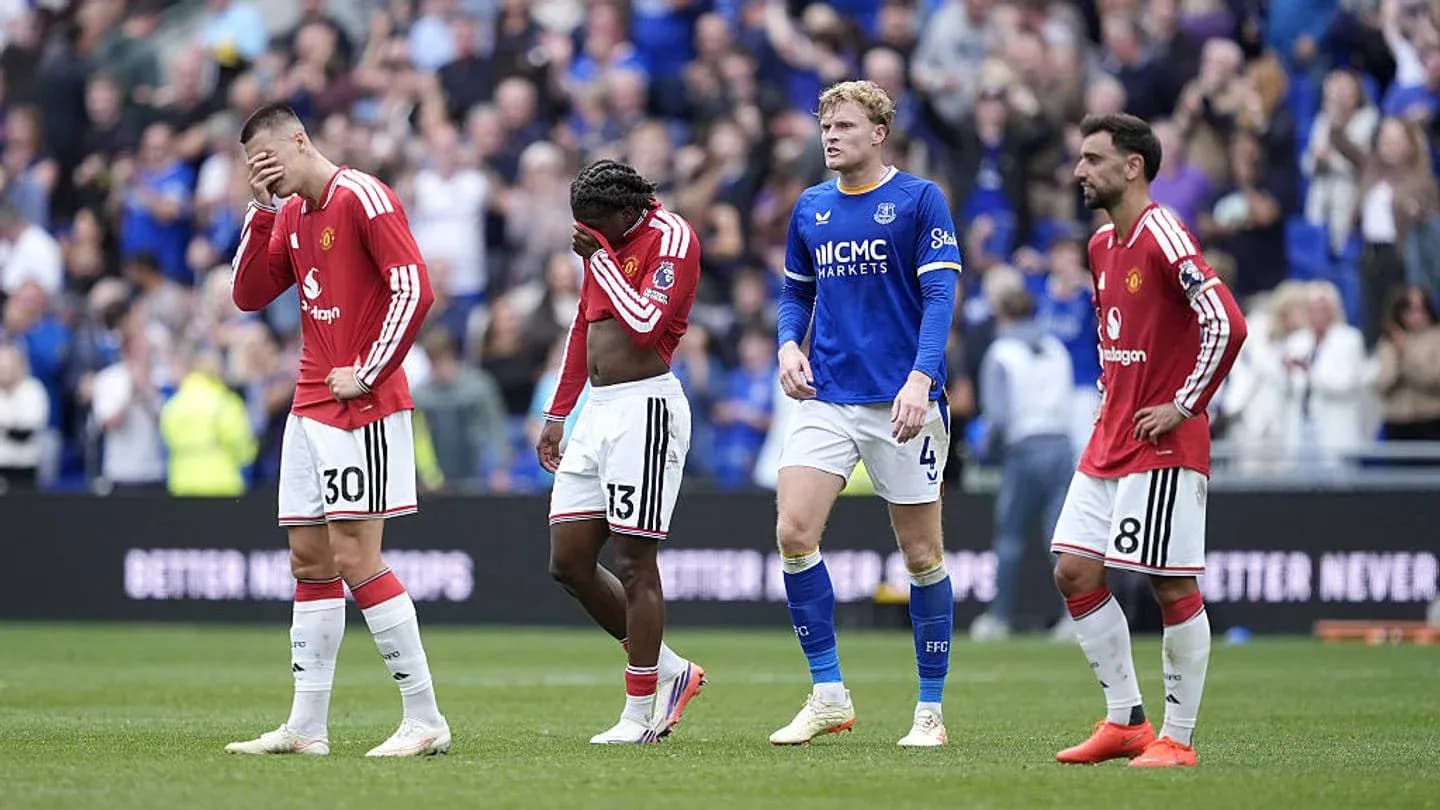
Manchester United have remembered how to score. Seven goals in two Premier League games against Ipswich Town and Everton suggest an attack starting to hum under Michael Carrick.
The problem is at the other end. And it’s becoming impossible to ignore.
United have opened their league campaign by conceding two goals in each of their first three matches: a 2–0 defeat at Hull City, a chaotic 5–2 win over Ipswich, and Sunday’s gut-punch 2–2 draw at Everton, sealed by a 96th-minute equaliser.
Three games, six conceded. A pattern, not a blip.
A Rare, Unwanted Echo of the Past
This kind of start does not happen often at Old Trafford. In the Premier League era, United have only once previously shipped at least two goals in each of their opening three fixtures. That was the turbulent 2020–21 season under Ole Gunnar Solskjær, when the campaign began with a 3–1 home defeat to Crystal Palace, a wild 3–2 win away to Brighton & Hove Albion and a 6–1 humiliation by Tottenham Hotspur. Eleven goals conceded in three games, and a season that never quite shook off the sense of vulnerability.
Before that, you have to rewind more than 50 years.
The 1972–73 campaign opened with a 2–1 home loss to Ipswich Town, followed by a 2–0 defeat at Liverpool and another 2–0 reverse at Everton. That United side, four years removed from lifting the European Cup in 1968 and only two away from relegation, was creaking badly. It was the farewell season for Bobby Charlton and Denis Law, and the beginning of the end for George Best. Frank O’Farrell did not survive past December.
The comparison is not exact, but the warning is clear. When United start seasons this porous, the story of the year tends to be written early.
Carrick’s Diagnosis: “Little Moments” With Big Consequences
Carrick, though, is not talking about collapse. He is talking about detail. About “little moments we can deal with a bit better.”
At Hull, set pieces undid them. Against Ipswich, the five goals at the other end drowned out the alarm, but the two conceded still exposed soft spots. At Everton, two long-range strikes found the net, the kind of goals that, as Carrick pointed out, “sometimes fly in the top corner, more often than not they probably don’t.”
That is the manager’s dilemma. Write them off as low-percentage wonders, or treat them as symptoms of a deeper issue in how his team defends space and pressure on the ball. Carrick has chosen the second path.
“We obviously can’t ignore it,” he said. “We need to concede fewer goals to give us a better chance of winning games. There’s things we need to get better at as a team.”
The Burden on the Forwards
The numbers from last season underline his concern. United’s attack was not far off title-chasing level: 69 league goals, just two fewer than Arsenal’s 71. But at the back, the gap was glaring. While Arsenal conceded 27, United let in 50. The cost was 14 points.
That is the crux of it. When a team leaks goals, the forwards have to play on a tightrope. Every game becomes a race to three or four. Every missed chance feels fatal.
United’s current run captures that tension perfectly. A 5–2 win looks emphatic, but it hides the reality that Ipswich twice found a way through. A 2–2 draw at Everton with a 96th-minute equaliser conceded does more than drop two points – it plants doubt. Can this team close out games? Can it be trusted to protect a lead away from home?
History’s Mixed Messages
United’s defensive frailty in the opening weeks used to be a more familiar sight in a different era of the club. In the 1960s, when attacking line-ups and 3-2-5 formations were standard across England, conceding twice was often just part of the deal.
The 1964–65 side, under Matt Busby, began the league season by conceding at least two in each of their first three games: a 2–2 draw with West Brom, a 3–1 defeat at West Ham, and another 2–2 draw at Leicester. One loss, two draws, plenty of goals going in both ways. That team still went on to win the title.
There is a lesson in that: a shaky start at the back does not automatically kill a season. But there is another one too. That United had the authority, the structure and the mentality to tighten up when it mattered.
Carrick now has to prove his version can do the same.
From Curiosity to Crucial Test
The raw data across the decades underlines how unusual this current pattern is:
- 1964–65: conceded at least two in each of the first three league games, but finished as champions.
- 1969–70: two or more conceded in each of the opening three again, including a 4–1 defeat at Southampton.
- 1972–73: a grim start that foreshadowed a sharp decline and managerial change.
- 2020–21: an erratic, open side that thrilled going forward and frayed under pressure.
- 2026–27: Hull 2–0 Man Utd, Man Utd 5–2 Ipswich, Everton 2–2 Man Utd – another season beginning with a soft underbelly.
Patterns are one thing. What Carrick does next is another.
The Mentality vs. The Margin
“The mentality is there,” Carrick insists. He sees a team willing to work, willing to press, willing to chase games. That much is obvious from the goal tally and the late drama already packed into this season.
But mentality is not just about chasing equalisers or hunting a fourth goal. It is about the cold, ruthless minutes when a side is 2–1 up away from home with the clock ticking into stoppage time. It is about decision-making on set pieces, about concentration on second balls, about not giving the opposition that one last sight of goal from 25 yards.
Those “little moments” Carrick talks about are where titles are won and lost, and where seasons drift from promise into frustration.
United have rediscovered their scoring touch. The question now is whether they can rediscover something far less glamorous and far more decisive: the habit of keeping the door shut when it matters most.