As the clock ticked past 23:00 BST on 1 September and the window slammed shut, one question echoed around Manchester United’s fanbase.
What about a left-back?
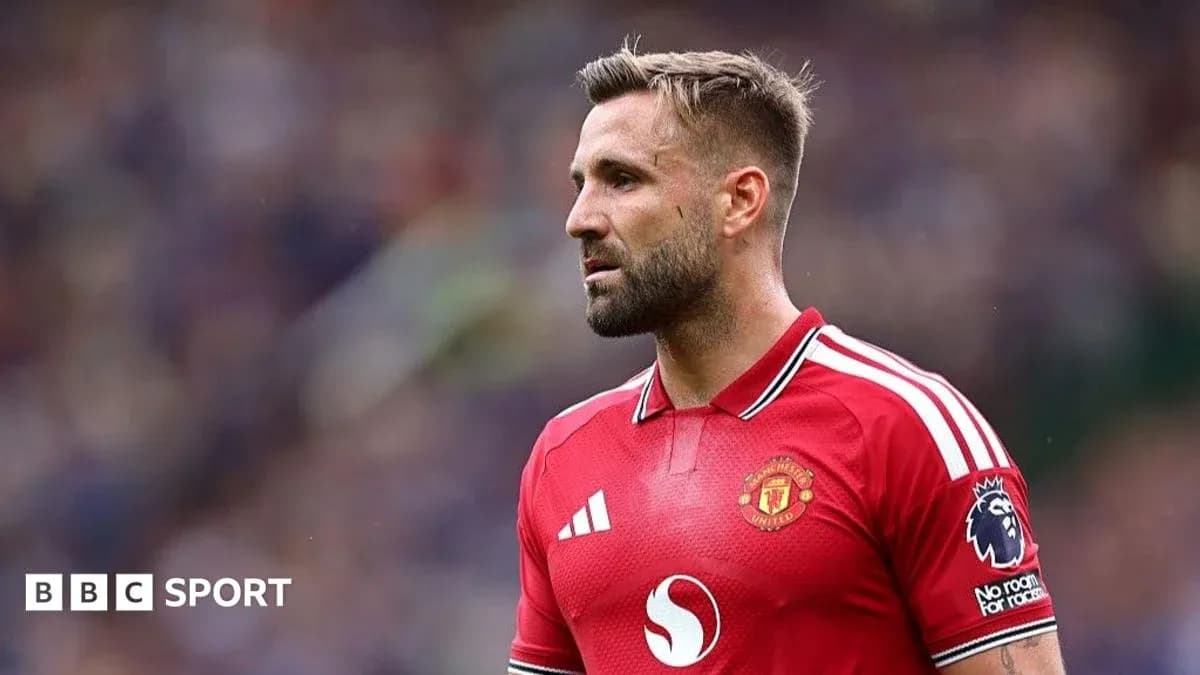
All summer, as the post-2025-26 inquest rolled into transfer talk, one weakness in Michael Carrick’s squad seemed obvious. Luke Shaw was the only senior, natural left-back. He had started all 38 Premier League games last season – an astonishing return given his injury history – but nobody inside or outside the club truly believes a 31-year-old can be asked to repeat that across a campaign that could stretch beyond 60 matches.
Tyrell Malacia’s exit at the end of June, when his contract expired, only sharpened the concern. With the Dutchman allowed to leave, a reinforcement felt less like a luxury and more like a necessity.
Targets were lined up. Lewis Hall at Newcastle. Alejandro Balde at Barcelona. Jorge Salinas at Racing Santander. The list was clear, the need even clearer. In the end, the late push centred on Rayan Ait-Nouri and the prospect of him crossing the Manchester divide on loan. Manchester City shut that down.
For that deal to move, United would have had to accept an obligation to buy down the line. They walked away, preferring to keep their powder dry for what they regard as first-choice options.
Now the deadline has gone. Until January at least, United and Carrick must live with a decision that can only be described as a calculated gamble.
The one that got parked: Lewis Hall
Inside Old Trafford, there is no ambiguity: Manchester United really like Lewis Hall.
If they could have struck a deal with Newcastle, they would have. Conversations made it clear, though, that prising away a highly rated 22-year-old from a club already stripped of key players by Premier League rivals would come at a prohibitive price.
United’s budget this summer was finite. Hard lines had been drawn on fees and wages. When the numbers around Hall began to balloon, something had to give.
The club chose to double down on what they saw as the true priority: midfield. Carlos Baleba arrived from Brighton for £70m, a major slice of the available funds. Hall, United decided, could wait. Next summer, not this one.
The pattern repeated elsewhere. United would have taken Balde on loan; Barcelona would only sell. Salinas had a manageable release clause, but Atletico Madrid led that race. By the time the focus flicked to Argentina defender Nicolas Tagliafico – and that move also failed to materialise – United had effectively moved on from the idea of a straightforward left-back purchase.
The late return to Ait-Nouri, prompted by an agent’s approach, felt like a tacit admission: the club are not entirely convinced by the path they have chosen.
Shaw, makeshift cover and a mystery prospect
The plan, stripped back, is simple enough.
Shaw remains first-choice left-back. Behind him, Carrick will lean on Noussair Mazraoui, who plays the role for Morocco, and Diogo Dalot, who has filled in on the opposite flank before. Harry Amass sits somewhere in that mix, though no one quite seems sure where.
Amass is the odd case in this story. A natural left-back from United’s academy, he impressed in a loan spell at Sheffield Wednesday last season, only to pick up an injury shortly after a winter switch to Norwich. This summer he shadowed Shaw in pre-season and caught the eye with his composure and energy.
Yet United were, at various points, willing to let him go.
The doubts are not new. In the summer of 2024, Erik ten Hag left Amass out of his Community Shield squad, even after the teenager had held his own against Mo Salah in a pre-season friendly in the United States a week earlier. Ten Hag’s view was blunt: physically, Amass was not ready.
Two years on, the defender should, in theory, be bigger, stronger, more seasoned. Interest has not been in short supply. Multiple clubs have tracked him, and his absence from United’s Premier League 2 game against Leicester on Monday only fuelled belief a loan move was imminent.
It never came. Amass stayed. His exact role in Carrick’s senior plans, though, remains opaque.
Yoro’s switch and the ripple effect
United’s willingness to treat Mazraoui as a left-back option has been eased by another experiment: Leny Yoro at right-back.
Signed from Lille in 2024 for £52m as a central defender, Yoro spent much of this pre-season operating on the right. Against Ipswich on Sunday, Carrick again pushed him into that role when he replaced Dalot, with Mazraoui coming on for Shaw on the opposite flank.
At 20, Yoro is raw in that position. But he is quick, powerful and comfortable on the ball. United fans only need to glance across the city at Josko Gvardiol’s reinvention at Manchester City to see how a centre-back can grow into a full-back role and reshape a back line.
That is the type of positional flexibility United are banking on. It allows them to look at Mazraoui, Dalot and Yoro as a rotating cast around Shaw, rather than feeling compelled to overpay for a specialist.
Scar tissue from past mistakes
One thing is clear: United were determined not to repeat old errors.
Having spent the summer holding firm on valuations, they were desperate to avoid another Alex Telles, Matteo Darmian or Sergio Reguilon scenario – short-term fixes who never truly met the standard and ended up clogging the wage bill and the squad list.
This time, the club hierarchy chose restraint over panic. No late scramble. No overpayment for a player they did not fully believe in.
On paper, it makes sense. From a distance, it probably is the right call.
But football is not played from a distance. It is played in the heat of a December away day when Shaw feels a hamstring, or in the intensity of a Champions League night when a makeshift full-back gets isolated one-on-one.
United have made their bet. Over the next four months, the fixture list will reveal whether it was shrewd discipline or a risk that comes back to haunt them.